AFRICA
- Ghana. 1972 (Nov), 1976 (Sep). Review contract
for supplying plant samples to the USDA/NCI anticancer cooperative
agreement; ecological study of Cynometra forest, collected ~60
associated species.
- *Kenya. 1972-1973 (Nov-Mar), 1973 (Oct-Dec),
1976 (Sep-Oct). Recollected more than 200 samples of antitumor plants (100
kg/sample); reconnaissance of southwestern Kenya for Gnidia subcordata;
assisted in procurement of 16 tons of Maytenus buchananii stems in
the Shimba Hills—SW of Mombassa; cuttings of Brucea antidysenterica
from Mt Kenya; ~2,000 specimens of vascular plants, lichens, mosses, and
liverworts from coastal regions, the Kikuyu Escarpment, Mt Londiani, Mt
Kenya, Kericho, and Kakamega.
- Tanzania. 1973 (Oct). Re-collections of antitumor plants,
Southern Highlands (Mufindi)—~100 kg/sample from 50 species; 200
specimens of bryophytes.
- Zambia. 1976 (Sep). Reconnaissance for Maytenus buchananii.
AUSTRALIA
- Western Australia. 1992 (Aug-Nov), survey and collection of Conospermum.
spp. 1991 (Feb): Re-collections of Conospermum and Anthocercis.
1981 (Aug-Oct): 758 general samples (1-2 kg/sample).
- Tasmania. 1981 (Nov). 70 kg of Notelaea ligustrina root
from southwestern rain forest with assistance from the Tasmanian Forestry
Commission, the American Embassy, and CSIRO.
SOUTH AMERICA
- ECUADOR
 | Galapagos Islands. 1997 (Jun). Special collections of Castela
for chemical analysis of antitumor agents.
|
NORTH AMERICA
- MEXICO
 |
Baja California 2000 (May): Recollections—Gulf Desert, lichen
exploration—Pacific Coast. 1996 (Mar): Recollections—Gulf Desert, lichen
exploration—Pacific Coast (San Carlos Mesa, Vizcaíno Peninsula-North
Coast E of Punta Eugenia, San Igancio to San Juanico). 1994
(Mar): 56 general samples, one 20 kg re-collection, and lichens, Pacific
Coast between Punta Canoas and Punta Baja, Gulf Coast from Punta Bufeo
to San Felipe. 1993 (Mar): 52 general samples, one 10 kg
re-collection, Pacific Coast between Punta Canoas and Punta Baja, Gulf
Coast from Punta Bufeo to San Felipe. 1991 (Feb): ~83 general
samples for chemopreventive screening, one lichen—Vermilacinia
leopardina for antibiotic screening, and general collections of
lichen specimens. Coastal chaparral and the Gulf Coast south to Bahía
de Gonzaga. 1990 (Apr): General lichen collections; recollections
of antitumor active plants Eriogonum preclarum and Dalea
juncea, and 66 general (100-500 g) samples, Vizcaíno Peninsula N to
Punta Abreojos, and Gulf Coast near Bahía San Luis Gonzaga. 1989
(Apr): General collections of lichens; re-collections and general
samples of vascular plants; entire peninsula including a transect of the
Cape Mountains, also Isla Cedros and Isla Santa Margarita. 1988
(Mar): Lichen collections and general samples of vascular plants for
chemopreventive screening, Pacific Coast between San Quintín
and Punta Santa Rosalillita. 1986 (May): 103 general samples (1
kg/sample) and ~10 re-collections of vascular plants (7 kg/sample) for
antitumor screening; ~1,200 lichen collections, entire peninsula of Baja
California. 1985 (May): ~50 samples of lichens for antitumor and
anti-AIDS screening (25–100g/sample) from Pacific Coast—Tijuana to
San Antonio Del Mar, Punta Negra to Punta Santa Rosalillita, and also
from the San Pedro Martír. 1980 (Feb-Mar): ~200 general
samples (1.5–2kg/sample) for antitumor screening, mostly from BCS. 1979
(Feb-Apr): ~150 general samples (1.5-2kg/sample) for antitumor
screening; entire peninsula.
 |
Coahuilla. 1976 (Aug). Procurement of 5 tons (dried) of Bouvardia
ternifolia.
 |
Jalisco. 1980 (May). 50 general samples (1-2 kg) for antitumor
screening, primarily between Puerto Vallarta and Guadalajara on back
roads. | | |
- UNITED STATES AND CANADA
-
 | Sep 2001–Aug 2004. Systematic Collection of Samples for Antitumor Screening under
reimbursable agreement
with the National Cancer Insitute,
United States and Territories, collections primarily from SW US, including TX,
also AK, HI (Kauai, Oahu), and the territory of Puerto Rico, ~ 2,700
samples supplies, mostly dried, ~500 g,
~30 fresh. |
 | 1998 CA NV OR (Jun-Jul): 240 systematic collection of samples. 1997 CA
(May): Selected seed samples of alkaloidal legumes and other medicinal
plants for tissue culture. 1995 SEUS (May): 88 general samples
from mostly FL TX and NM, also scattered collections from MI AR OK and
TN; 5 recollections, 5-10 kg each from FL AR and WV; 1 special
collection for preclinical studies of anticancer compounds. 1994
AZ (Oct): Recollection in TX for preclinical study of antitumor agents.
Great Lakes region: ~20 general (100–500 g) samples for antitumor
screening; recollection of 1 bryophyte and 1 vascular plant. Pac NW
(Jul, CA OR WA ID MT and NV): Recollections, 1 fern, 2 bryophytes, 50
general samples. 1993. MI (Oct): recollection, moss. CA (Jul):
Recollections, mosses, ferns, for antitumor research, ~100 general
samples for antitumor screening. NC (May): two 5 kg recollections,
mosses. 1992. Pac. NW (Jul-Aug): Recollections, lichens, mosses,
for antitumor/ anti-AIDS research; taxonomic study of Taxus. 1991.
N US and Canada (Jul-Aug): general samples (100+ g/sample) for antitumor
screening, 67 vascular plants, 38 bryophytes; 1-5 kg samples for
analysis of taxane compounds, shrub and tree forms of yew, Californian
nutmeg, Taxus canadensis, Taxus cuspidata, Torreya californica); 1-2 kg
lichen re-collections for antitumor screening, Cladina arbuscula,
Peltigera canina, Xanthoparmelia cumberlandia, 1-5 kg of bryophytes
for antitumor screening, Dicranum ontariense, Lescuraea incurvata,
Pellia epiphylla, Ptilidium ciliare, and 5 kg of vascular plants, Betula
papyrifera, Comptonia peregrina, Eriodictyon californicum, Eriogonum
microthecum. NV (May): 22 general samples (100+g) for antitumor
screening of vascular plants, 5 kg of Stanleya pinnata for
antibiotic screening. MD (Jun, Cumberland): 7 bryophytes samples
(100+g). 1990. NV AZ (Dec): 5 kg—Peucephyllum schottii,
Forsellesia nevadensis, Fallugia paradoxa for antibiotic screening.
Oct—TN (Great Smoky Mts. Natl. Park), NY (Letchworth St.
Park) and PA (Alleghany Natl. For.): 30 bryophyte samples (100 g/sample)
for antitumor screening. Sep—CA: Taxus brevifolia seed, bark (5
kg) and root (5 kg), and live plants; 5 kg of vascular plants (3 spp.);
10 general samples (100 g/sample) of bryophytes and vascular plants for
antitumor screening. NH (Aug, White Mts. Natl. For.) 33 kg of moss Polytrichum
pallidisetum for antitumor screening; 60 general samples (100
g/sample) of bryophytes for antitumor screening; live and dried samples
of Taxus canadensis for tissue culture and antitumor screening.
Pac NW (Jun-Jul): 100 bryophyte samples (100 g/sample) and 5
re-collections (5 kg/sample) of vascular plants for antitumor screening.
SW U.S. (Apr, TX NV CA AZ): 5 re-collections (5 kg/sample) and 30
general samples (100 g/sample) of vascular plants for antitumor and
chemopreventive screening. WA (Mar, Jul) yew bark inspection; bryophyte
general samples for antitumor screening.
|
 | 1989 WA (Nov 8-11): bark inspection (Taxus brevifolia),
20 samples (100 g/sample) of bryophytes for antitumor screening. U.S.
wide (Aug 25-Oct 16): 150+ samples (100-500 g/sample) of vascular plants
for chemopreventive and antitumor screening, 20 re-collections (1
kg/sample) of lichens for anti-AIDS screening. NC VA (Jul): 3 lichen
recollections (1-5 kg/sample) for anti-AIDS screening. 1988 CA OR
(Jul): ~70 samples, edible and medicinal plants for chemopreventive and
antitumor screening; inspected 30 tons of yew bark. 1987. MD, VA
NJ (Sep-Oct): 20 general samples, edible plants (500 g/sample). CA NV
(May): re-collections, Cercocarpus betuloides (8 kg rt), Cryptantha
confertiflora (10 kg whole plant). MD: 20 general samples, edible
plants. 1986. E U.S. (NC to MA, WI, Jul): Recollections,
bryophytes and lichens for antitumor screening (Anomodon attenuatus
50 kg, Bazzania trilobata 5 kg, Brachythecium laetum (oxycladon) 1
kg, Dicranum fulvum 22 kg, Hylocomium splendens 23 kg, Peltigera
canina 3 kg, Peltigera elizabethae 1 kg, Polytrichum
pallidisetum 6 kg, Plagiomnium ciliare 1 kg, Ptilium
crista-castrensis 22 kg, Tortula ruralis 1 kg). 1985.
OR CA (May-Jun): ~100 general samples (25-100 g/sample) of lichens. E
U.S. (MD to FL, Jul): ~50 samples of lichens. WV VA MD (Oct-Nov): 2–50
kg/sample (dried) of bryophytes—Bartramia pomiformis, Eurhynchium
pulchellum, Polytrichum ohioense for isolation of antitumor agents. 1984.
W U.S (CO UT AZ NM) TN (Aug): 17 general samples (100+ g/sample) of
lichens for antitumor screening; recollection (1 kg), moss (Anomodon
attenuatus). NEUS (Jul, White Mts), 10–20 kg recollections of
bryophytes for antitumor screening (Anomodon attenuatus, Dicranum
fulvum, Polytrichum pallidisetum, Bazzania trilobata, Diphyscium
foliosum, Pleurozium schreberi, Ptilium crista-castrensis). 1983.
CA (Jul): Recollection of moss Plagiomnium venustum for isolation
of active agents. 1981. TX NV CA OR (Apr-Jun): Recollections for
isolation of antitumor agents, 50 kg of Erioneuron pulchellum,
Kalanchoe tubiflora, Gutierrezia microcephala, Iris missouriensis,
100 kg of moss Claopodium crispifolium; 57 general samples (1-2
kg/sample) of selected medicinal plants for antitumor screening. 1980.
US-Wide: 200 (1-2 kg) samples of bryophytes for antitumor screening [TN
and NC (Great Smoky Mts Natl. Park), KT (Nov), WV (Oct), MD VA PA NH ME
(Sep)]. CA AZ UT NV (May- Jul) ~100 general samples (1-2 kg) of vascular
plants from for antitumor screening; recollections, Dirca
occidentalis (50 kg), Claopodium crispifolium (150 kg) and Plagiomnium
venustum (150 kg) for isolation of antitumor agents.
```````````````````````` |
 | 1979. CO NV CA OR (Sep, Feb-Apr). Recollections (50 kg/sample),
Ipomopsis aggregata, Horkelia fusca; ~125 general samples for
anticancer screening (1-2 kg/sample) of higher plants, 17 species of
bryophytes. 1978. TX (Big Bend Natl. Pk) NV CA (Nov-Dec): ~100
samples (1-2 kg/sample) for antitumor screening. VA NC TN (Sep): ~50
general samples (1-2 kg/sample) for antitumor screening. TX CA
(May-Jun): reconnaissance of the Chuckawalla Mountains (CA) and of TX
for 1 ton samples of Colubrina californica and C. texensis;
75 general samples (1- 2 kg/sample) for antitumor screening. 1973
WI (Jul): ground and aerial reconnaissance of WI and southern Ontario
for 4 tons of seed of Thalictrum dasycarpum. AZ CA (Apr-May): 20
recollections for anticancer screening. 1967-1972 CA: ~300 samples (.5-1
kg/sample) for antitumor screening, Mohave and Colorado Deserts, 50
large samples (50 kg/sample) from northern and southern CA; ~1,300
collections for thesis, ~1,000 collections from wilderness areas,
Trinity Alps, Marble Mts, Yolla Bolly Mts, Salmon Scott Mts. |
|
Richard Spjut has more than 20 years
experience in plant exploration activities, primarily in the acquisition
of plant samples for biological screening programs (anticancer,
anti-AIDS, antibiotics, chemo-preventive medicine). His undergraduate
and graduate training include courses specifically dealing with the
taxonomy of bacteria, algae (fresh water), fungi, lichens, bryophytes,
aquatic plants, grasses, and general and advanced work in vascular
plants (ferns, conifers, flowering plants). This experience has been
maintained for all groups of terrestrial plants as a result of
collecting plants for the NCI antitumor and anti-viral screening
programs (e.g., Spjut et al. 1986, 1988, Spjut 1994, 1995, 1996; Terrell
et al. 2000).
Prior to collecting plants for the NCI antitumor
screening program, Richard Spjut conducted floristic surveys of the
Trinity Alps and Yolla Bolly Wilderness areas in the Klamath Region of
California. During the
summers of his early graduate studies he backpacked with a plant press
into these wilderness areas collecting and identifying more than 600
species of vascular plants. He also collected in other areas of the
Klamath Region such as along Willow Creek in Humboldt County and along
the Smith River in Del Norte County after daily work on Survey Lines for
new roads where he had to camp for ten day periods. Consequently he
learned to recognize more than 800 species in northern California. This
knowledge formed the basic foundation for his later contract work and
employment with the USDA as recognized by his peers.
During the next ten years the Richard Spjut
continued collecting for the NCI program as an employee of the USDA
Agricultural Research Service (ARS).
From 1973–1977, he obtained recollections of more than 200
species in Africa (Kenya, Tanzania), Australia (Western Australia,
Tasmania), Mexico, and throughout the United States. One of his more
productive recollection trips was in Tanzania where he re-collected
50–100 kg of fourteen species: Apodytes dimidiata (ws, sb),
Boophone disticha (whole plant), Croton macrostachyus (rt, sb,
tw-lf), Dais cotiniifolia (st-lf), Ekebergia benguelensis
(sb, tw-lf), Garcinia smeathmannii (sb), Podocarpus milijianus
(sb), Gnidia glauca (rt, ws, sb, tw-lf), Gnidia kraussiana
(whole plant), Hypoxis spp. (whole plant), Maesa lanceolata
(sb), Peponium vogellii (aerial parts), Psorospermum
febrifugum (rt), and Schefflera volkensii (rt).
The active agents of several of these recollections were reported
in Cassady et al. (1990).
He has also perhaps acquired the most experience of
any ethnobotanist in the procurement of massive recollections: 15 tons
of Maytenus buchananii stems in Kenya, reconnaissance of Zambia
for Maytenus buchananii, reconnaissance of Kenya for 500 pounds
of Gnidia subcordata leaves, aerial and ground reconnaissance of
Wisconsin and Ontario for 8,000 pounds of Thalictrum dasycarpum
seed, 5,000 pounds of Bouvardia ternifolia plants from Coahuilla
(Mexico), ~500 pounds of Colubrina californica and C. texensis
stems in California and Texas, aerial and ground reconnaissance of
Western Australia for Conospermum spp., and certified the
identification of massive collections of Taxus brevifolia bark
for the NCI.
In late 1977 when the NCI modified their extraction
methodology and requested that ARS botanists put more emphasis on
collecting new taxa, Richard Spjut subsequently targeted medicinal plants and
genera not previously collected for the NCI. Geographical areas with
concentrations of taxa of interest became the focal point for
‘bio-diversity’ sampling. During
1978–1981, he obtained 1,736 samples, 758 of which were from
Western Australia, an area that has ~12,000 species, 80% of which are
endemic. One of his samples
led to the discovery of the Anti-HIV chemical conocurvone; this was the
root of Conospermum unilaterale (Proteaceae).
When the NCI terminated their agreement with the
ARS in 1982, Richard Spjut continued to collect medicinal plants under a
new organization, World Botanical Associates (WBA). As Director, he has procured more than 3,000 samples for
pharmaceutical screening and published four reviews on antitumor
screening of vascular plants and bryophytes (Spjut 1985, Spjut et al.
1986, 1988, 1992). In one
expedition to Baja California (Mexico) he was accompanied by the Dean of
the School of Pharmacy at the Ohio State University (John Cassady) for
recollections of plants that had shown activity in the KB and ASK
bioassays (Spjut & Marin 2000); during a three week period they
obtained 8–10 kg recollections of Atamisquea emarginata, Berginia
virgata, Bergerocactus emoryi, Forchhammeria watsonii, Gochnatia
arborescens, Jatropha cinerea, Krameria parviflora, Mascagnia macroptera,
Phaulothamnus spinescens, Stillingia linearifolia, and Xylonagra
arborea, and collected 103 general samples from more than 50
species.
The
wide variety of plants collected by Richard Spjut has allowed him to
gain an in-depth knowledge of the taxonomy of many families of vascular
plants. This is clearly evident in his book on
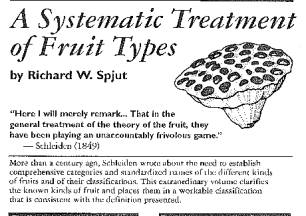
“A Systematic Treatment of Fruit Types” (Memoirs, New
York Botanical Gardens, 1994). The advertisement shown here on the right was reproduced from Economic
Botany.
Besides vascular plants, Richard Spjut has conducted
studies on lichens in which he (Spjut 1995b) has described one new genus
(Vermilacinia) and more then 50 new species in Niebla and Vermilacinia
of California and Baja California (Spjut 1996), and supplied lichen
samples for antiviral, antitumor and carotenoid screening (Czeczuga et
al. 1997).
He also initiated collection of bryophytes for
antitumor screening that led to the first discovery of P-388 activity in
mosses, Claopodium crispifolium (Spjut et al. 1986).
Because Dean Cassady's group was not obtaining consistent
bioassay results with recollections, Spjut re-examined his vouchers and
suggested that the antitumor active agent might be the product of an
associated organism, in particular a species of Nostoc that he
identified in the samples (Spjut et al. 1988). Consequently, he
submitted samples of Nostoc to the NCI for which they reported
significant P-388 activity (Spjut et al. 1988). This, along with other
independent studies, led the NCI to procure more samples of blue-green
algae from marine and fresh water habitats.
Cryptophycin, a dioxadiazacyclohexa-decenetetrone, was later
isolated from a species of Nostoc, a novel anticancer
chemotherapeutic agent that has less drug treatment resistance than
vincristine, colchicine and taxol (Smith et al. 1994), while Boyd et al.
(1997) have also discovered an antiviral agent Cyanovirin from N.
ellipsosporum. However, ansamacrolids were isolated from Claopodium
crispifolium, suggesting activity may be due to actinomycetes
(Cassady et al. 1990; Suwanborirux et al. 1990). The moss microbial
association is perhaps analogous to that in the movie “Medicine Man”
where the active agent turned out not in the plant that was initially
thought to contain the chemical, but in another organism (species of
ant) that happened to be with the plant at the time it was extracted.
Other recollections of bryophytes by the PI, however, have led to the
isolation of active agents that are clearly a product of the moss
(Cassady et al. 1990) or liverwort (Chonigming et a. 1997).
Richard Spjut's collection of bryophytes for the NCI certainlyinfluenced the
writing of his major professor’s wife, Carol Norris. One of her many
romantic novels, Lost Letters (Fig. 4), was about a fictitious
botanist—Brandy who collected bryophytes in California for the NCI,
including a recollection of Plagiomnium, a moss that Spjut had
recollected 100 kg from near Willow Creek, California. It is interesting
that Carol Norris also mentioned taxol as a successful drug for treating
cancer, discovered from “Taxus occidentalis,” a name also
used by the botanist Nuttall (1849) who described the species.
It was not until 1990 (Rowinsky et al.. 1990) that taxol actually
became recognized as a drug (paclitaxel).
Richard Spjut's contribution to the discoveries of
antitumor agents in bryophytes has been recognized by a moss named in
his honor, Orthotrichum spjutii Norris & Vitt, a species that
is known only from the eastern slopes of the Sierra Nevada, California.
Finally, he is working on publishing a taxonomic revision
of Taxus. The
information he provided to NCI as a result of his review of the
distribution and ecology of T. brevifolia for the USDA in 1977
became part of the contract solicitation that was distributed by the NCI
during the late 1980’s and early 1990’s.
He has subsequently presented his taxonomic concepts of the genus
at many international meetings (Spjut 1992, 1993, 1998, 2000; Spjut et
al. 1993) and submitted a paper to the editor of Sida Miscellany
that is currently under revision. His taxonomic characters for the North American Flora have
been accepted (Hils 1993).
|
|