|
||||
English yew
©The
World Botanical Associates Web Page
Prepared by Richard W. Spjut
Photos and illustrations added September 2006, Dec. 2006; updated July 2007, reformatted June 2010
|
||||
|
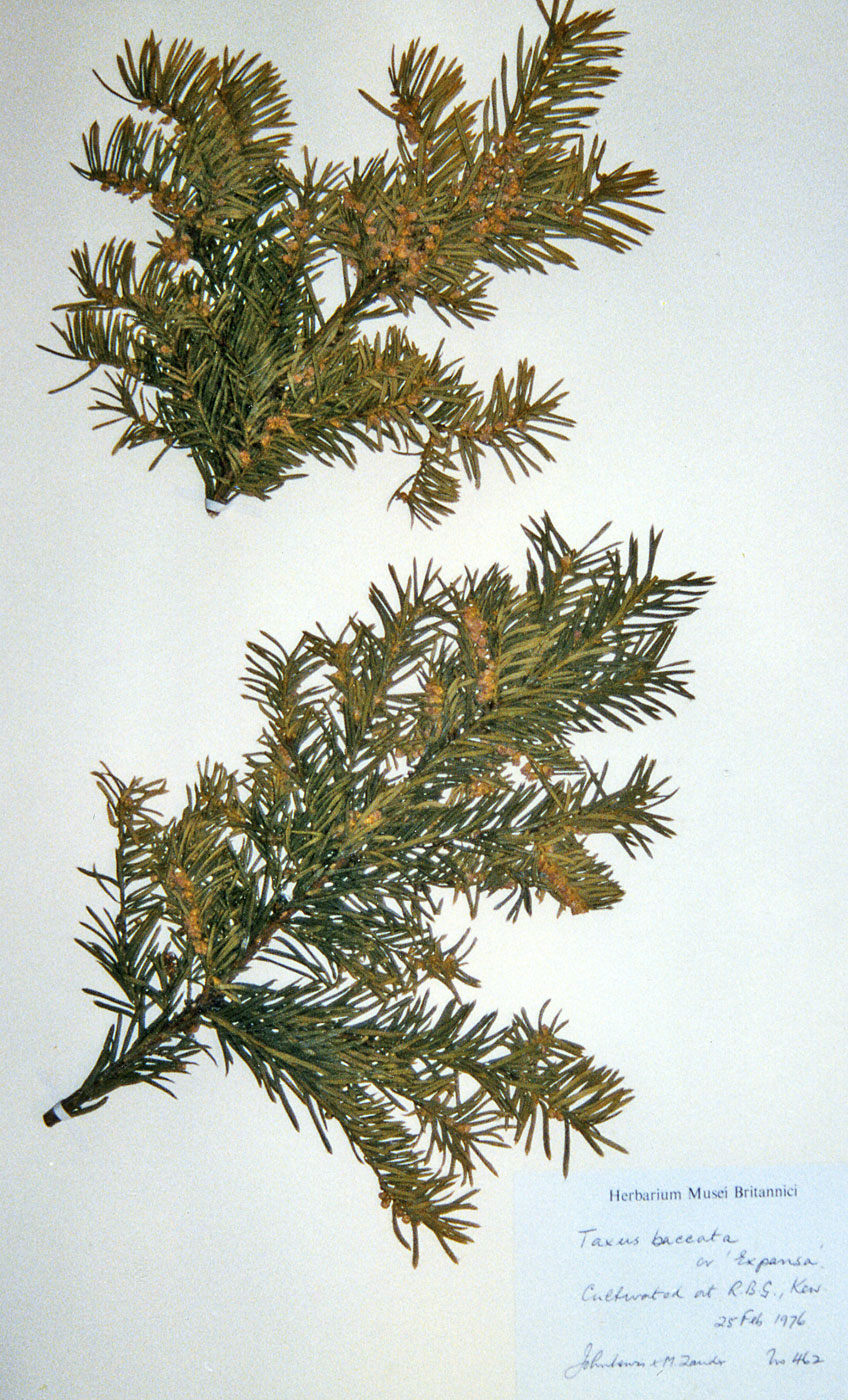
England: Kew Gardens, cult., Johntown & Zander 462 (K), cv. 'Expansa'. Proposed neotype for Taxus baccata var. expansa |
England: Kew Gardens, cult., Johntown & Zander 559 (K), cv. 'Expansa'.
|
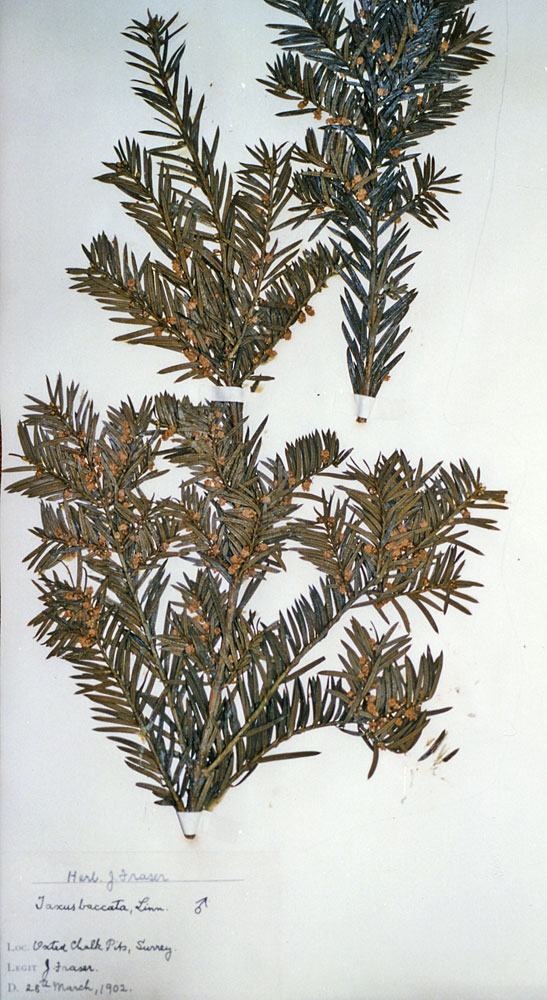
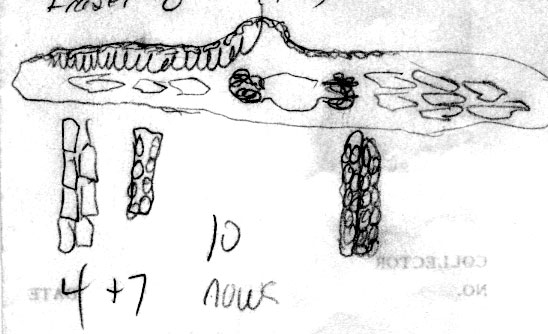
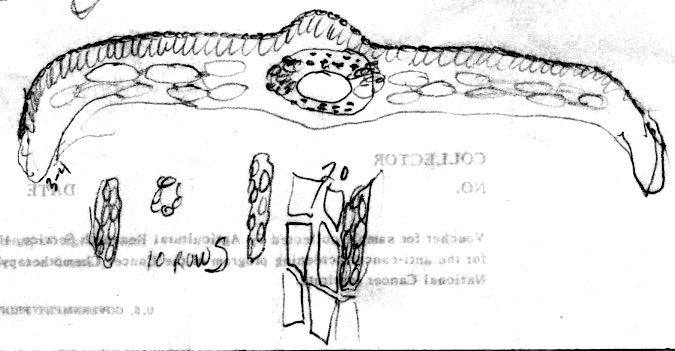
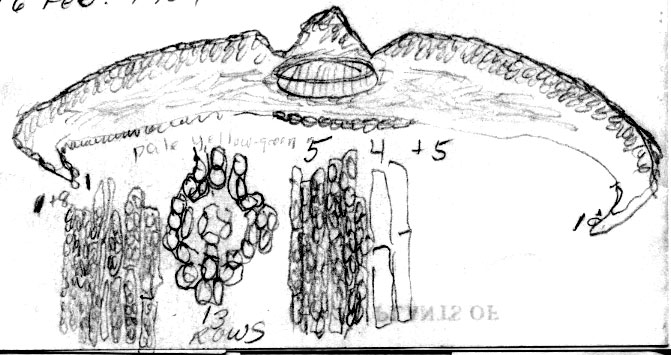
England: Surrey, chalk pits, Fraser, Mar. 1902 (K). Illustration indicates leaf abaxial surface as 4 marginal cells across lacking papillae, followed by 7 rows of papillose cells, a stomata band with 10 rows of stomata and a papillose midrib. Taxus recurvata |
|
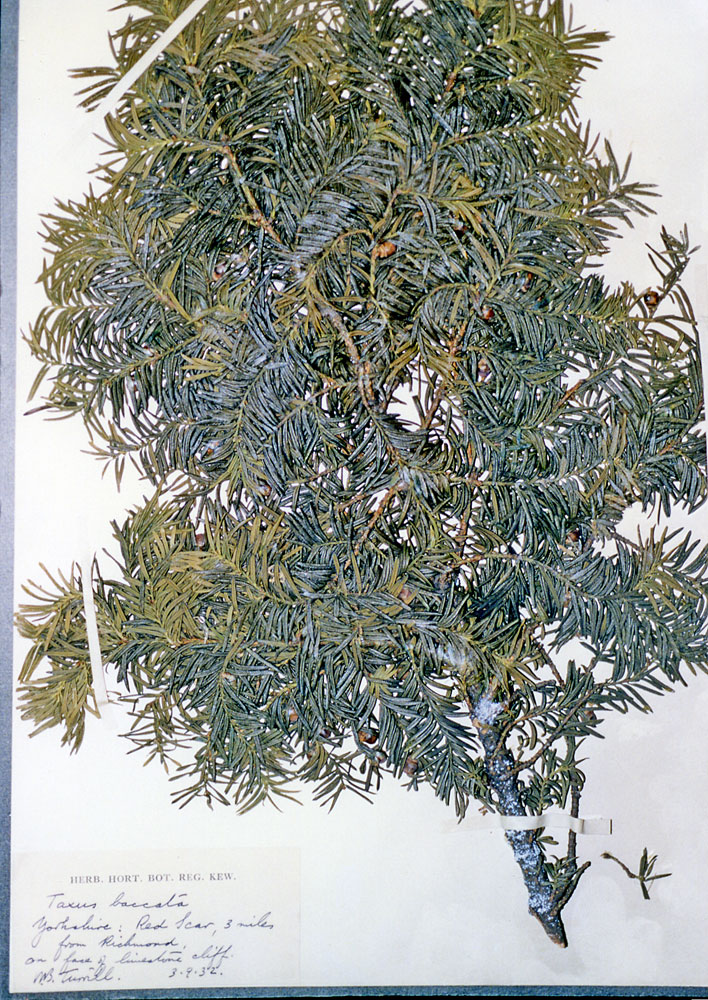
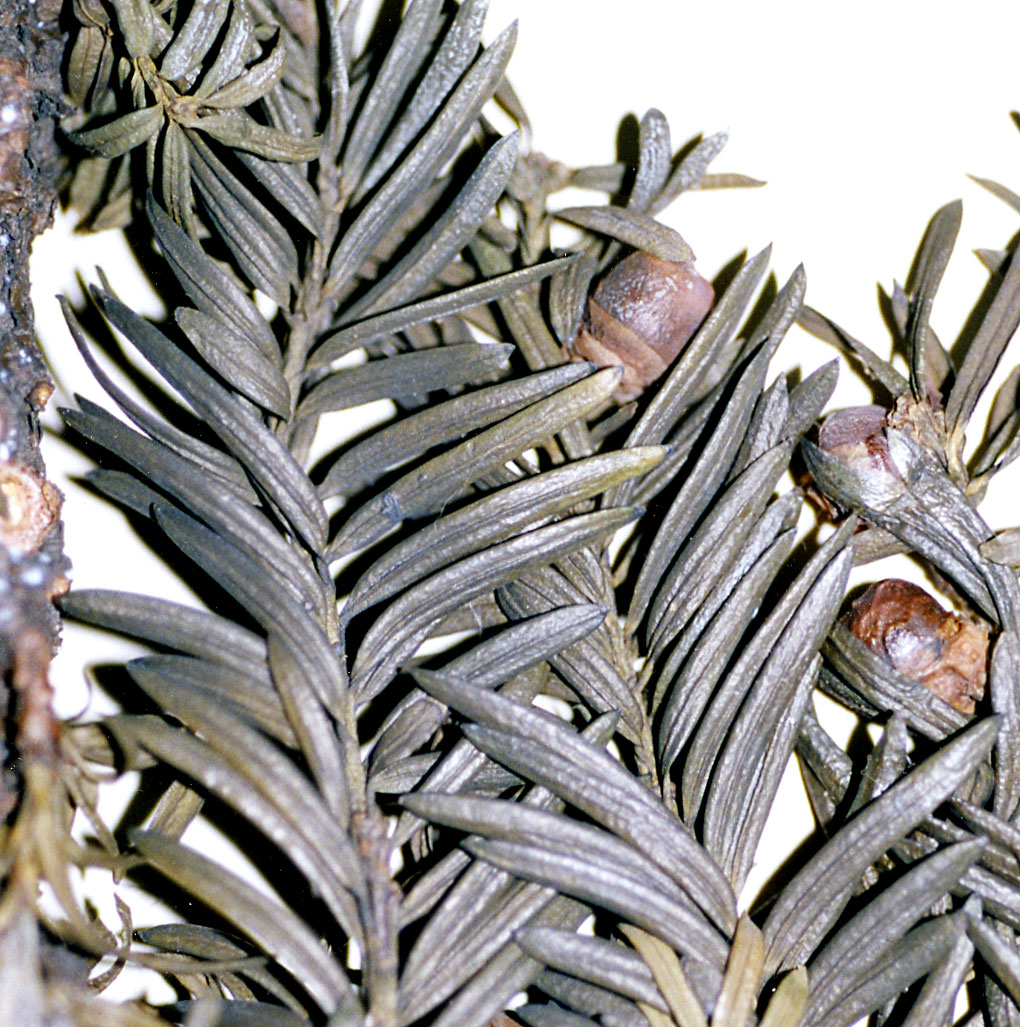
Taxus baccata (var.) procumbens Loudon, Encycl. trees shrubs 2067. 1844, taxonomic synonym proposed. Taxus baccata f. procumbens (Loudon) Pilger, Mitt. Deutsch. Dendrol. Ges. 25: 11. 1916. Original material uncertain, described as "low, and somewhat trailing shrub, not very common in collections.” Neotype proposed—England: Yorkshire, 3 mi from Richmond, on face of limestone cliff—9 Mar. 1932, Turrill s.n. at K!
|
||
|
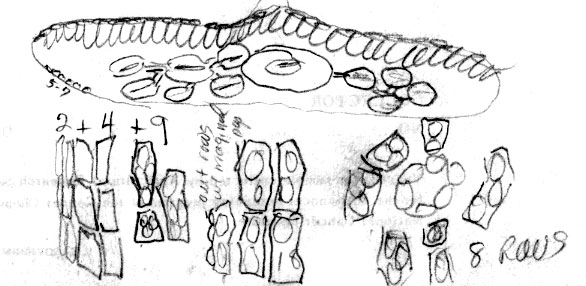
Taxus baccata (var.) procumbens Loudon, Neotype Illustration shows abaxial leaf surface with 2 rows of narrow cells followed by 4 rows of wider irregular cells without papillae, 9 rows of irregularly shaped papillose cells, a stomata band with 8 rows of stomata, and a papillose midrib 18 cells wide, the papillae strongly medial in position except marginal on the outer row of cells. Seeds appear subcylindrical with prismatic faces, flattened from the apex in one seed.
|
||
|
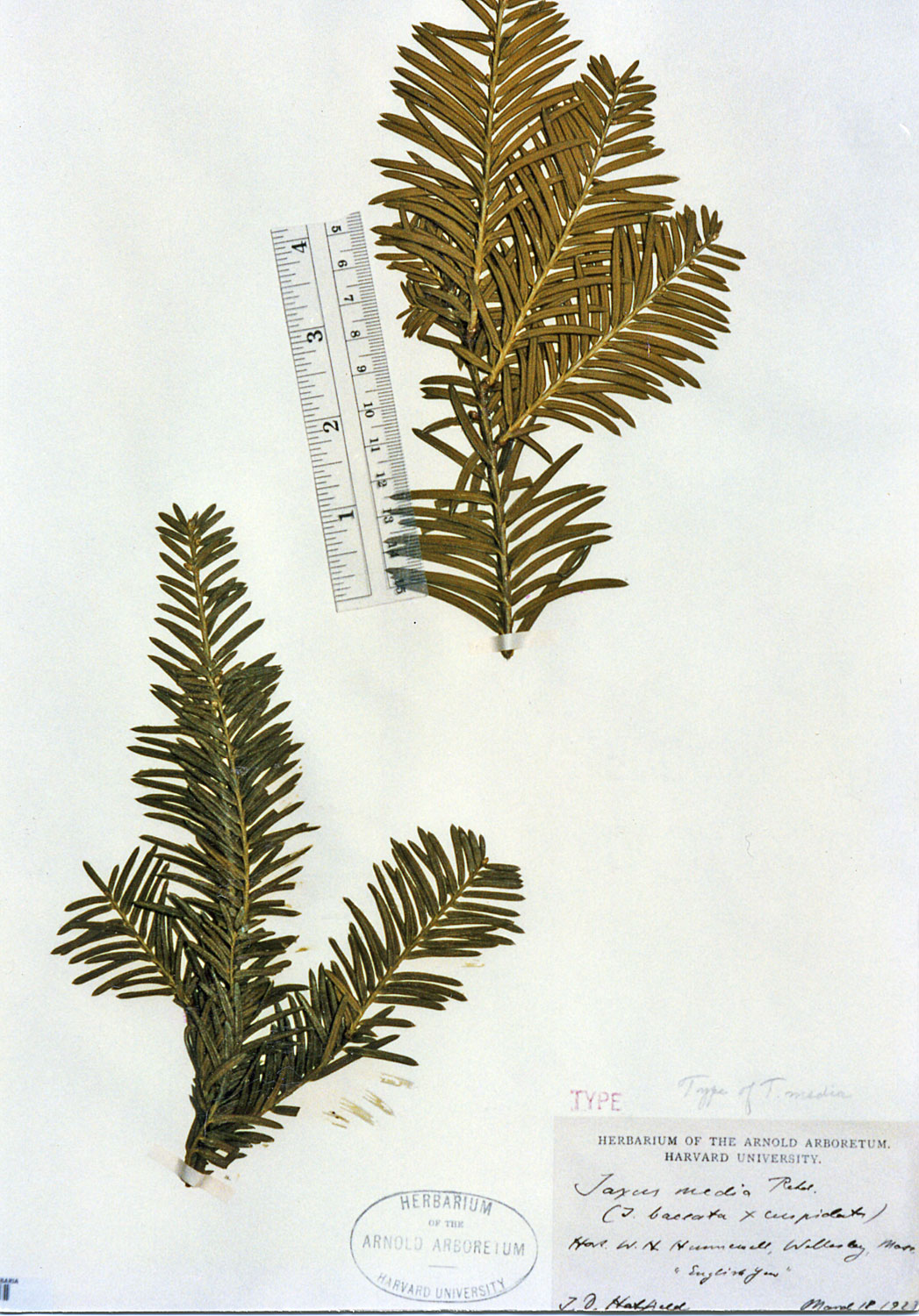
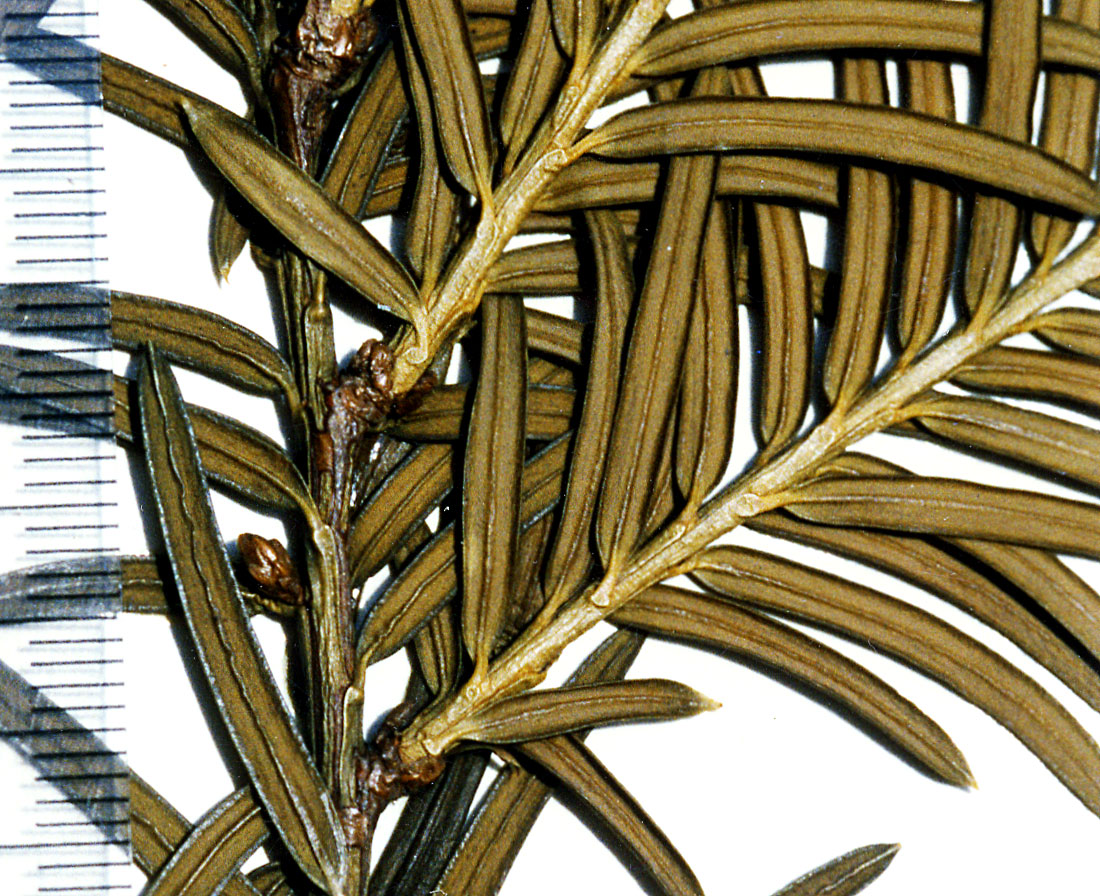
Taxus baccata (var.) imperialis Carrière, Traité gén. conif. 520 (1855), “feuilles plus distantes, falquées”; T. baccata (f.) imperialis Beissner, Handb. Nandelholzk. 171. 189, taxonomic synonym proposed. Type undetermined. Taxus communis pendula J. Nelson, Pinaceae 172. 1866, taxonomic synonym proposed. Taxus baccata (var.) pendula Kent in Veitch, Man. Conif. ed. 2, 129. 1900. Taxus baccata f. pendula, Pilger, Mitt. Deutsch. Dendrol. Ges. 25: 11. 1916. Original herbarium material unknown, described by den Ouden & Boom (1965) to have “branches pendulous along the stem; branchlets long contorted, pendulous; sprays half-contorted, decurving.” Taxus media Rehder (Figs. 260–261), J. Arnold. Arb.4: 197. 1923, taxonomic synonym proposed. Type—Horticulture: from Walter Hunnewell, Wellesley, Massachusetts, U.S.A., 18 Mar 1923, Hatfield s.n., A (A-11270, holotype!).
Taxus media holotype
|
||
|
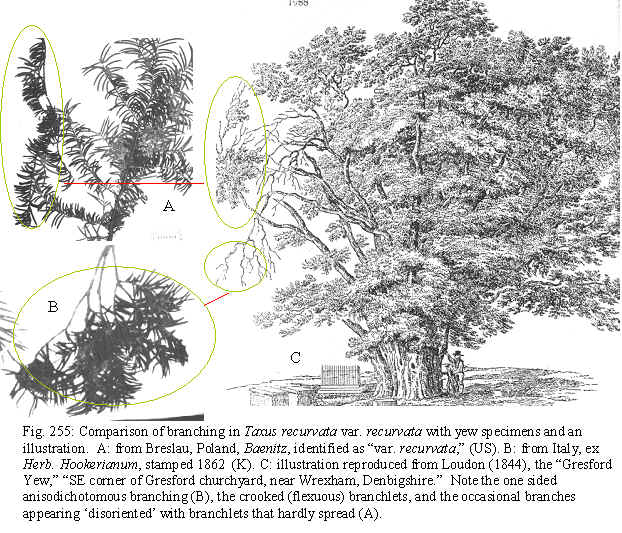
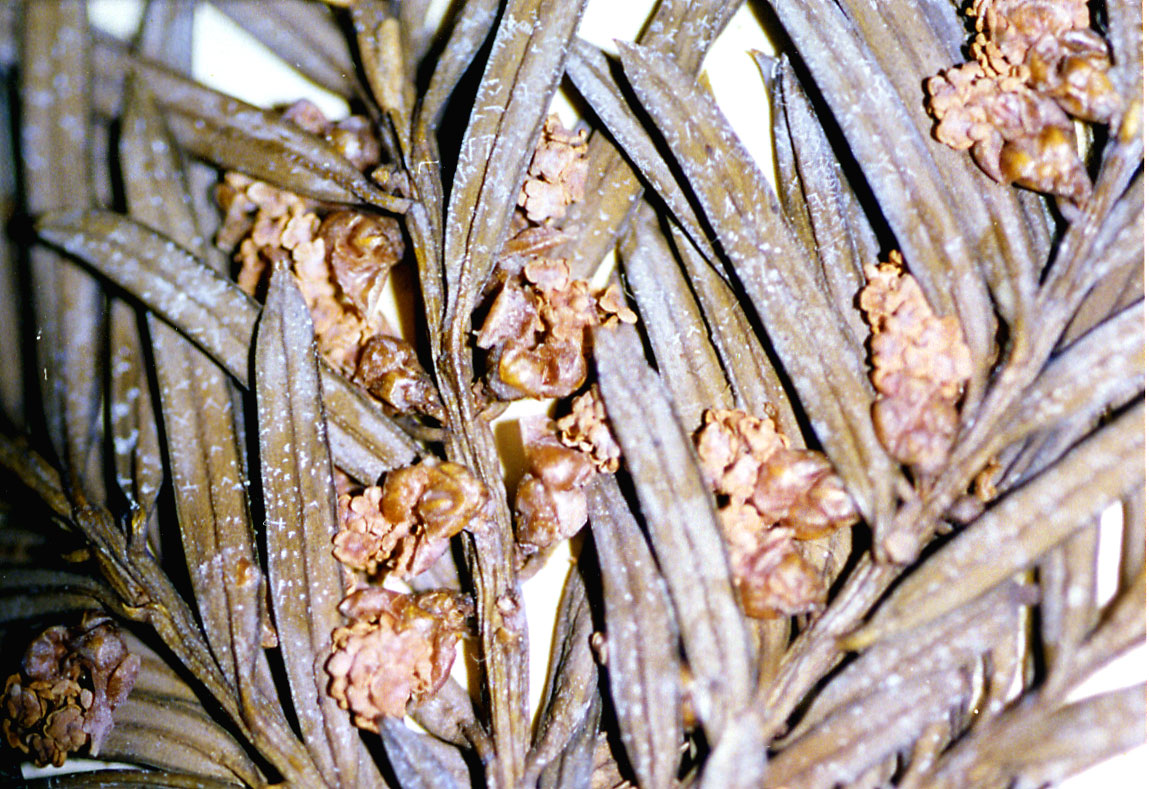
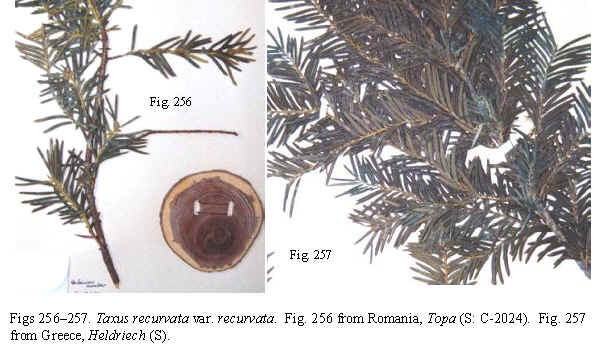
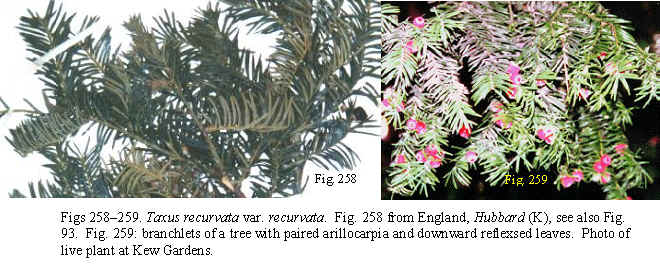
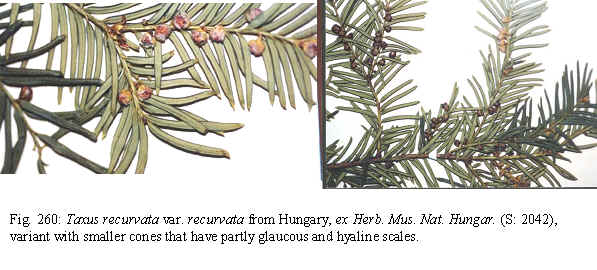
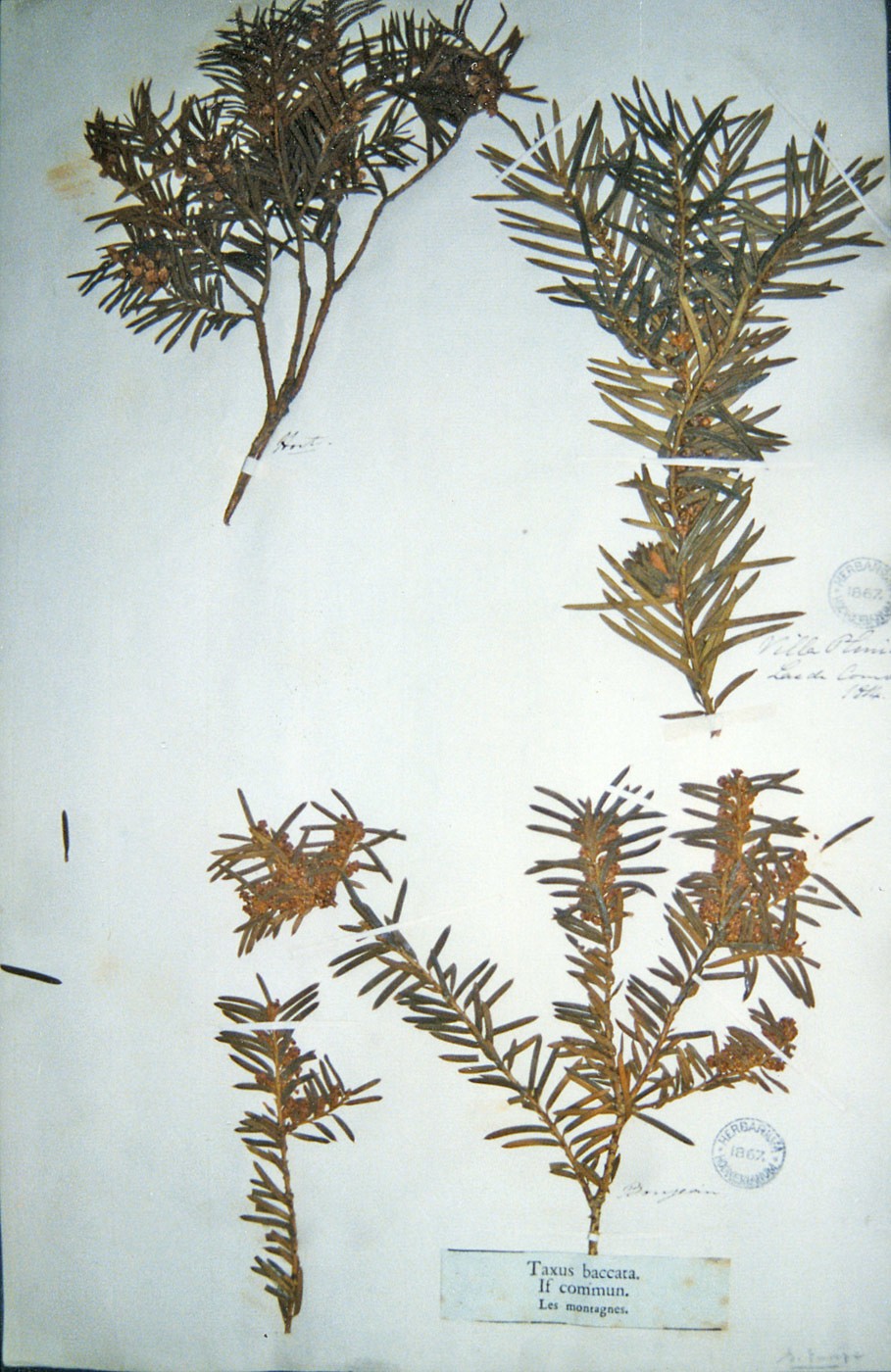
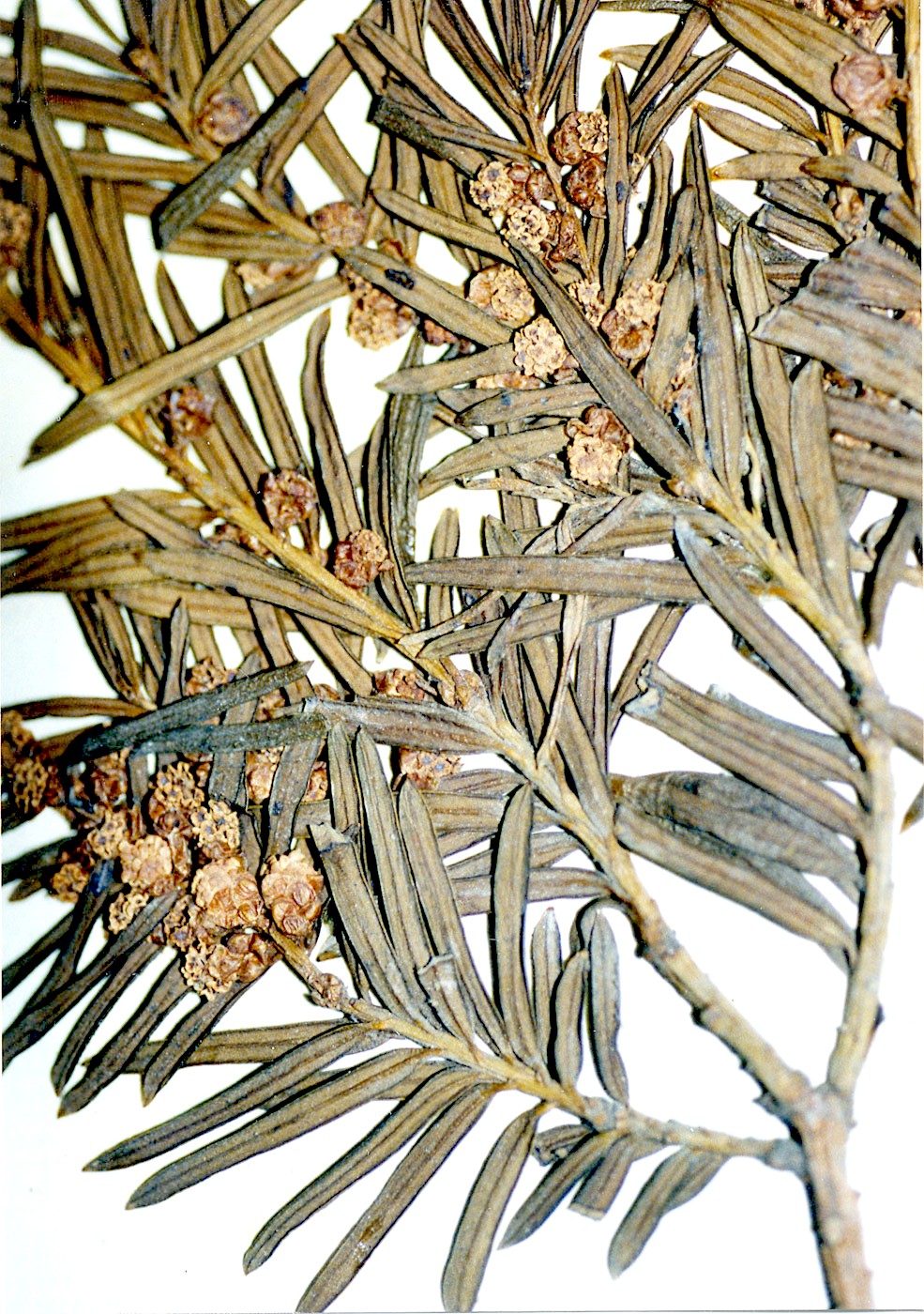
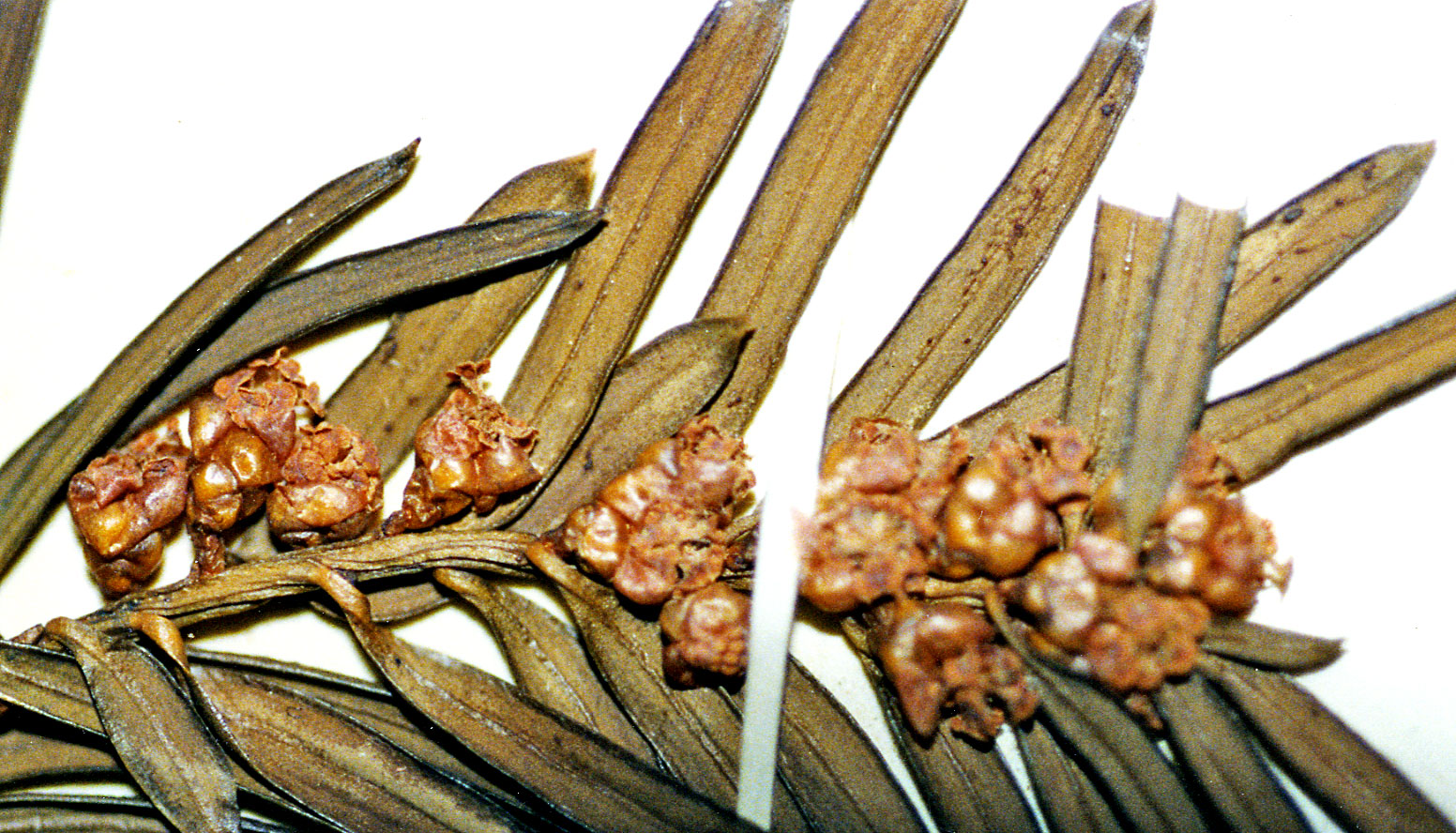
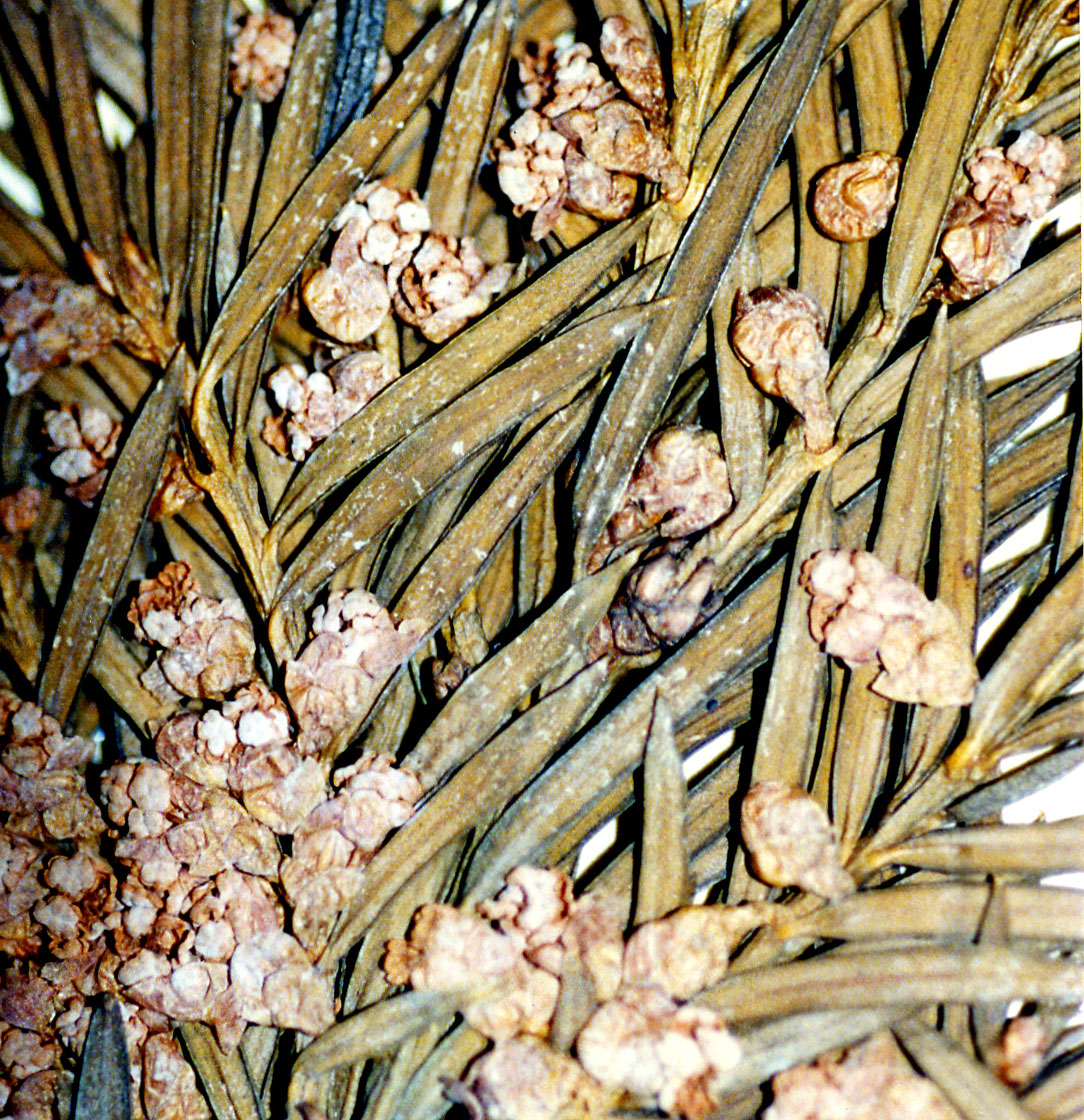
Trees or shrubs with erect trunks and ascending crooked branches, often with galls; branchlets variously spreading, arising subpinnately to subfastigately from a horizontal to nearly erect branch, pendant or recurved or flexuous, leaves widely divergent in nearly a radial to nearly two-ranked arrangement, crisscrossing more than overlapping when pressed, abruptly bent downwards near apex, or in other plants notably erect. Stomata bands and adjacent cells papillose to within 4–8 cells of margins; stomata usually (7-) 8–10 (-11) rows in olive green bands—W European plants, 12–15 rows in plants of E Europe and Caucasus Mts. Male cones abundantly produced on 1st yr twigs, in successive leaves with the appearance of a spikelike arrangment, or sometimes more scattered, ~1.5 mm wide at maturity. Female cones maturing on 1st yr branchlets; seed subglobose to subcylindric, reddish purple, to 6 mm long, 5 mm diam. This species is recognized by the leaves recurved along the blades, crisscrossing as they spread from branchlets, appearing strongly convex across the adaxial surface, and showing a sharp contrast in color between the upper and lower surfaces, and by seeds that develop on branchlets of the current season, often appearing prismatic. Taxus baccata differs by paler green leaves that spread in the same plane as the branches, overlapping to slightly crisscrossing. Three varieties are differentiated by habit, relative length of leaves to width, and by the relative angle at which leaves crisscross each other: recurvata, intermedia and linearis. The seed in the type of T. recurvata hasflattened faces, appearing almost prismatic in the upper part, tapering acutely to apex. In other specimens, especially in the other varieties seeds are similar to T. baccata, varying from globose to subcylindric, broadly rounded to truncate at apex, except for a short nipple.. 19a. Var. recurvata (Figs. 92–96, 255–264). English yew. Distribution: Europe, SW Asia (Caucasus Mts.) Mostly understory shrubs or trees, probably most often near edges of hardwood deciduous forest and woodlands, but entirely comprising forests on chalk. Branchlets widely divergent and recurved, subpinnate from horizontal to erect branches, or pendant, dark green, becoming purplish in age; bud-scales persistent, dark brown, ovate, obtuse or deltoid-cuspidate, ~1.0–1.5 mm long. Leaves often only slightly spreading from young shoots, appearing almost adpressed to branchlets, wide spreading and recurved on older branchlets, erect secund to spreading along both sides of branchlets in nearly two-ranks, crisscrossing more than overlapping, especially on young branchlets, linear, falcate, 1.0–2.5 cm long, 1.5–2.5 mm wide, (resinous), tapering to a sharply pointed acute apex, often abruptly recurved near apex, dark green above, pale yellowish green below, notably convex across adaxial surface to rounded midrib, rounded obtuse to acute at margins, revolute along margins when dried, slightly concave below to a rounded keeled midrib; upper (adaxial) epidermal cells elliptical in transverse section, 8–12 µm tall and 10–25 µm wide, similar along abaxial margins and midrib; stomata bands and adjacent cells papillose to within (1-) 4–8 cells from margins, without stomata across 5–15 cells; papillae usually distinct, not concrescent, in two alternate rows; stomata bands olive green, usually with (7-) 8–10 (-11) stomata rows in W Europe, 12–15 rows in E Europe and Caucasus Mts. Male cones often along successive leaves—in subcylinrical like spikes, 1.5–2 mm wide at maturity, scales often glaucous. Female cones maturing on 1st yr branchlets; seed ovoid, with angled or flat faces, or rounded, reddish purple, to 6 mm long, 5 mm diam. The typical English yew (T. recurvata var. recurvata) is recognized by its arcuate or bent (crooked) branchlets with recurved linear leaves that are often deflexed near the ends of branchlets, although leaves may appear erect-secund on older branchlets. Dried leaves usually show a sharp contrast in color between the two surfaces, appearing dark green above and yellowish green below, and dried leaves may appear strongly curled (notably convex across the adaxial surface and revolute along margins).
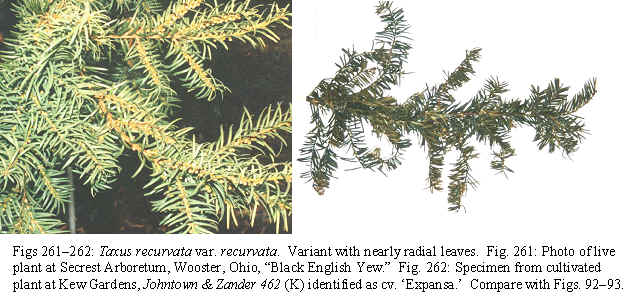
Specimens from the British Isles that are more densely branched with leaves spreading almost radial might belong to a distinct variety, comparing favorably with a specimen in K referred to cv. ‘Expansa’ (Figs. 262–262). Cones also vary in size and texture of scales. In the type—with seed, the cone scales are relatively thin and glaucous. These features seem comparable to scales of male cones in other plants characterized by leaves spreading more radial, but other plants with radial spreading leaves also have the larger thicker yellowish brown scales that is commonly seen in T. baccata.
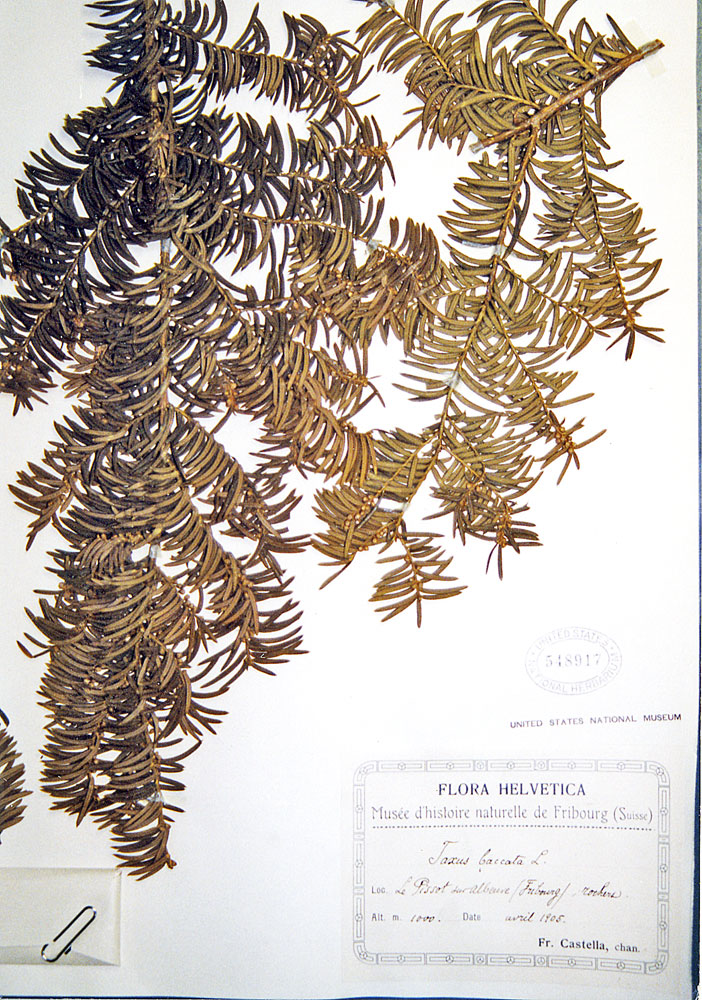
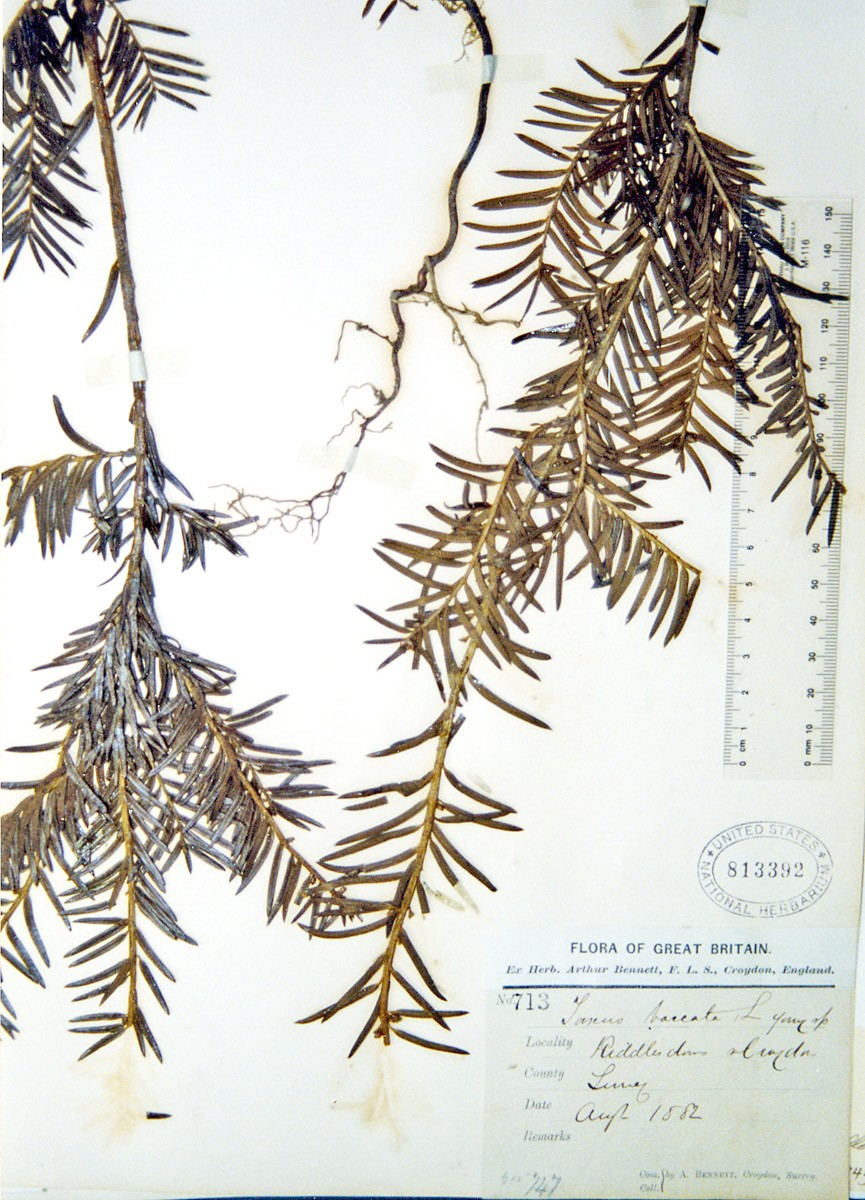
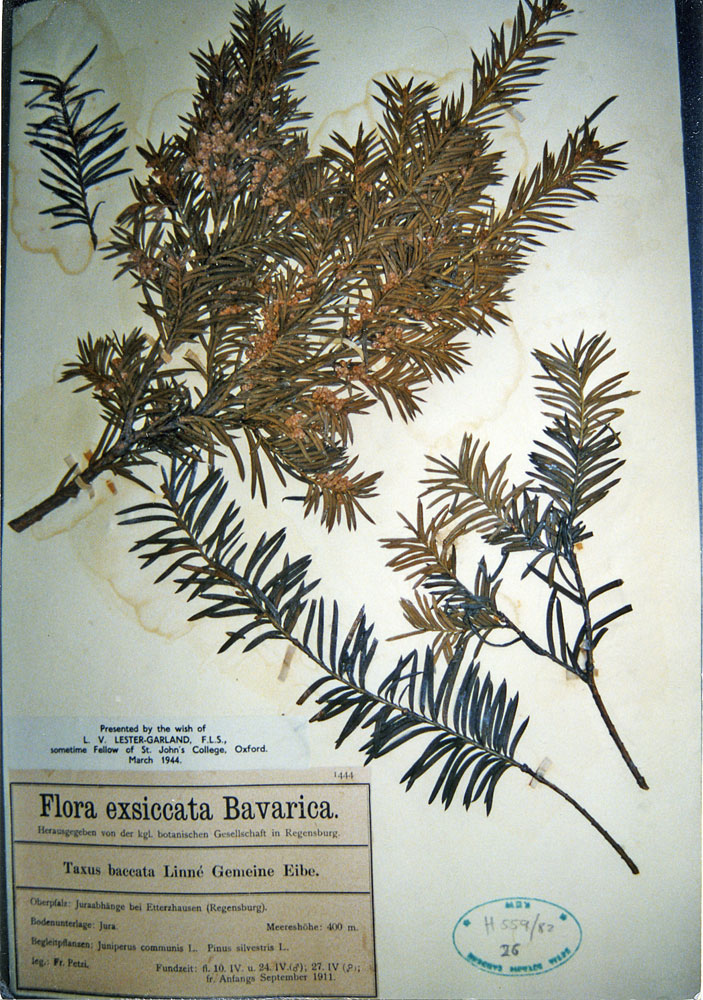
The varietal name procumbens may apply to plants similar to var. repandens, or to T. canadensis as suggested by Loudon (1844), but he did not treat var. procumbens as a synonym of T. canadensis as later done by Rehder (1949). Loudon (1844) indicated he had material in his collection, suggesting, therefore, the name may have been based on cultivated plants, but it is not clear whether such material came from England or North America, while Silber & de Wolf (1970) indicated there is no record for such introduction. The proposed type for T. baccata var. procumbens, nevertheless, may prove to be a distinct variety upon further study. The type for T. media, which has pale olive green leaves (Fig. 264), is included under this variety by general characteristics of branching, color of branchlets and leaves, and by leaf arrangement. Although Rehder (1923) considered this a hybrid involving cultivars of the T. cuspidata (Alliance) and T. baccata (Alliance, T. fastigiata), the only applicable feature that I can relate to T cuspidata is the absence of papillae over a relatively broad marginal zone on the abaxial surface of leaves, a border of 12 cells wide compared to narrow border of 4–7 cells in most European specimens of the T. baccata Alliance. As mentioned under T. baccata var. glauca, occasional European specimens, which resemble the type for T. media, lack papillae on their leaves across 8 or more marginal cells. This includes specimens before the alleged hybrid T. media was developed; for example, one that was collected from Sweden in 1853. The type for Taxus media also resembles Cv. ‘Repandens,’ a putative hybrid recognized by its low flat-topped habit, generally wider than tall. The similarity is seen in the leaves turned slightly upwards near the junction of branchlets with the main branch, and in their dark green marginal border. The cv. 'Repandens' exhibits hybrid features between elegant yew (T. baccata var. elegantissima) and Irish yew in the broad marginal region of smooth cells on its abaxial surface of leaves, and leaf stomata having 11 rows in each band. These features occur in the Irish yew. Moreover, the cv. ‘Repandens’ and other “hybrid” taxa were described at the time Rehder (Bailey 1923; Rehder 1923) described T. media. On the other hand, cv 'Repandens' may have been introduced from plants or seed collected in SW Asia. Elias (1992) recognized a distinct shrub form of T. baccata in Ukraine and Georgia, but the limited herbarium material does not indicate on the labels whether the plant is a shrub or tree; thus, I cannot draw any further conclusions. Representative Specimens—England: Surrey, Box Hill, Turrill (K); Kent, cult. Zander 559 (BM); Riddlesdown, Bennett & Croydon 713 (US: 813392); Surrey, chalk pits, Fraser, Mar. 1902 (K). British Isles, without locality, Michaelstone (K). France: Corsica Herb.Churchillanum (K). Switzerland: Le Pissot sur albouve, 1000 m, Apr 1905, Castella (US); Kellermann (US: 518500). Germany: Bavaria, Petzi 1444 (K); without locality,.ex Short Herb. (PH); Dresden, Reichenbach (PH). Poland: Silesiaca: Breslau, park in Sibyilnort, 130 m., Göpperthain, 120 m, ex Herb. Baenitz, var. recurvata (US: 1396504); Silesia, Proskau, 180 m, “f. dovastonii”, Baenitz (US 1396500); Scheitniger Park, 120 m, Baenitz (P). Austria: Tirol, Gander, yr 1869 (K, US 157025). Romania: Bukovina, Cernauti distr., rivulum Tisova pr. pagum Cuciurul, 400 m, Topa 1150, Bot. Mus. Exsic. (K, S: C-2024, US). Hungary: Bakony, Ex Herb. Mus. Nat. Hungar. (S: C-2041, 2042); ex Herb. Mus. Hist. Nat 11416., ‘Semperaurea’ (US: 3069548). Ukraine—Crimea: S coastal mt. range “Yaila,” Ai-petri northern slopes, ca 15 km WSW of Yalta, 1150 m elev., on yaila, open montane meadow, Elias et al. 5615 (NA). Czech Republic: Moravia Centralis, 4-450 m, Jirasek & Suza (K, S) Italy: Mountains, yr 1814, ex Hooker Herb. (K). Bosnia: Mt. Trebevic near Sarajevo, 1450 m, Biol. Inst. Dubrovnik 37, PI-369710 (NA). Greece: Mt. Oeta, near Mt. Katavothra, in fir forest, 4500-6000 ft, Heldreich (S: C-2023); Mt. Olympus, 750-850 m, Handel Mazzetti (K). Syria: Gesbeldagh (BM, S, US). Russian Federation: Hosharia, Princeps Kascelsky, ex. Herb. Hort. Imper. Petro. (S: C-2026). W Transcaucasia: Caucasus: [Georgia?] Suchum (Abehazia), in silvis faucium Petkir (fl. Madshara), prop. Urb. Suchum, Woronowa (S: C-2027). Without locality data: Jussieu, Cat. No. 171739 (P).
|
||
|
Italy: Mountains, yr 1814, ex Hooker Herb. (K). Illustration shows abaxial leaf surface with 3-4 rows of smooth marginal cells, undetermined number of papillose cells, stomata 10 rows, 20 midrib cells, partially papillose. |
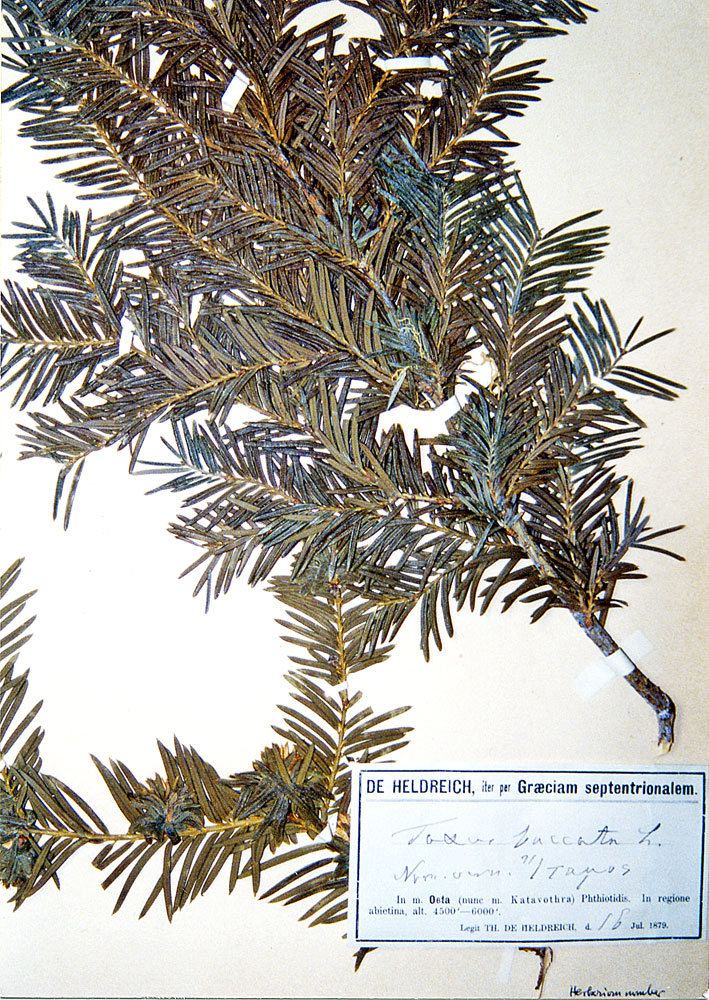
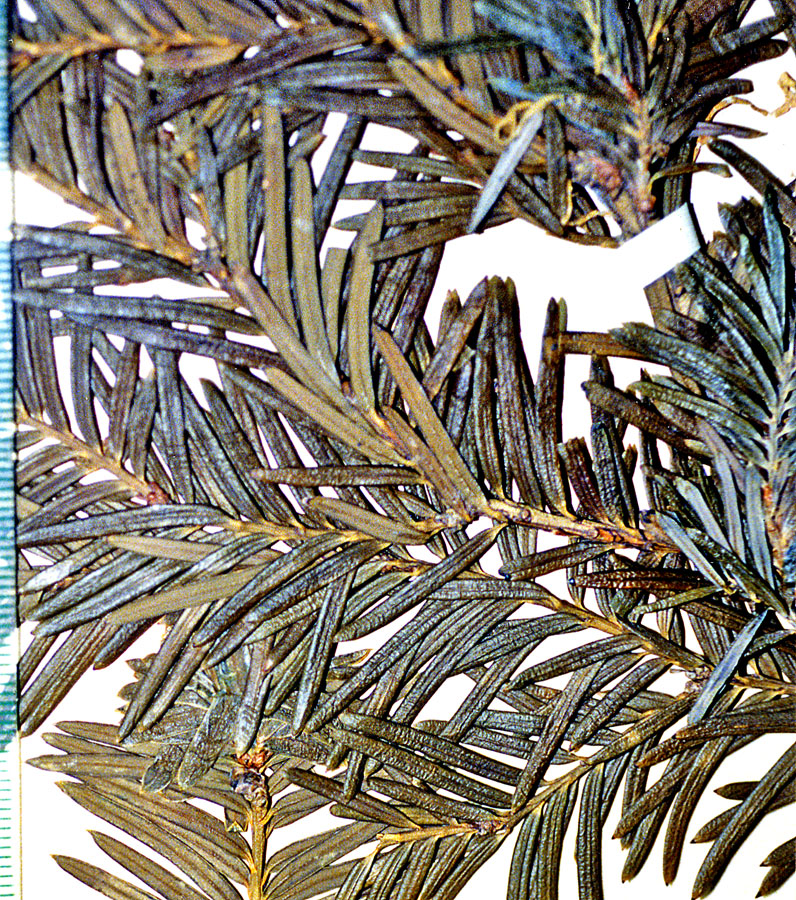
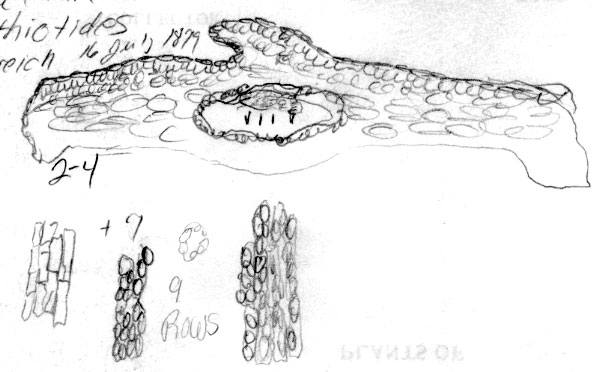
Greece: Mt. Oeta, near Mt. Katavothra, in fir forest, 4500-6000 ft, Heldreich (S: C-2023). Illustration shows abaxial leaf surface with 2-4 rows of smooth marginal cells, 7 rows of papillose cells, stomata 9 rows, and a papillose midrib. |
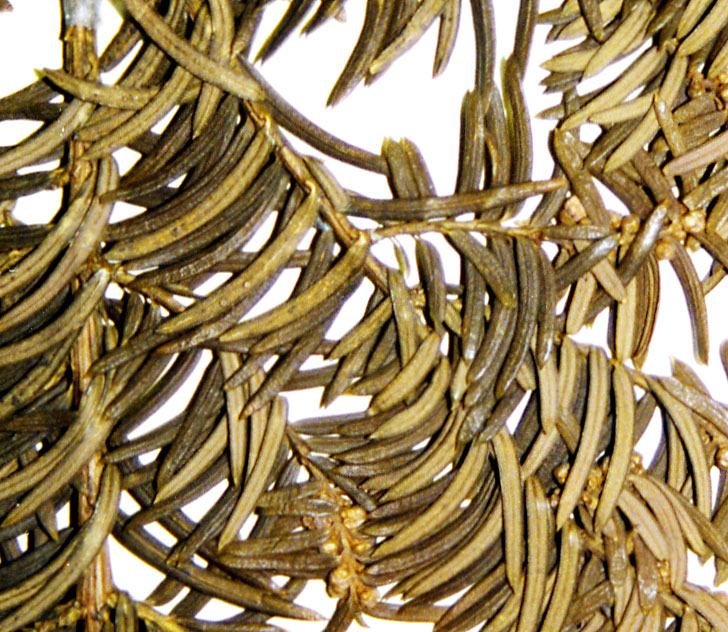
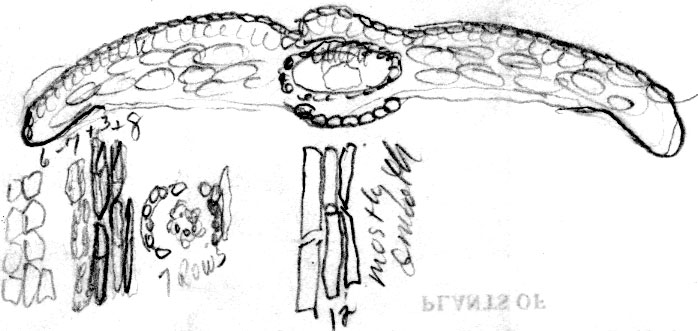
Switzerland: Le Pissot sur albouve, 1000 m, Apr 1905, Castella (US). Illustration shows abaxial leaf surface with 6-7 rows of smooth marginal cells, which are mostly short quadrate, 3 rows of obscurely papillose cells, and 8 rows of prominently papillose cells, stomata in 7 rows, and a smooth midrib 12 cells wide. |
|
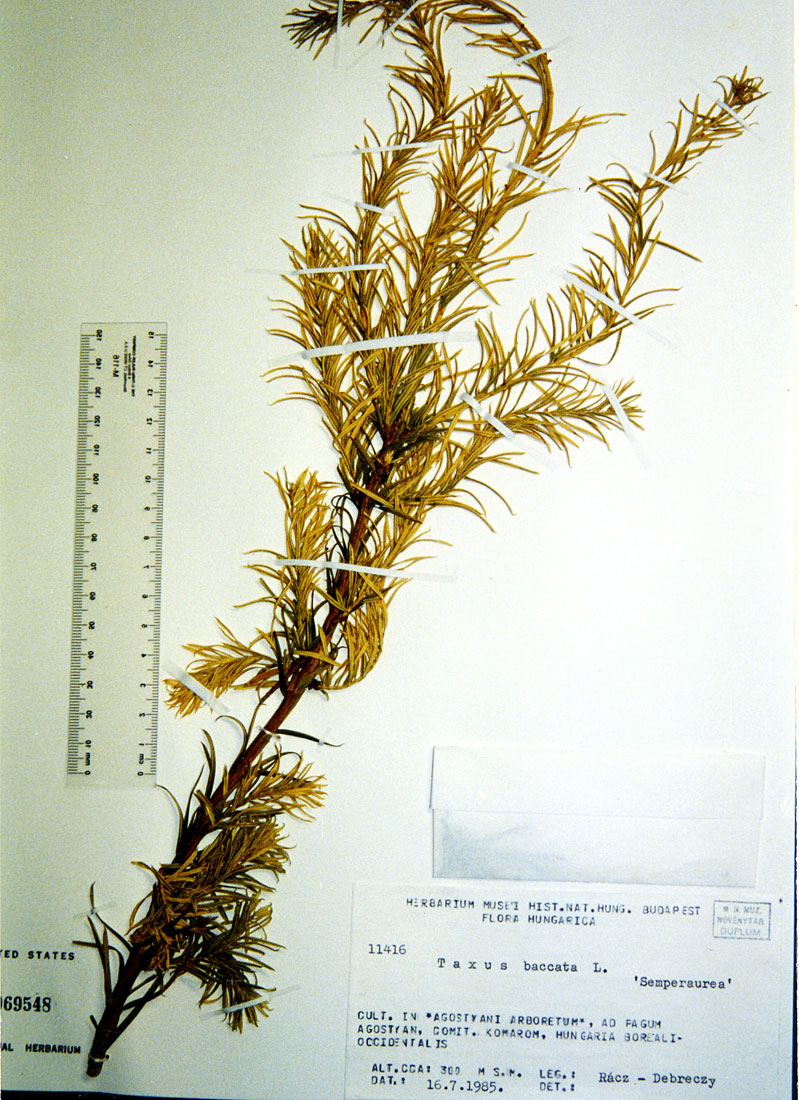
Hungary: Cultivated, ex Herb. Mus. Hist. Nat. 11416, cv. ‘Semperaurea’ (US: 3069548). |
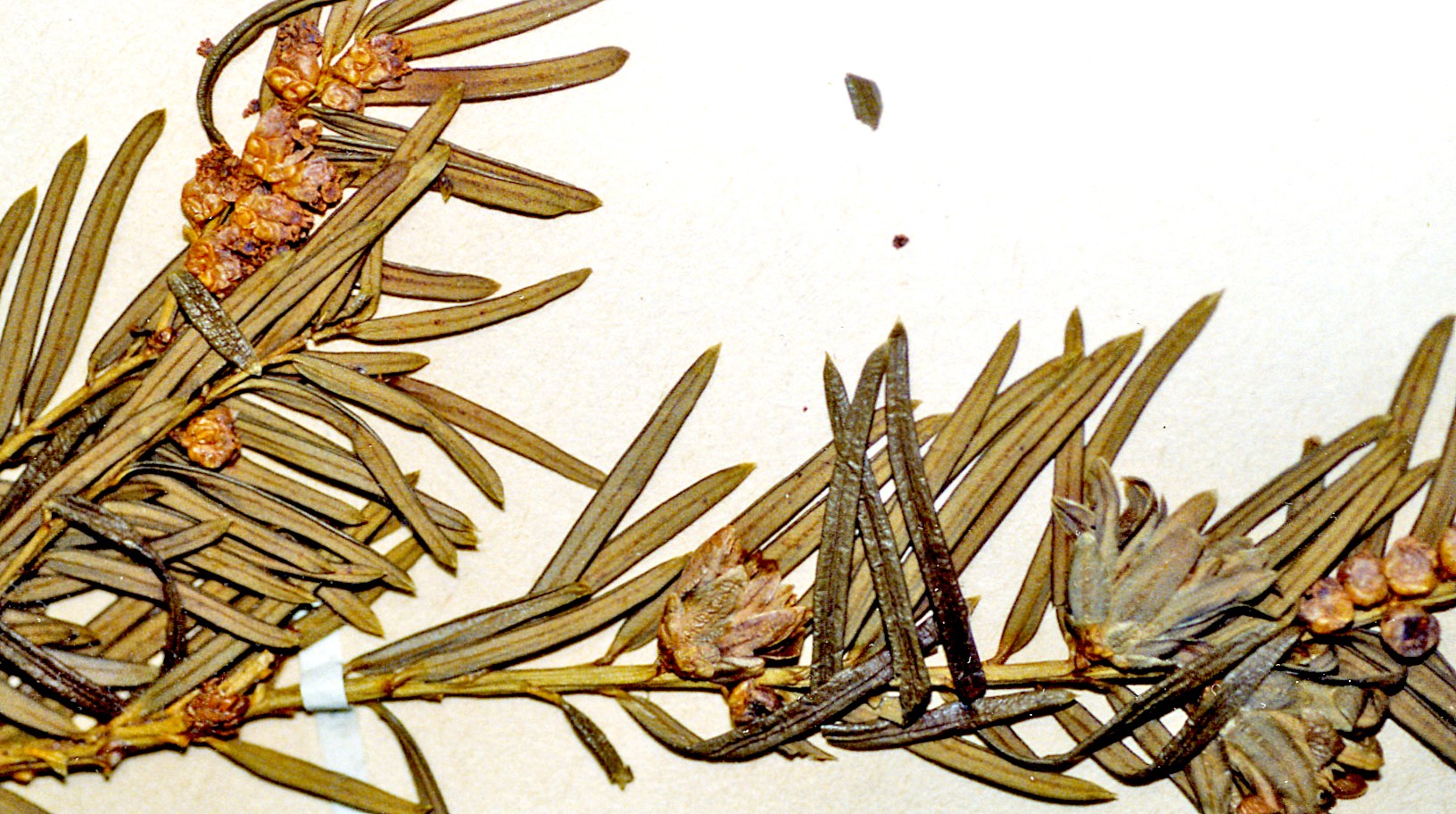
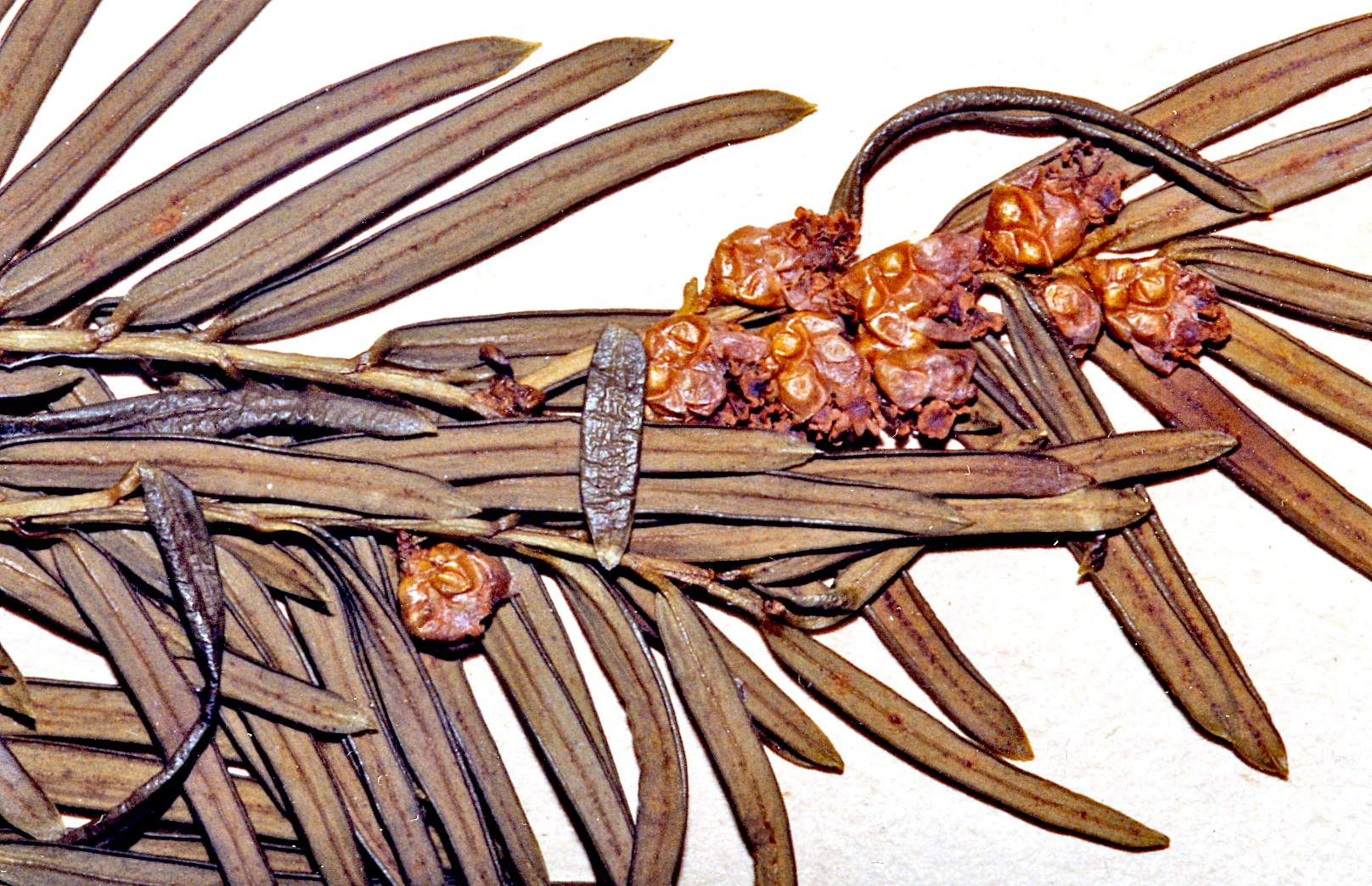
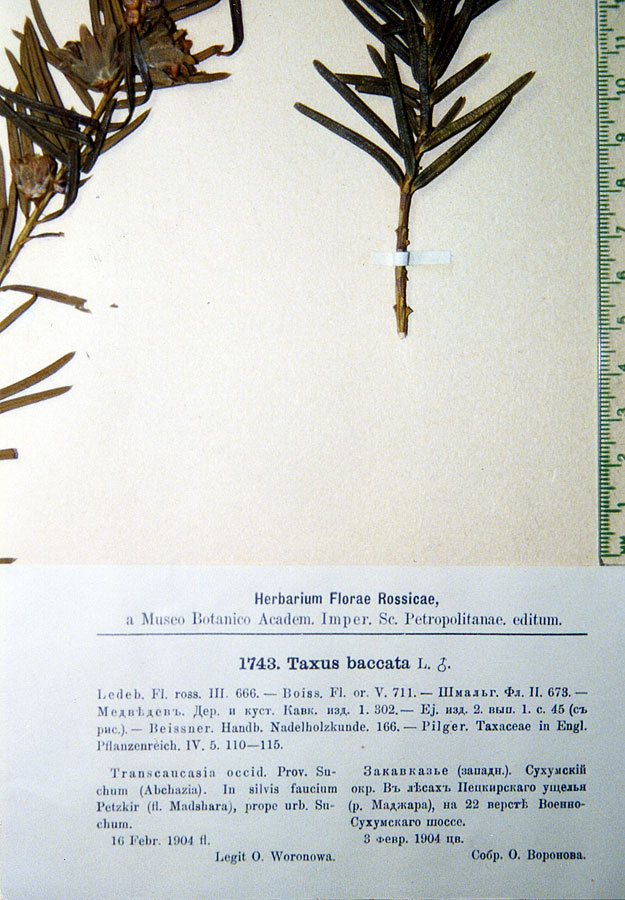
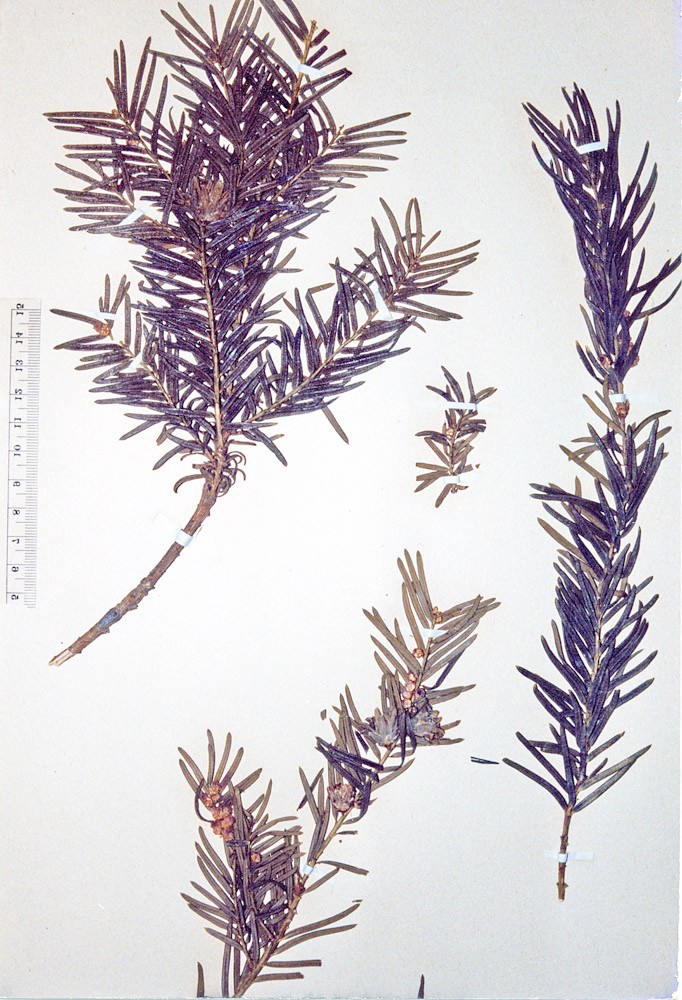
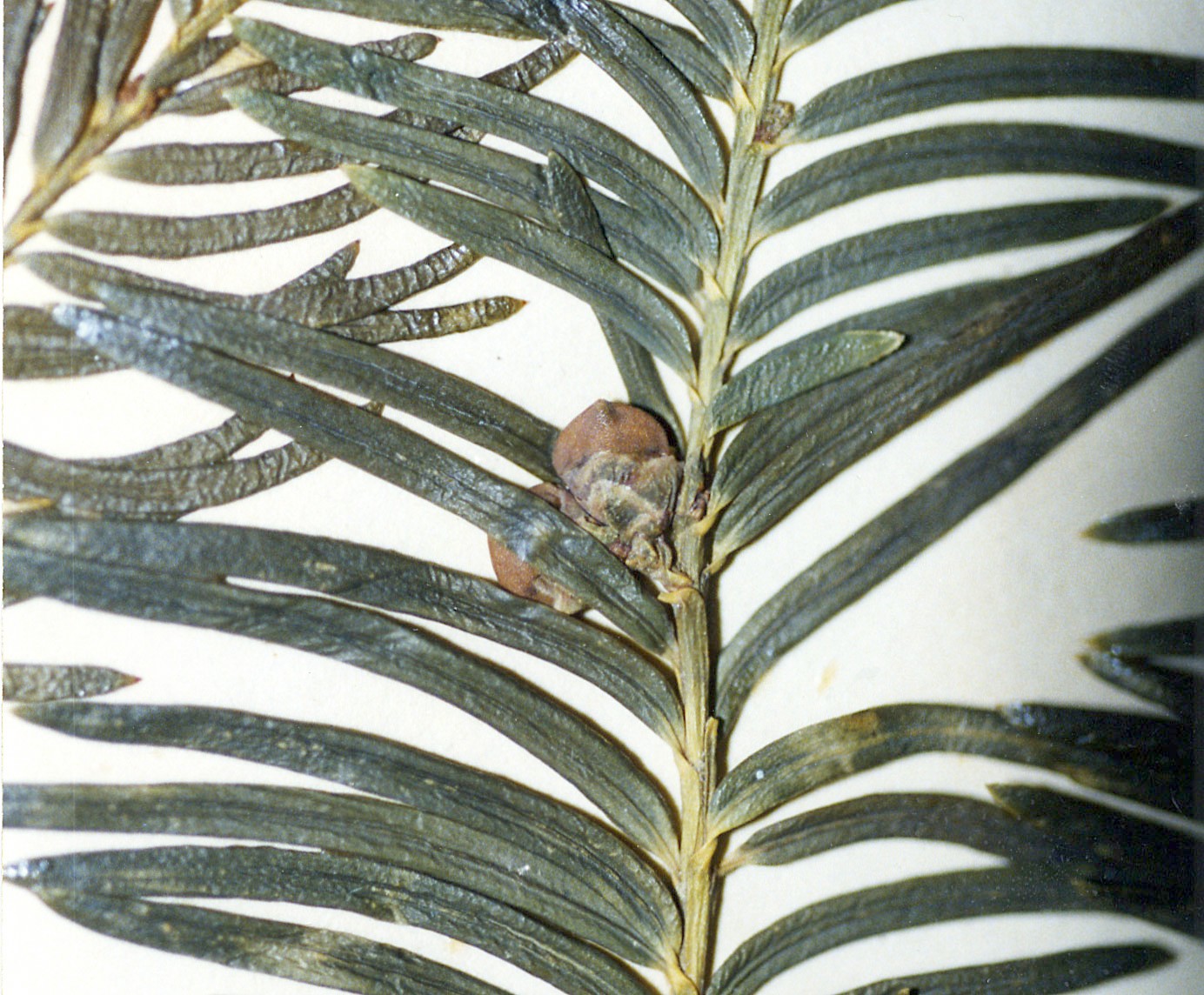
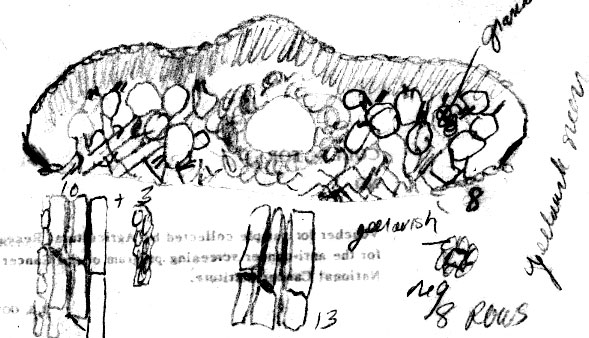
W Transcaucasia: Caucasus: [Georgia?] Suchum (Abehazia), in silvis faucium Petkir (fl. Madshara), prop. Urb. Suchum, Woronowa (S: C-2027). Illustration shows abaxial leaf surface with 1 marginal cell lacking papillae, 8 rows of papillose cells, stomata in 13 rows, and a partly papillose midrib of 14 cells, the outer 5 rows papillose. The strongly recurved leaf margins, the relatively high stomata counts, leaf papillose essentially to the margin, and enlarged abaxial midrib cells would seem to warrant separate taxonomic status, but the overall gross morphological features strongly agree with T. recurvata var. recurvata. The large leaf buds are due to the yew artichoke gall, Taxomyia taxi |
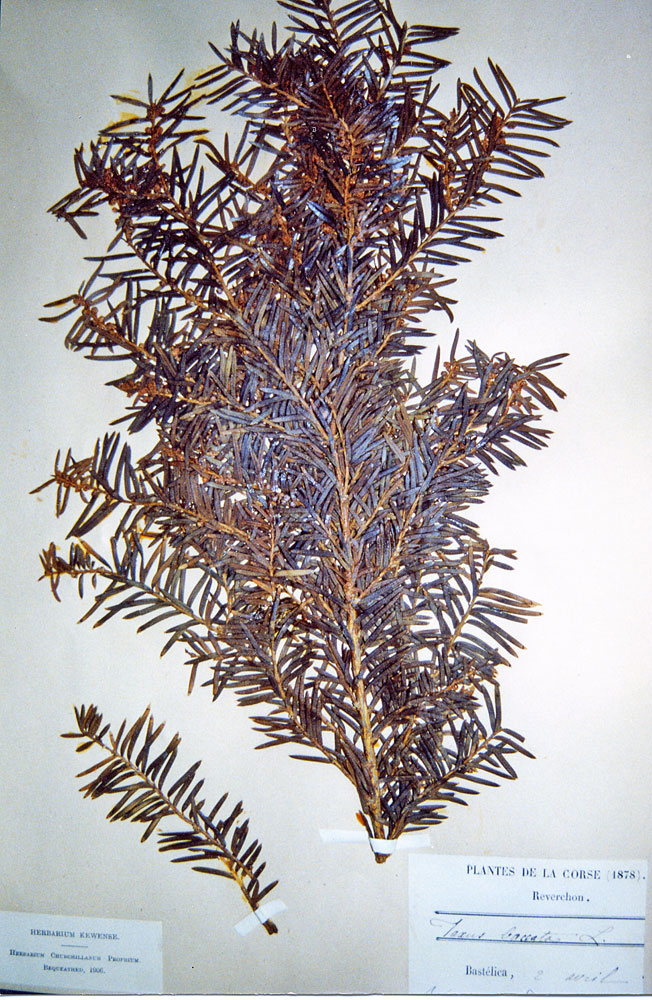
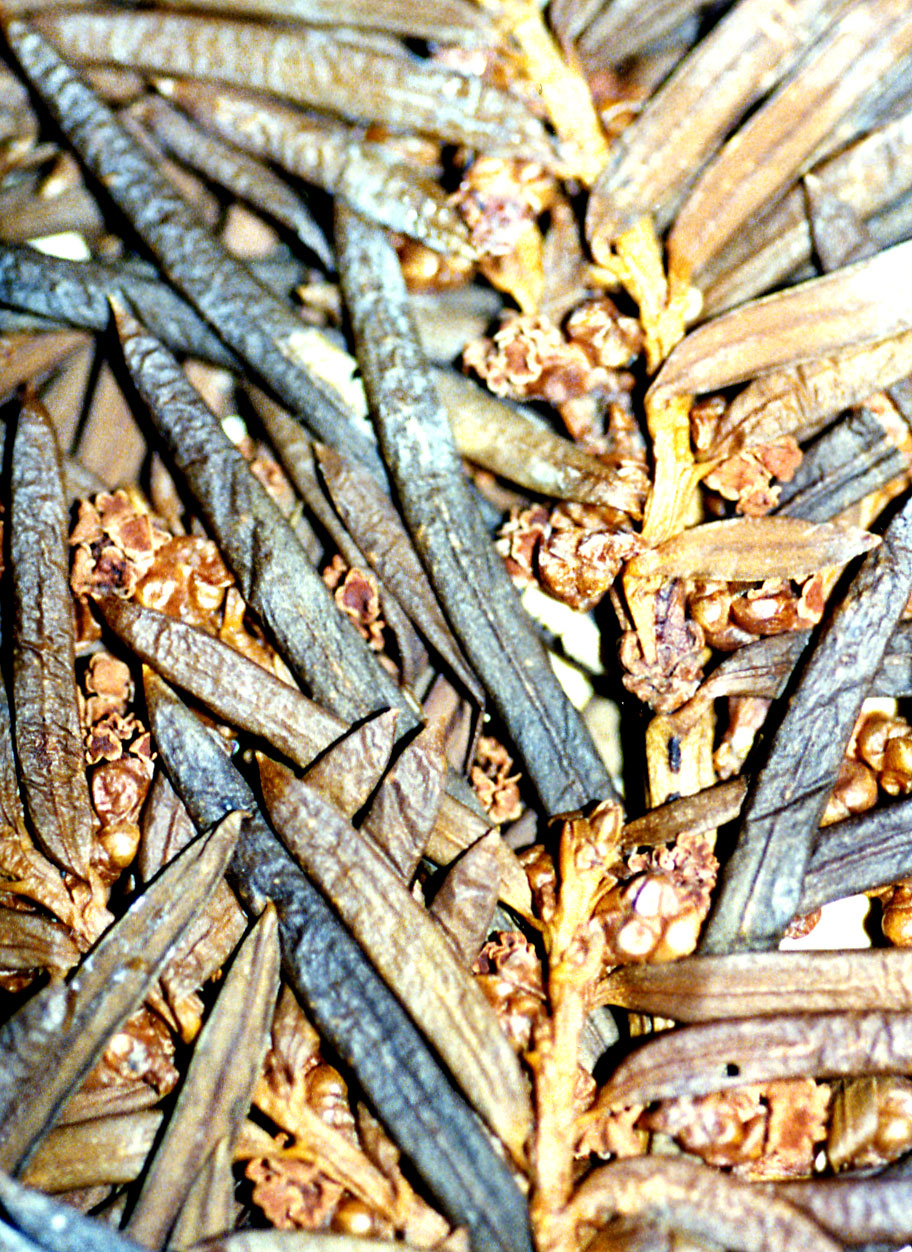
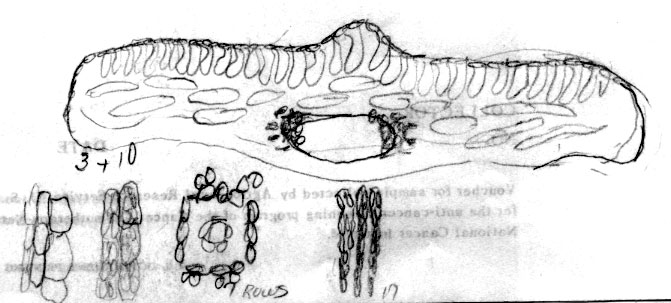
France: Corsica Herb. Churchillanum (K). Illustration shows abaxial leaf margin to lack papillae across 3 cells followed by 7 rows of papillose cells, a stomata band with 7 rows, and a papillose midrib of 17 cells, the papillae notably marginal. |
|
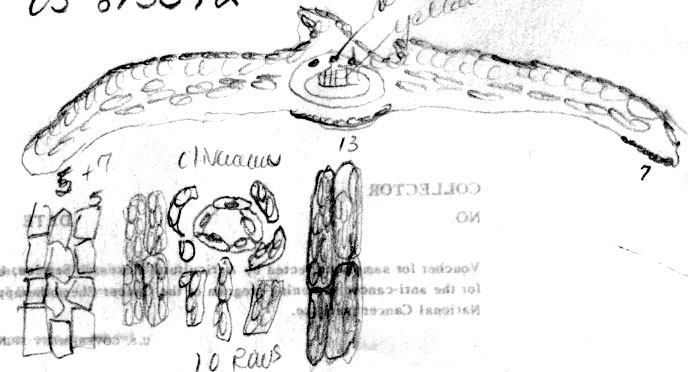
England: Riddlesdown, Bennett & Croydon 713 (US: 813392). Illustration shows abaxial leaf margin to lack papillae across 5 (-7) cells followed by 7 rows of papillose cells, a stomata band with 10 rows of stomata, and a papillose midrib of 13 cells across. |
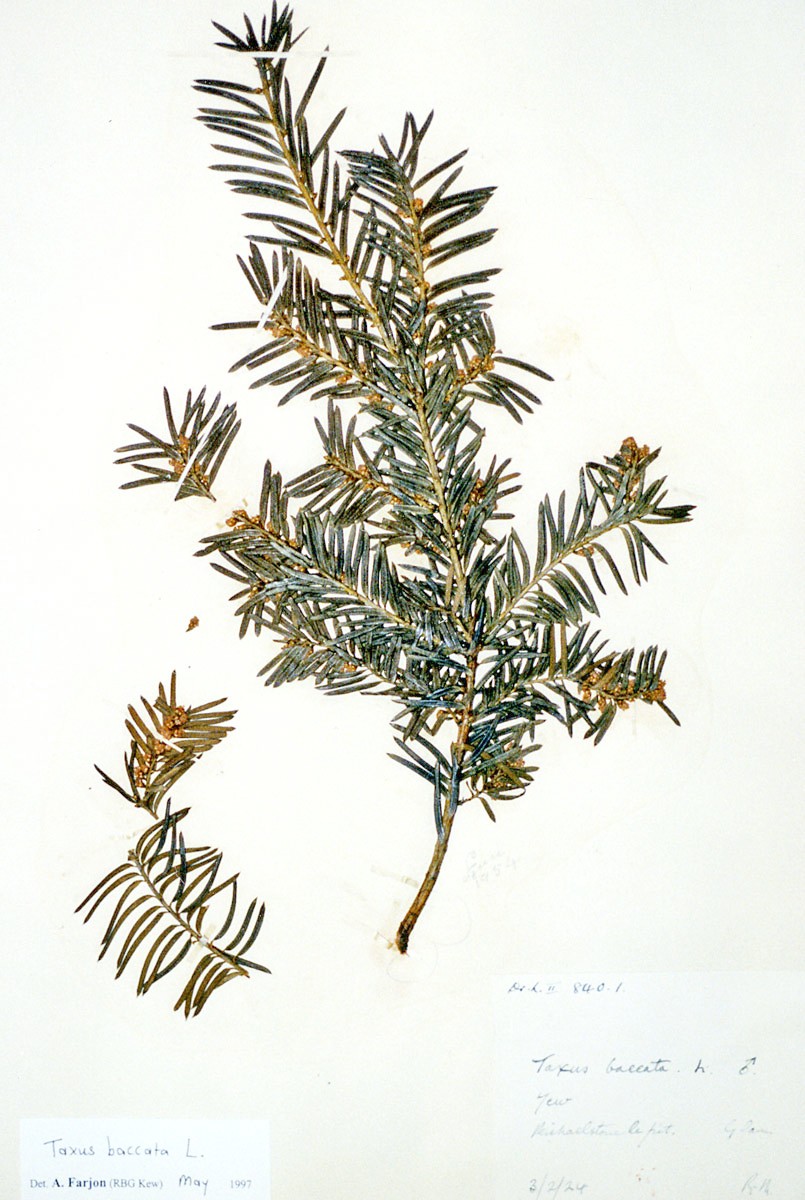
England SW, Michaelstone, collector Ruth? 3/2/24 (K) .Illustration shows abaxial leaf margin to lack papillae across 4 cells followed by 12 rows of papillose cells, a stomata band with 10 rows of stomata, and midrib of 13 cells across, papillose except for the outer row. |
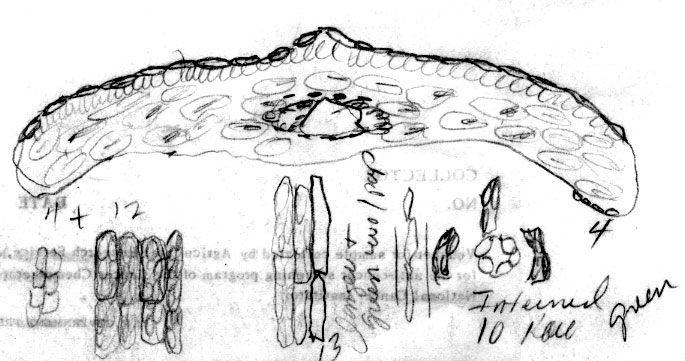
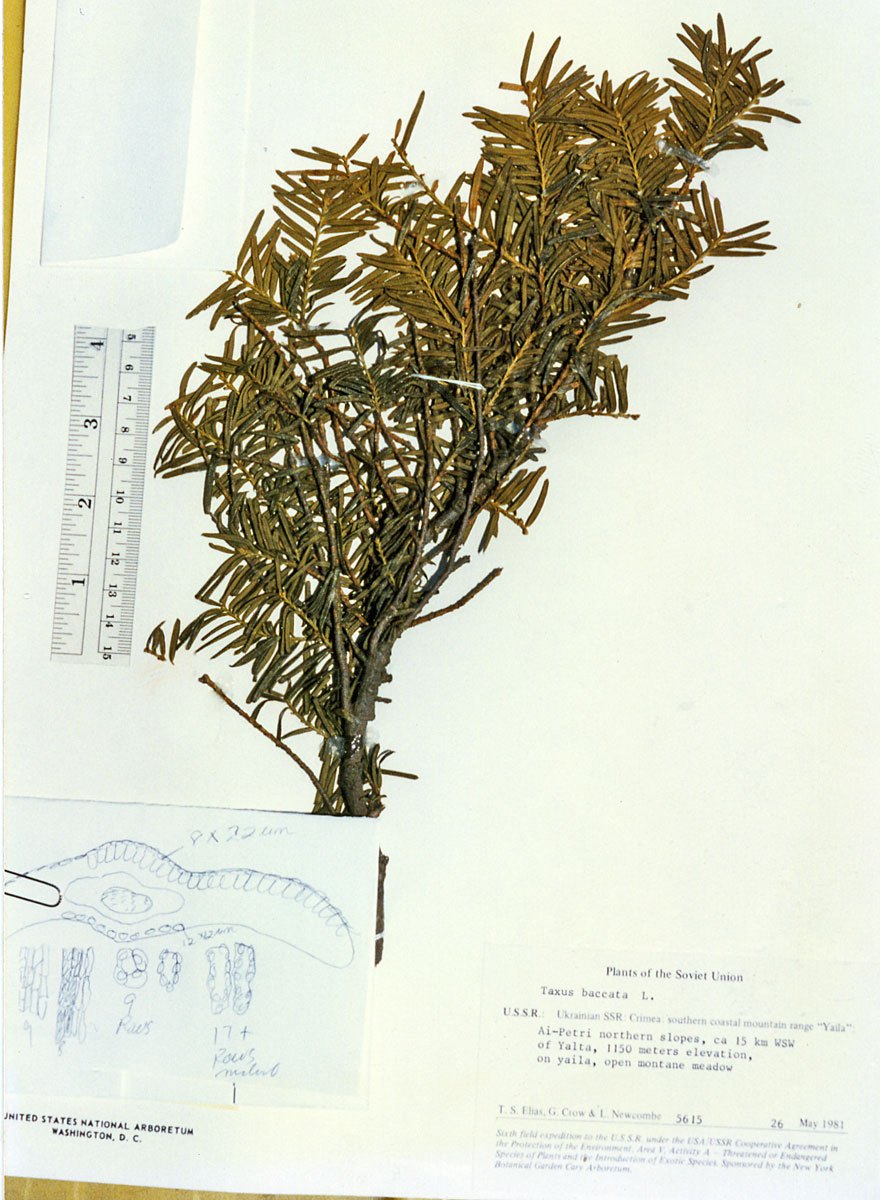
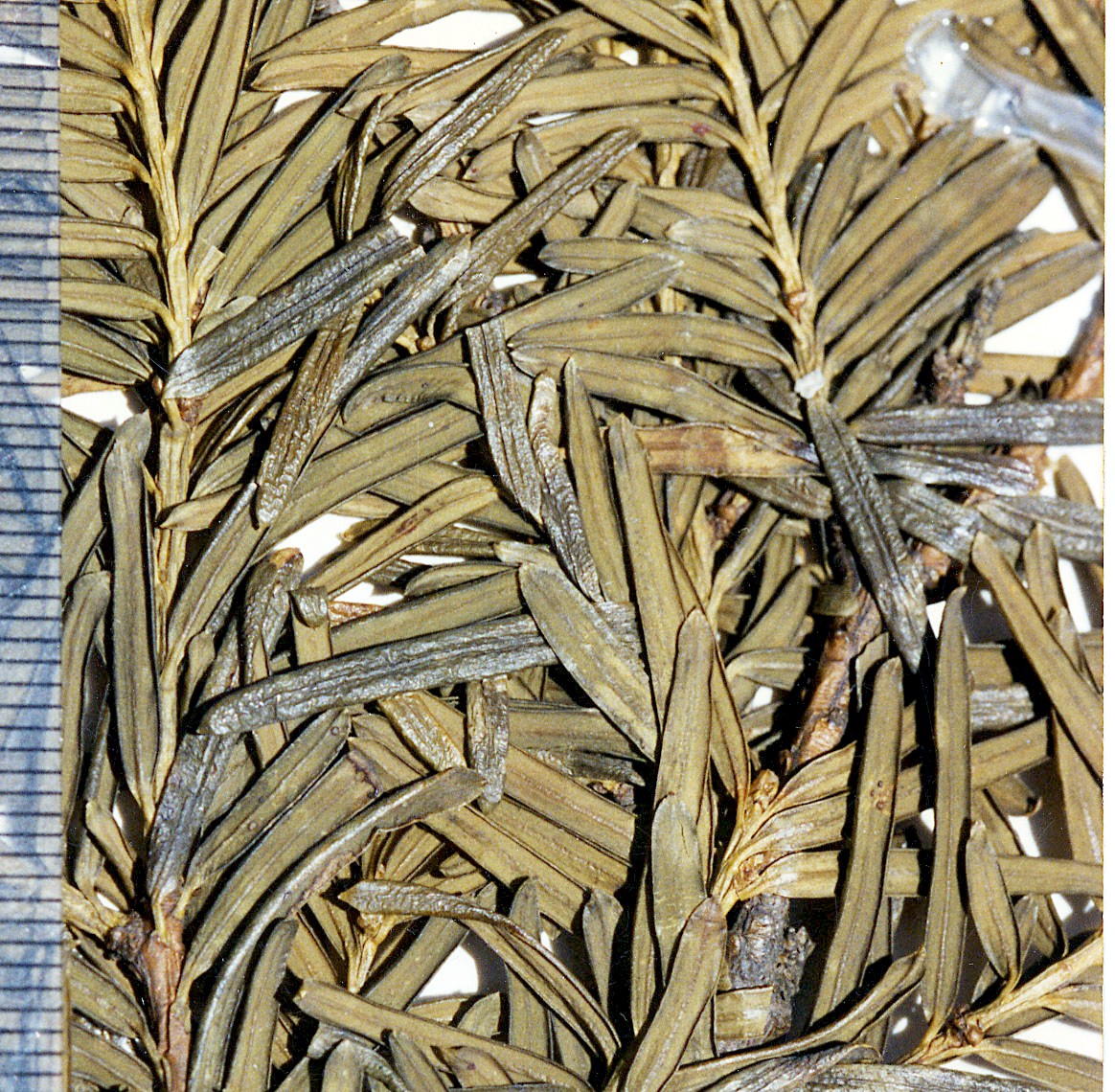
Ukraine—Crimea: S coastal mt. range “Yaila,” Ai-petri northern slopes, Elias et al. 5615 (NA). Illustration indicates abaxial leaf margin lacks papillae across 9 cells followed by 8 rows of papillose cells, a stomata band with 9 rows of stomata, and papillose midrib of 17+ cells across. Epidermal cells are ~12 µm in diam. on abaxial midrib, and 8 µm tall and 22 µm wide on the adaxial surface. |
|
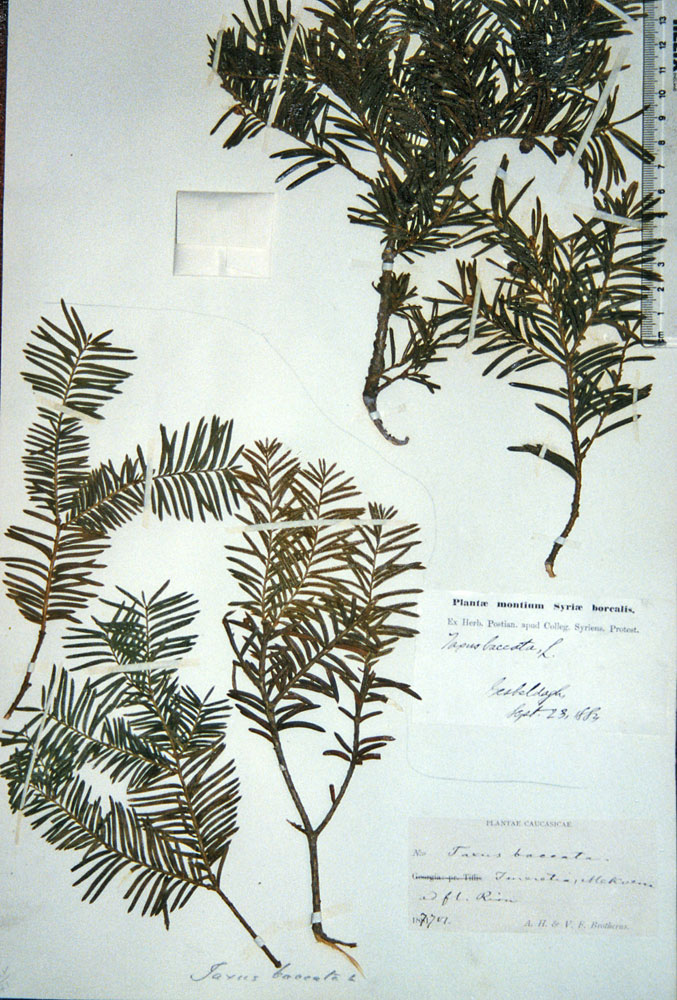
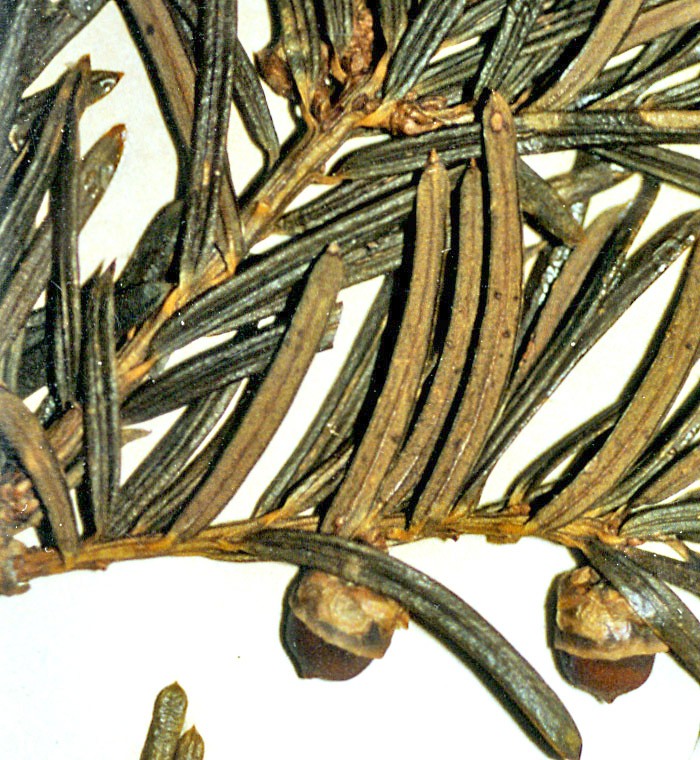
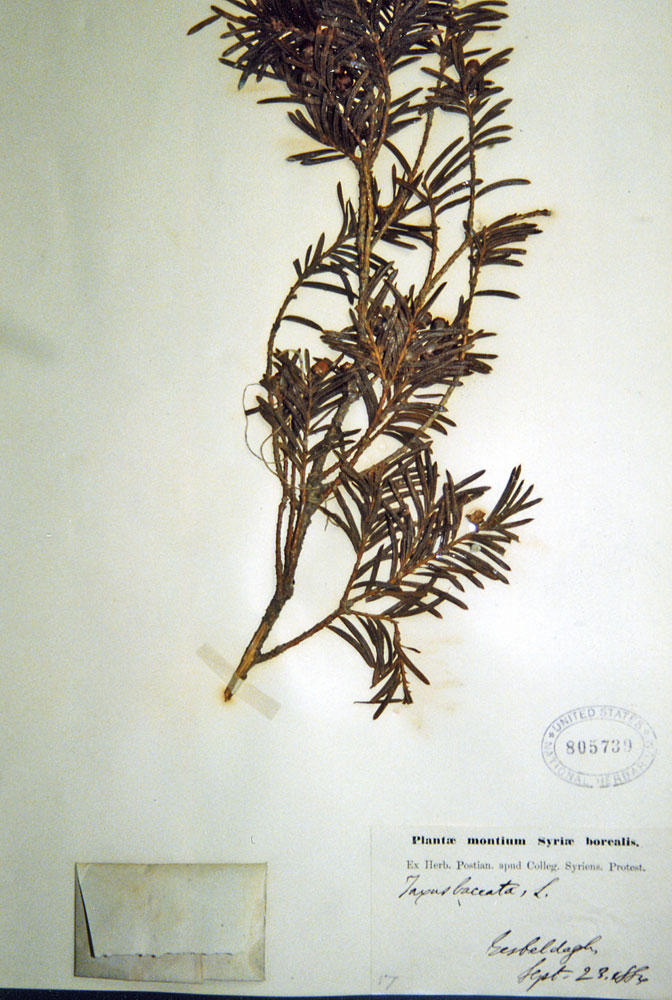
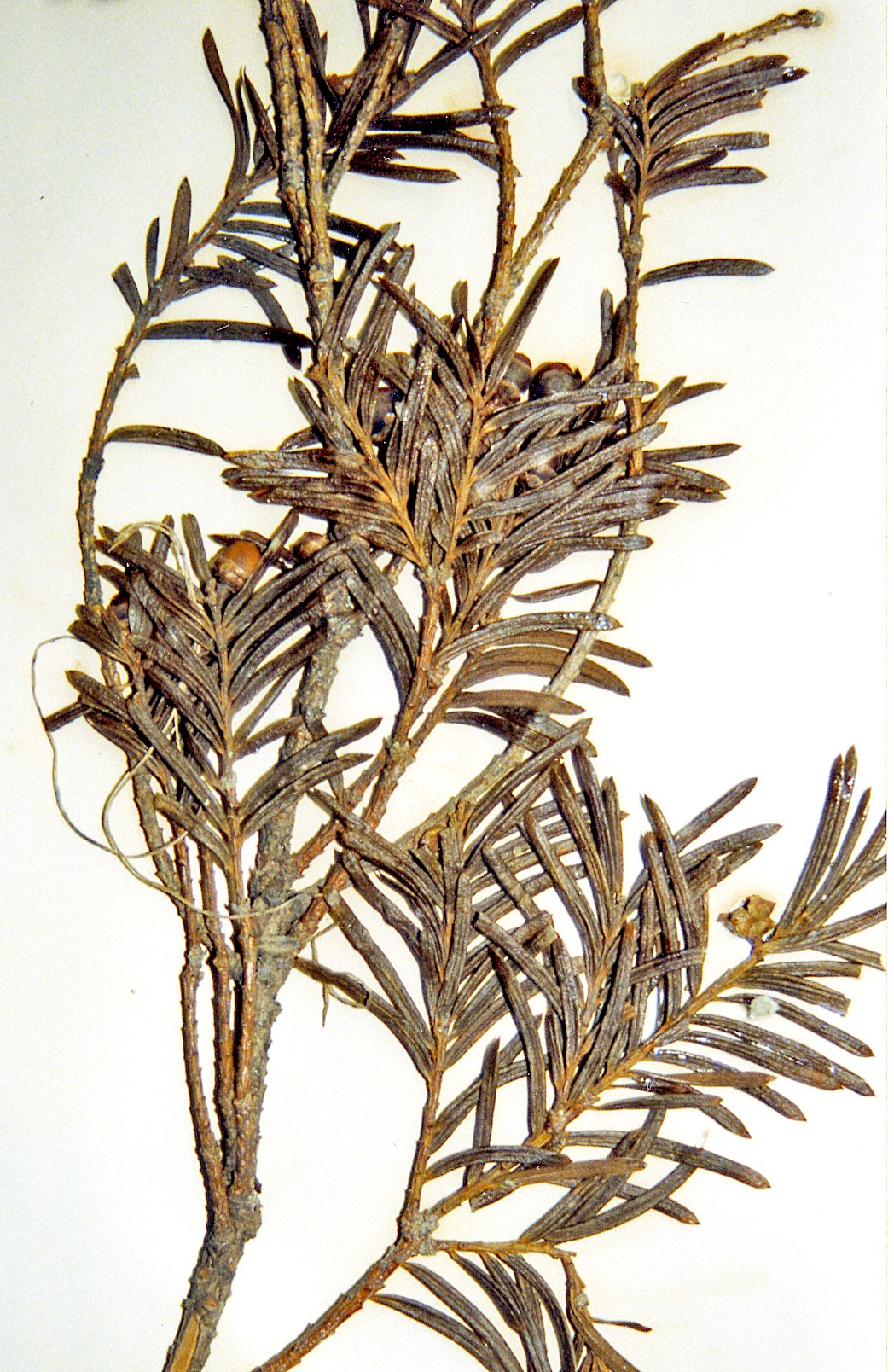
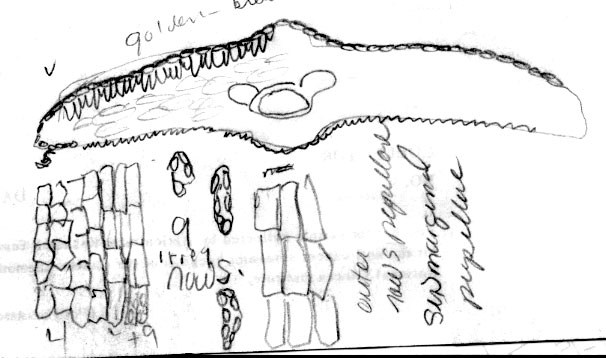
Syria: Gesbeldagh (BM-top, US). Illustration from specimen at Museum of Natural History in London (BM) indicates abaxial leaf margin lacks papillae across 4 cells followed by 9 rows of papillose cells, a stomata band with 9 irregular rows of stomata, and smooth midrib of 15 cells across. The specimen at the Smithsonian Institution differed only slightly in having 10 stomata rows and 6 papillose rows of cells (instead of 9) between stomata band and leaf margin. |
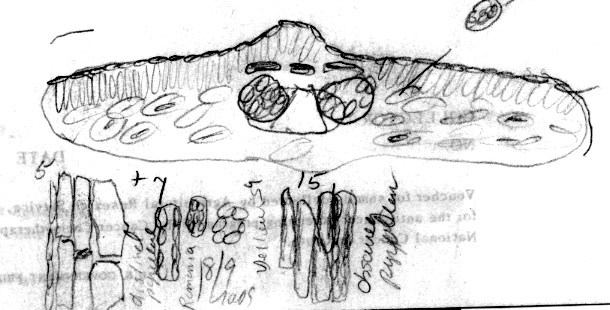
Germany: Bavaria, Petzi 1444 (K). Illustration indicates abaxial leaf margin lacks papillae across 5 cells followed by 7 rows of papillose cells, a stomata band with 8 rows of stomata one side of the midrib, 9 on the other side, and an obscurely papillose midrib of 15 cells across. |
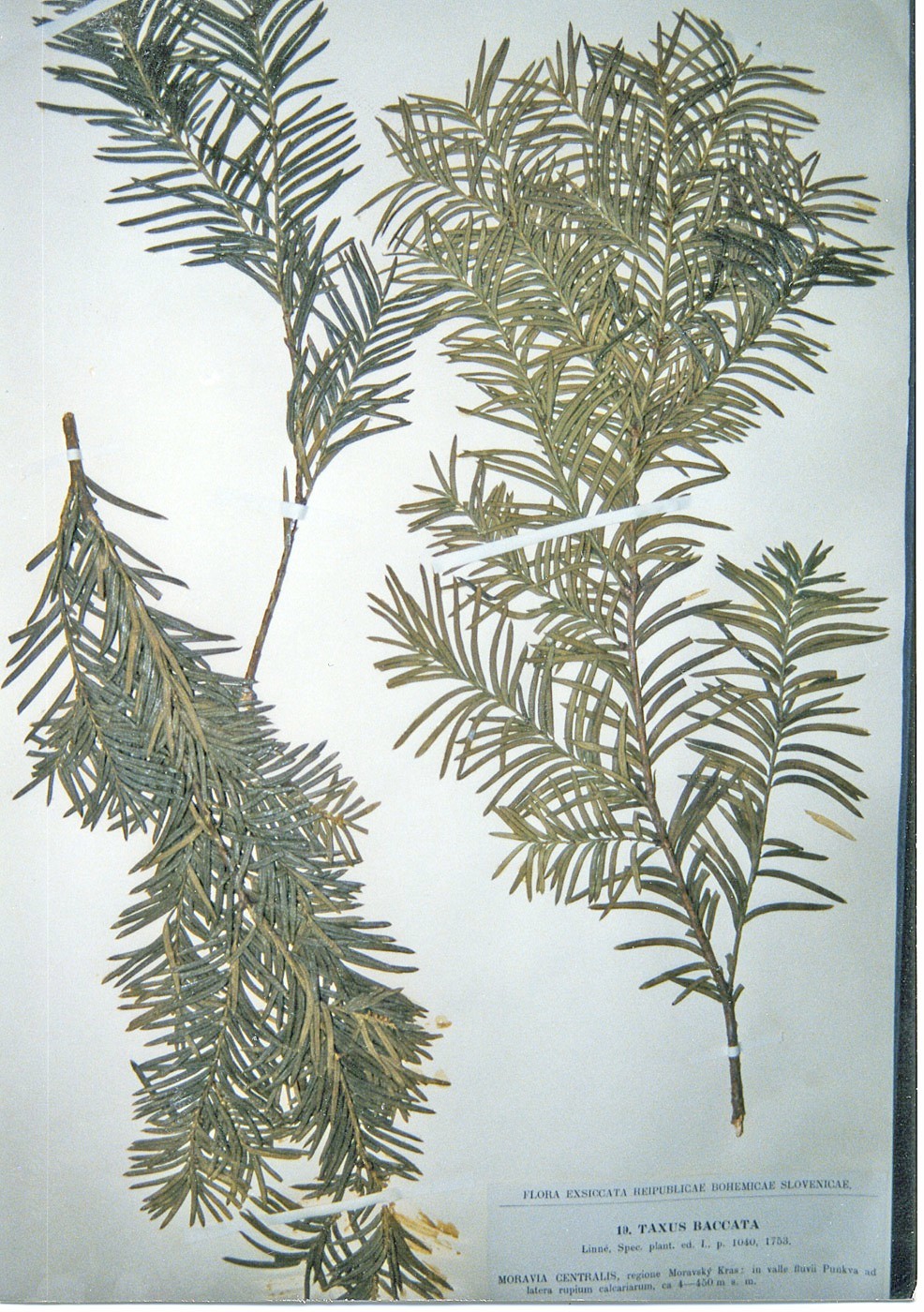
Czech Republic: Moravia Centralis, Jirasek & Suza (K). Illustration indicates abaxial leaf margin lacks papillae across (4-) 6 cells followed by 12 rows of papillose cells, a stomata band with 10 rows of stomata, and a partially papillose midrib. The leaf mesophyll was also noted to have reddish parenchyma cells similar to what occurs in Taxus contorta. |
|
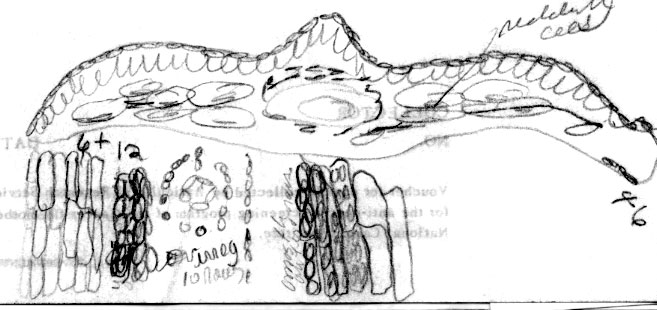
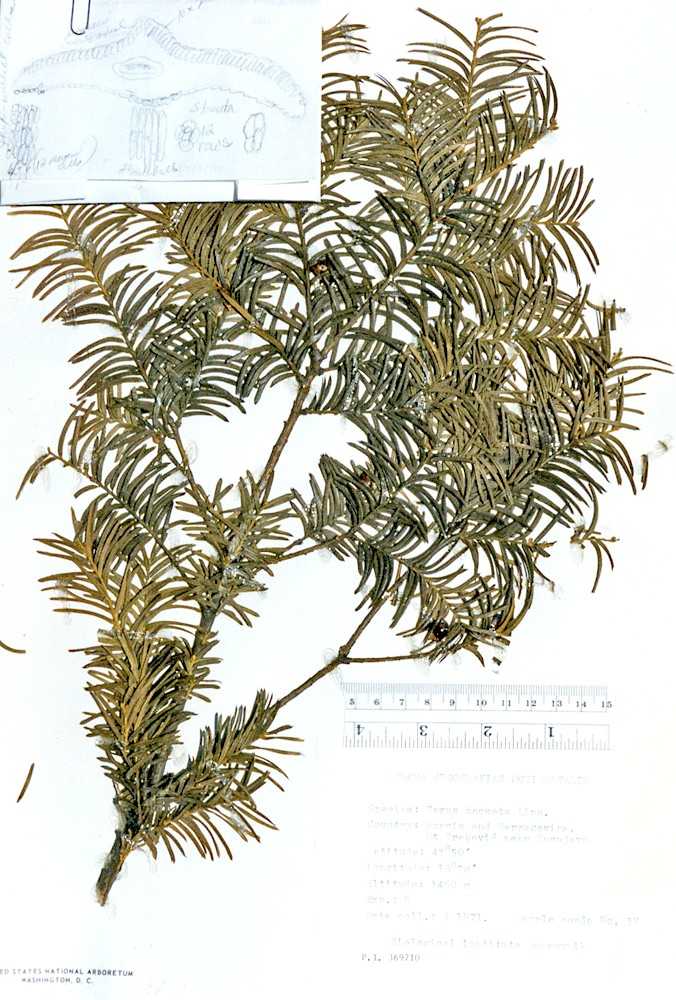
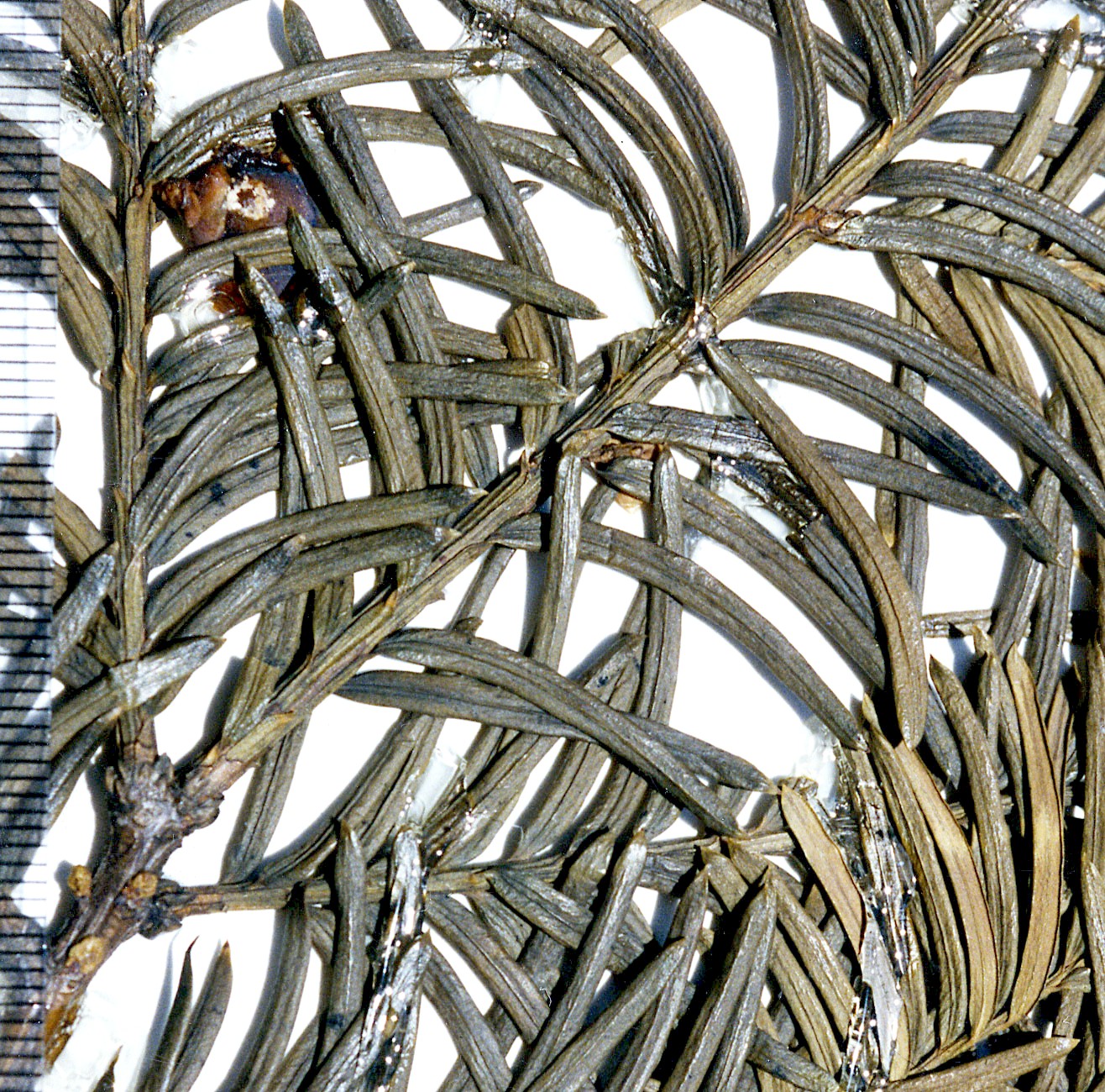
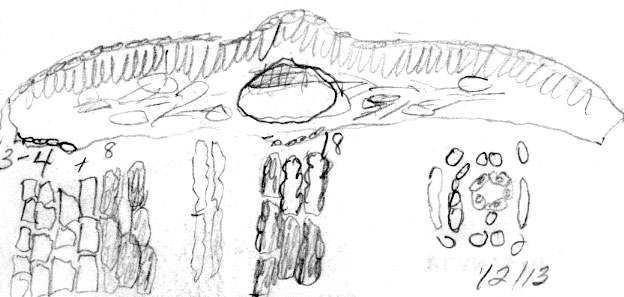
Bosnia:
Mt. Trebevic near Sarajevo, 1450 m, Biol. Inst. Dubrovnik 37, PI-369710
(NA). Illustration attached to specimen indicates there are 12 rows
of cells along the abaxial leaf margin 4 of which lack papillae (thus 8
rows are papillose), a stomata band with 12 rows of stomata one side of
the midrib, 13 on the other side of the midrib as indicated in the other
drawing below, and a papillose midrib of 20 cells across, or 18 cells
across in the other drawing. Adaxial epidermal cells were measured
to be 10 µm tall and 20 (-29) µm wide. |
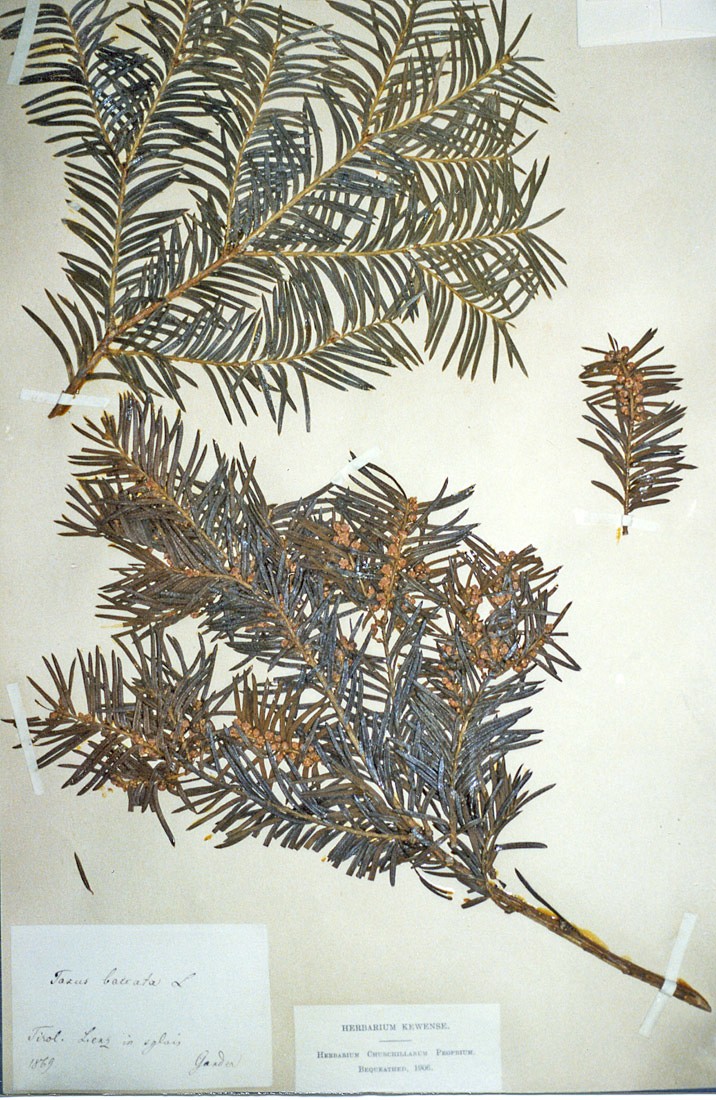
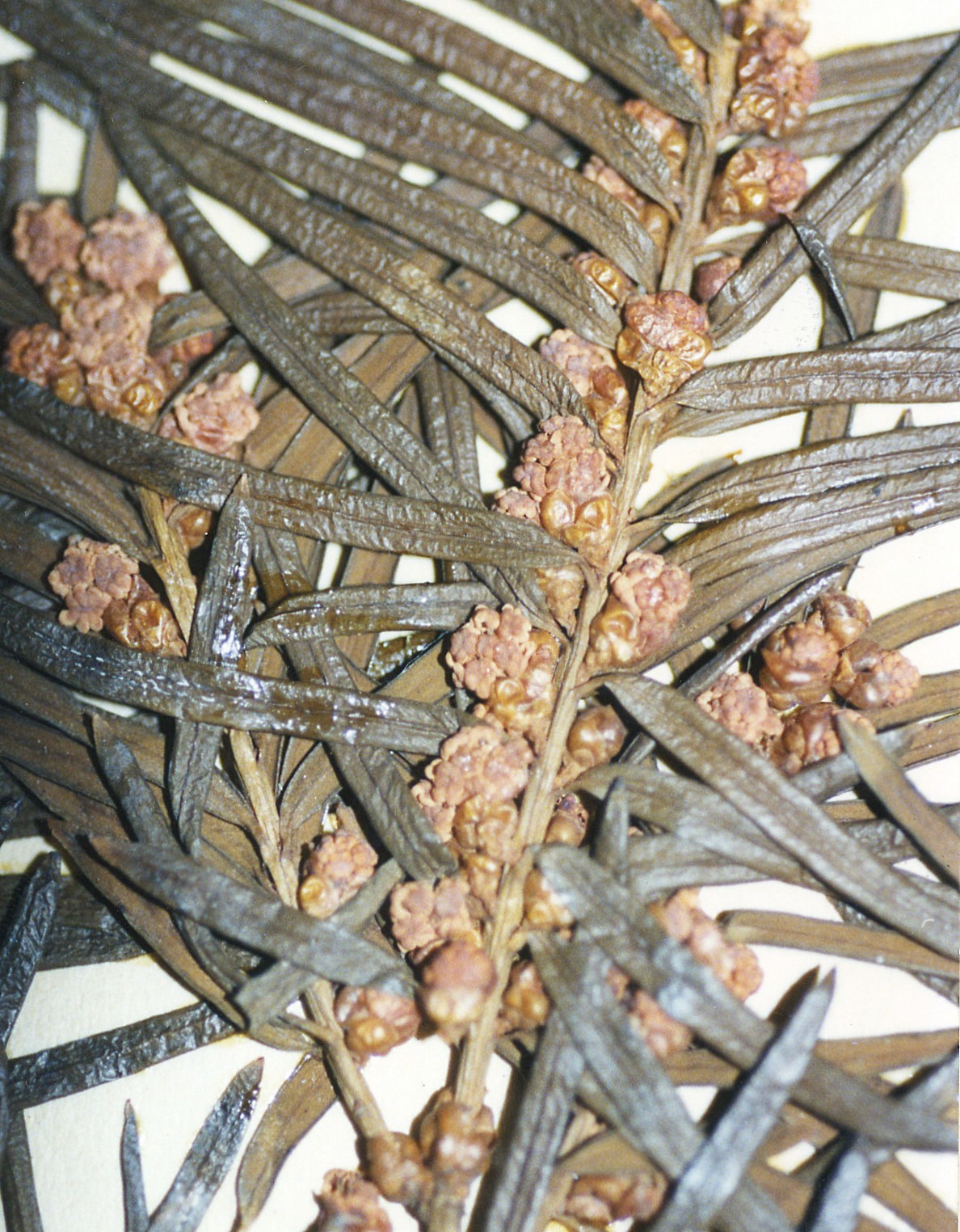
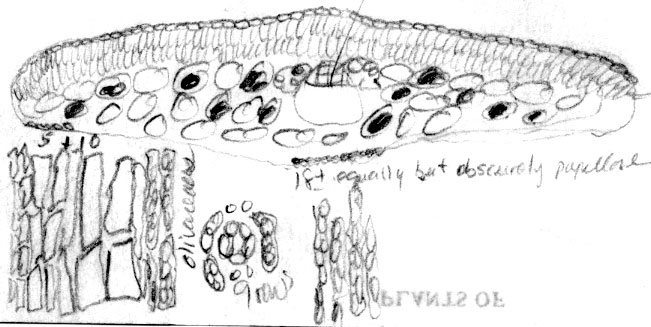
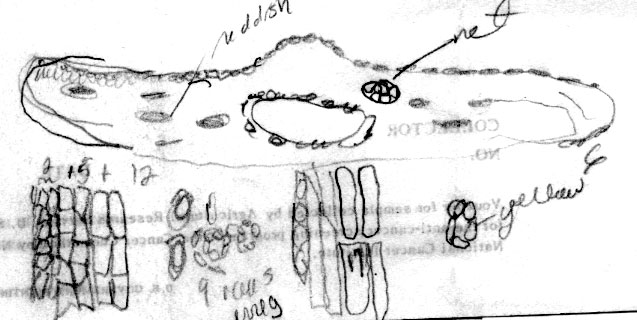
Austria: Tirol, Gander, yr 1869 (K). Illustrations, one from a specimen at the US (left) and other from a specimen at K indicate that the abaxial leaf margin lacks papillae across 5 cells followed by 10–12 rows of papillose cells, a stomata band with 9 rows of stomata, and a partially papillose midrib of 17–18 cells across. The leaf mesophyll was also noted to have reddish parenchyma cells similar to what occurs in Taxus contorta. |
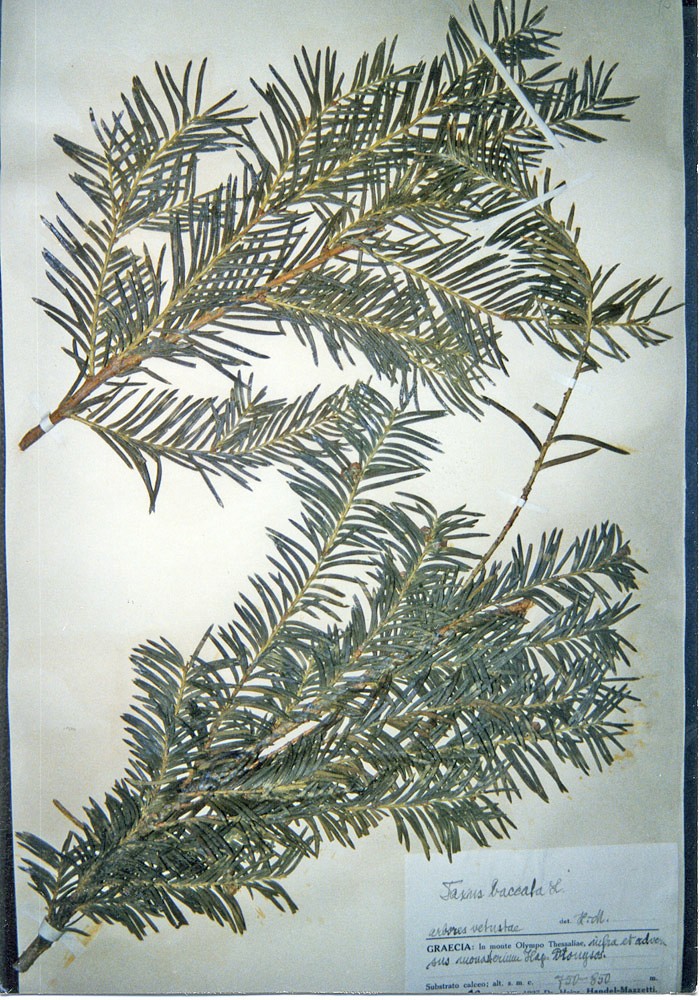
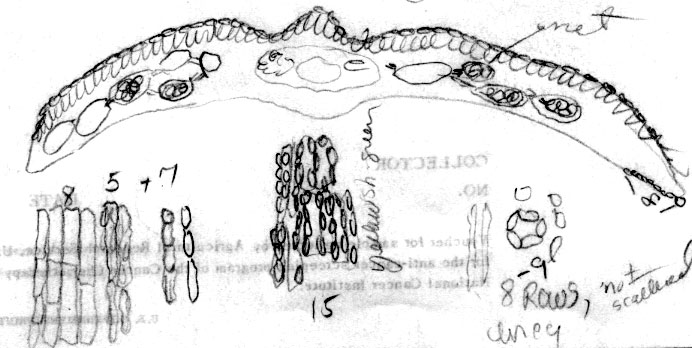
Greece: Mt. Olympus, 750-850 m, Handel Mazzetti (K). Illustration indicates that the abaxial leaf margin lacks papillae across 8 cells followed by 12 rows of papillose cells, 7 of which are narrower, a stomata band with 8–9 rows of stomata, and a papillose midrib of 15 cells across, the papillae notably marginal. The leaf mesophyll was also noted to have reddish parenchyma cells similar to what occurs in Taxus contorta. |
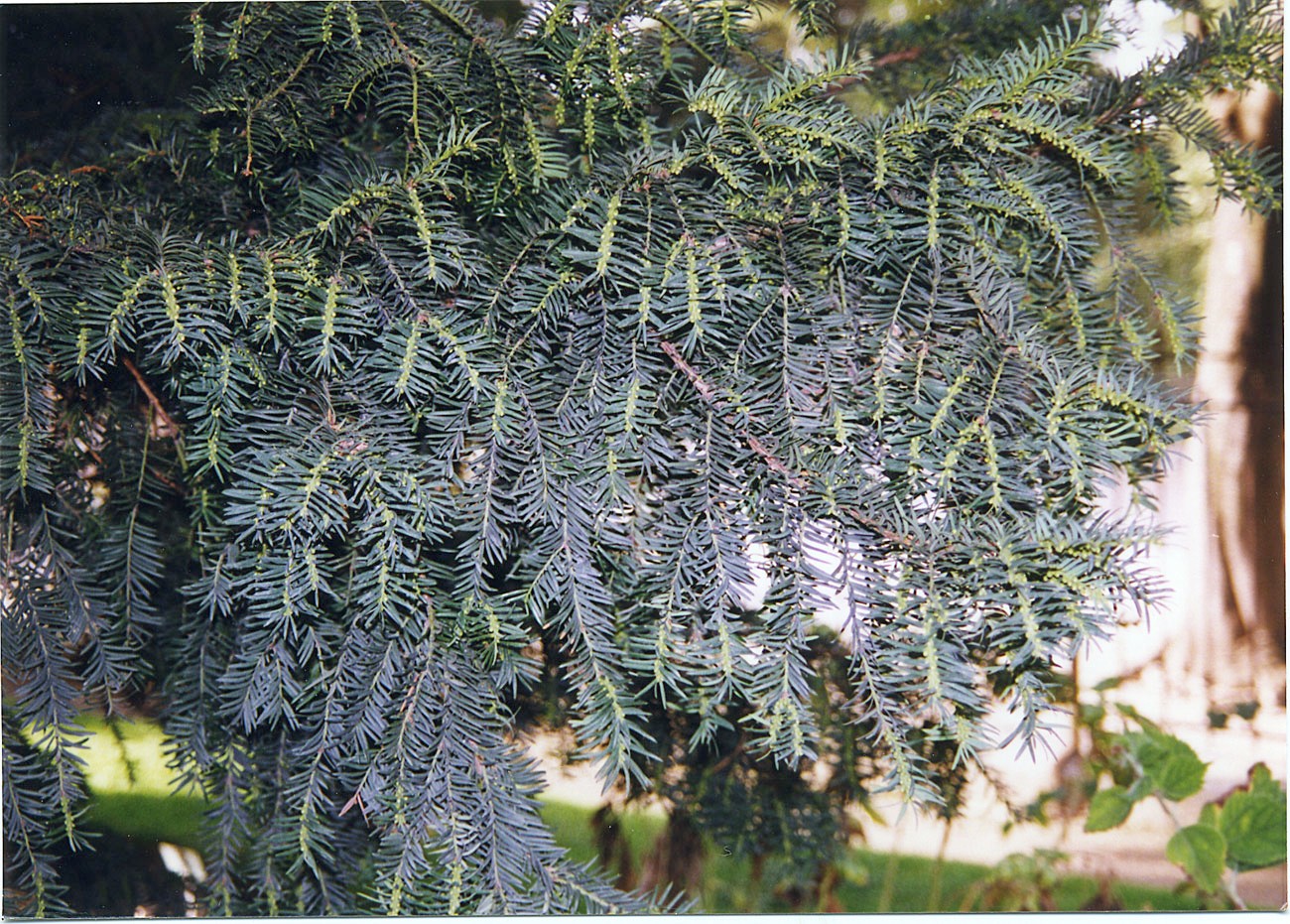 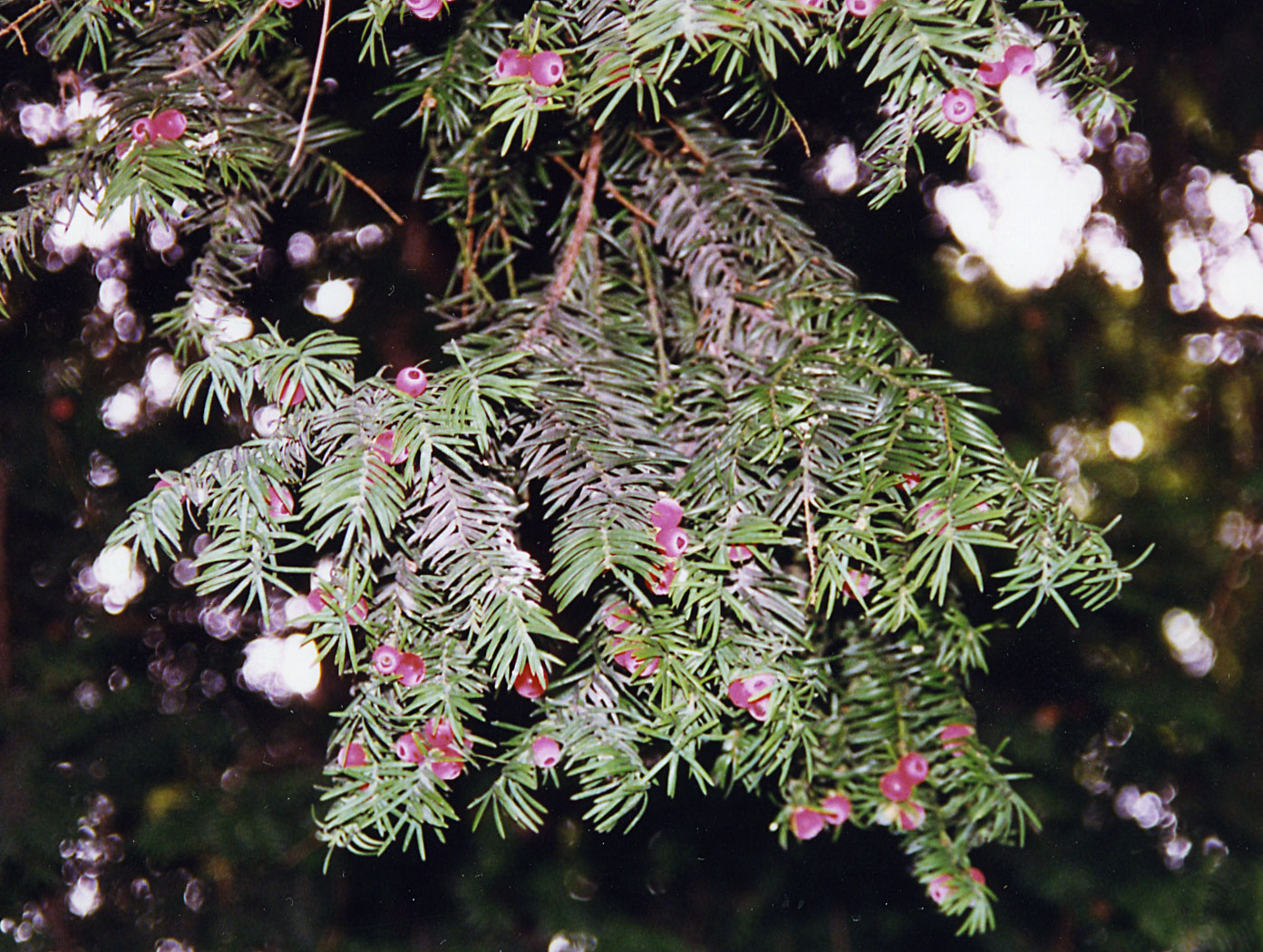 Jardin des Plantes, Paris.
|
||
|
Links to photos on web pages: http://www.mob-zabrze.pl/flora/foto/taxus-baccata1.jpg http://flora.nhm-wien.ac.at/Seiten-Arten/Taxus-baccata.htm
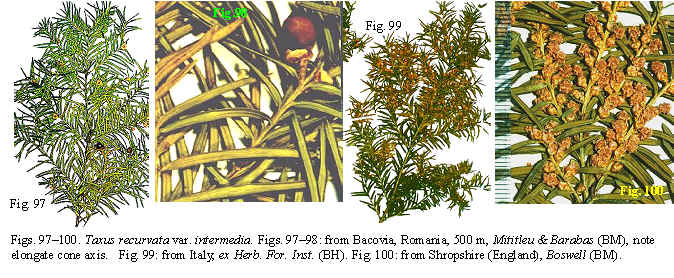
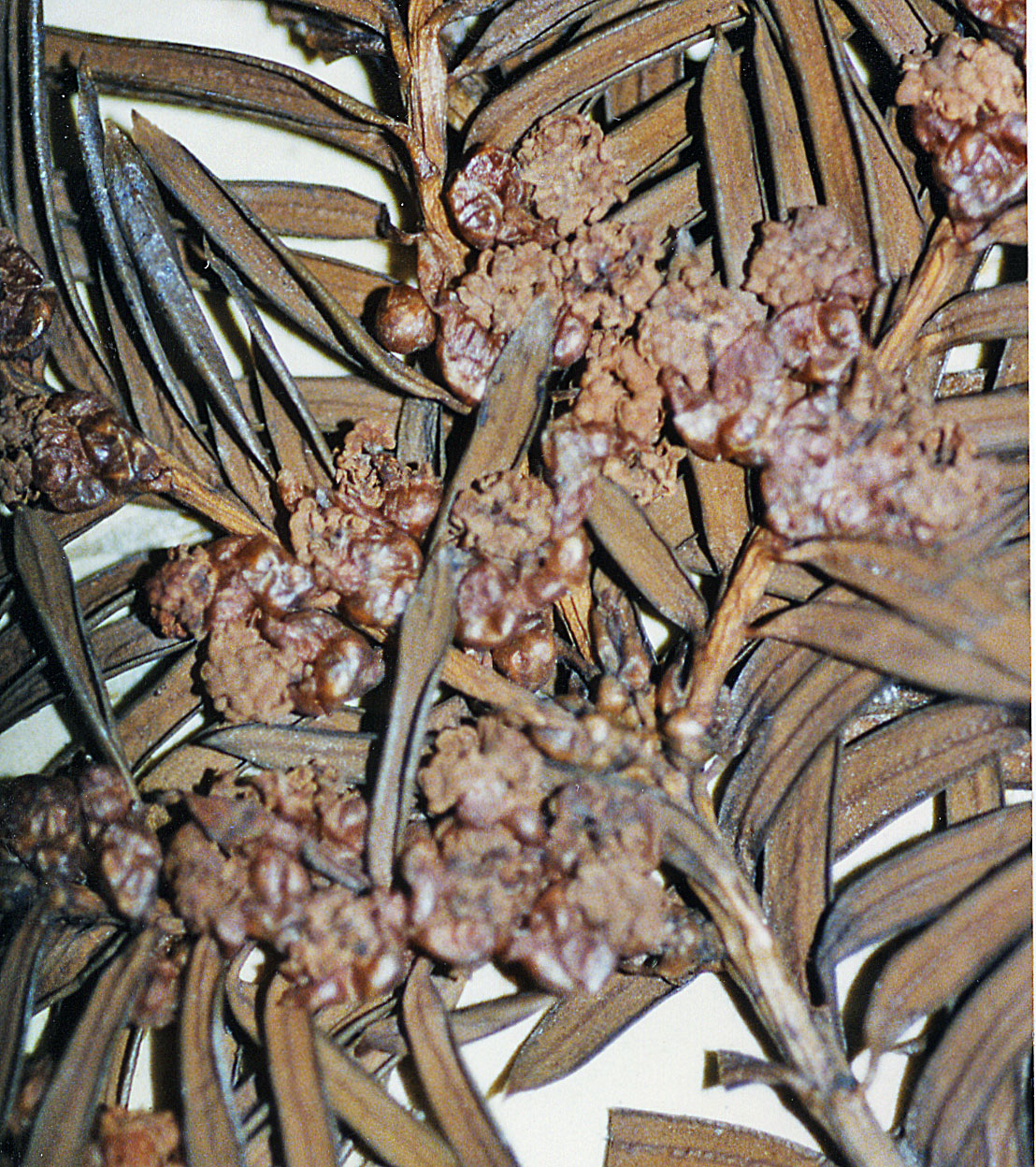
19b. Taxus recurvata var. intermedia (Carrière) Spjut (Figs. 97–100), comb. nov. proposed. Taxus baccata (var.) intermedia Carrière, Traité gén. conif. 738. 1867. “Plante viguoureuse; branches grosses, pas très nombreuses, dressés-fastigiées, à ramifications peu nombreuses; ecorce jaunâtre; feuilles petiolées, éparses, distantes, légèrement arquées, mais non falquées, raides, épaisses, longues de 12–25 mm, large de 2–3, longuement atténnées en une pointe rougeâtre.” Taxus baccata (f.) intermedia (Carrière ) Beissner, Handb. Nandelholzk. 171. 1891. Reportedly originating from seed of T. fastigiata at the Trainon Gardens inVersailles, France. Original herbarium material unknown. Type undetermined. Taxus baccata var. empetrifolia Spjut ined., website, www.worldbotanical.com Apparently arborescent with wide spreading or horizontal branches, branchlets subpinnate, rigid, straight, not recurved; leaves crisscrossing near base to mid region, linear, mostly straight, spreading more at petiole than by bending of the blade, more often plane but recurved along margins in specimens intermediate to typical variety, dark to olive green above, pale rusty (yellowish orange) below in dried specimens.
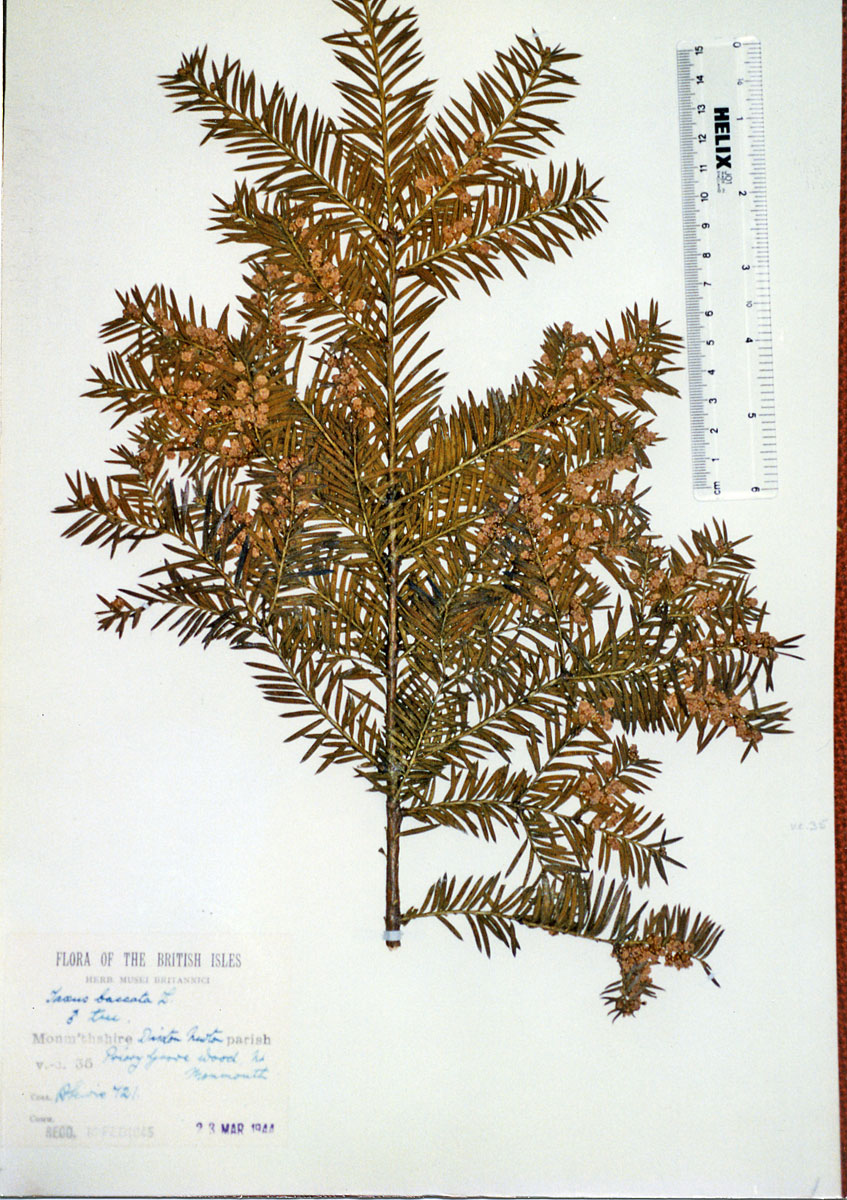
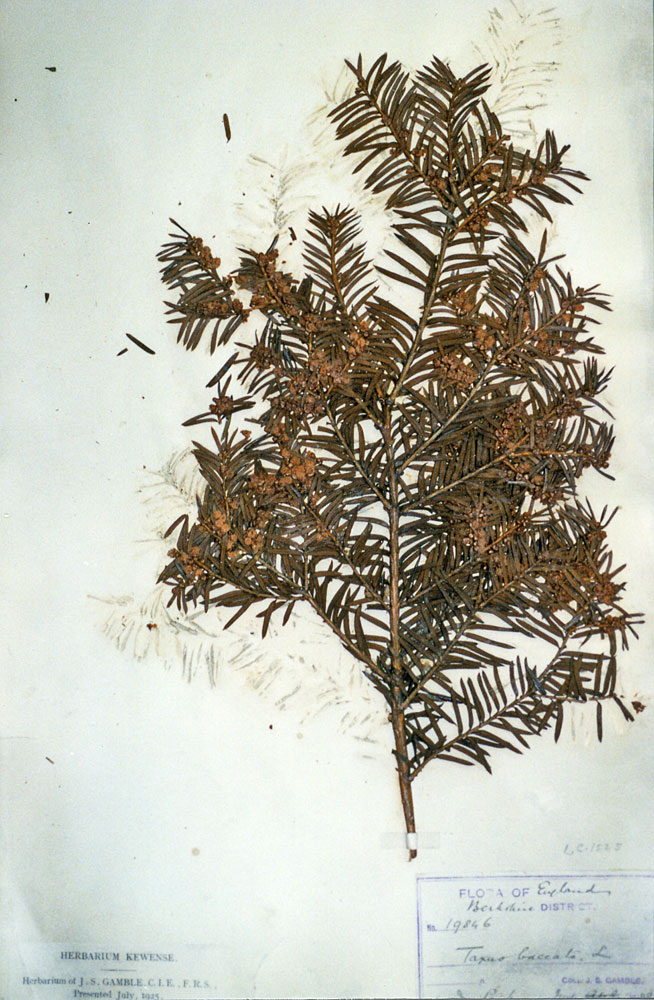
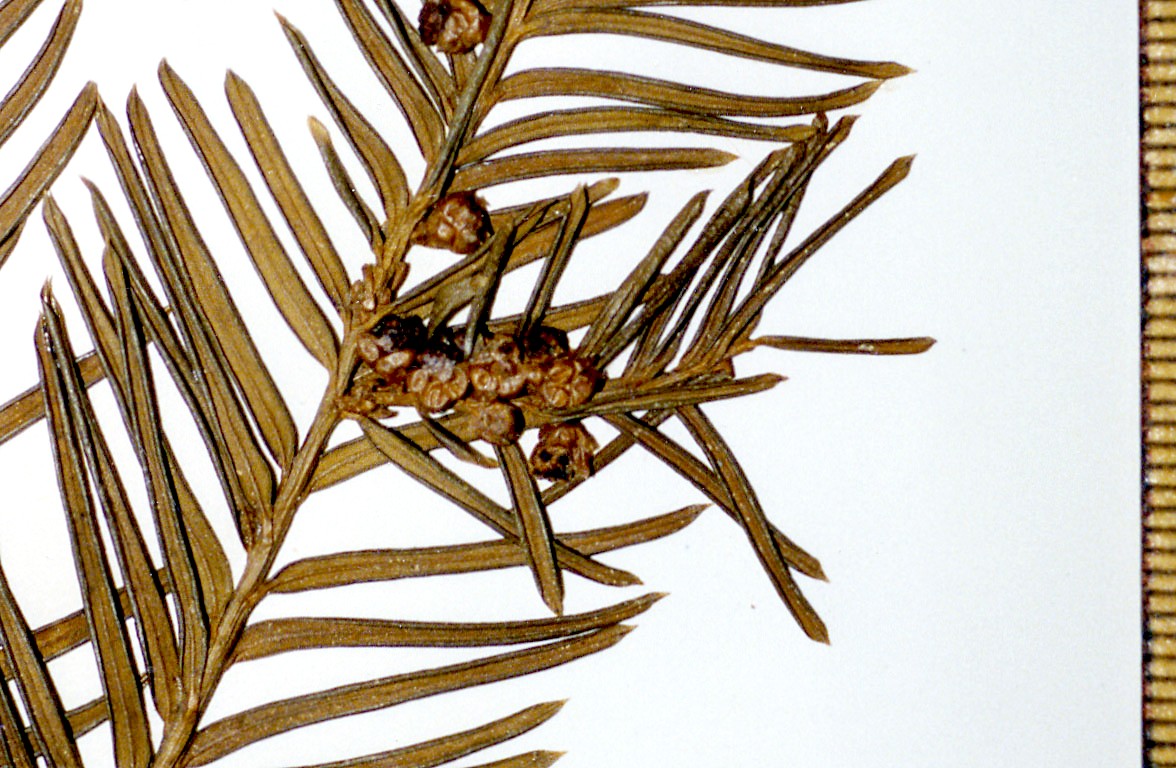
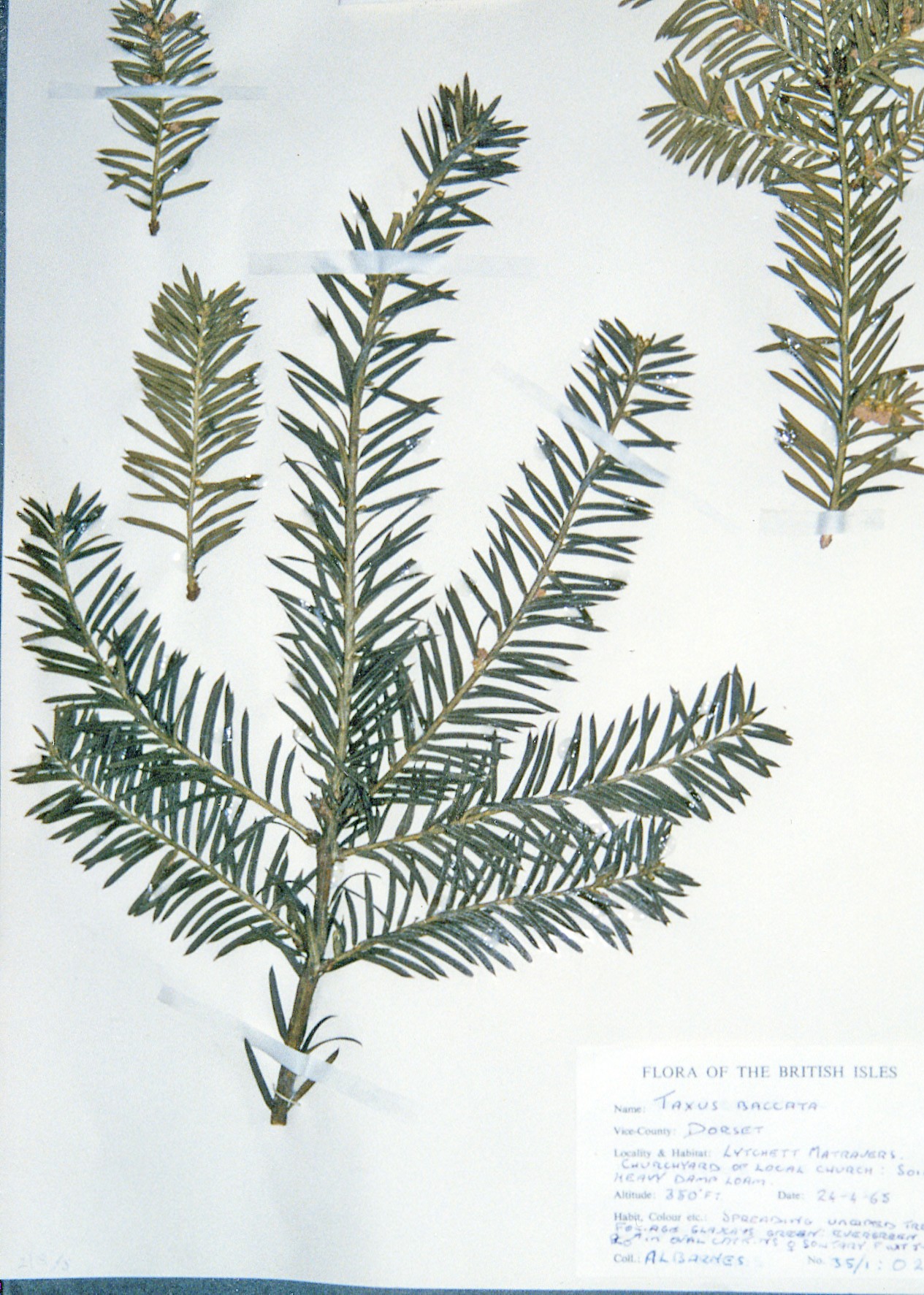
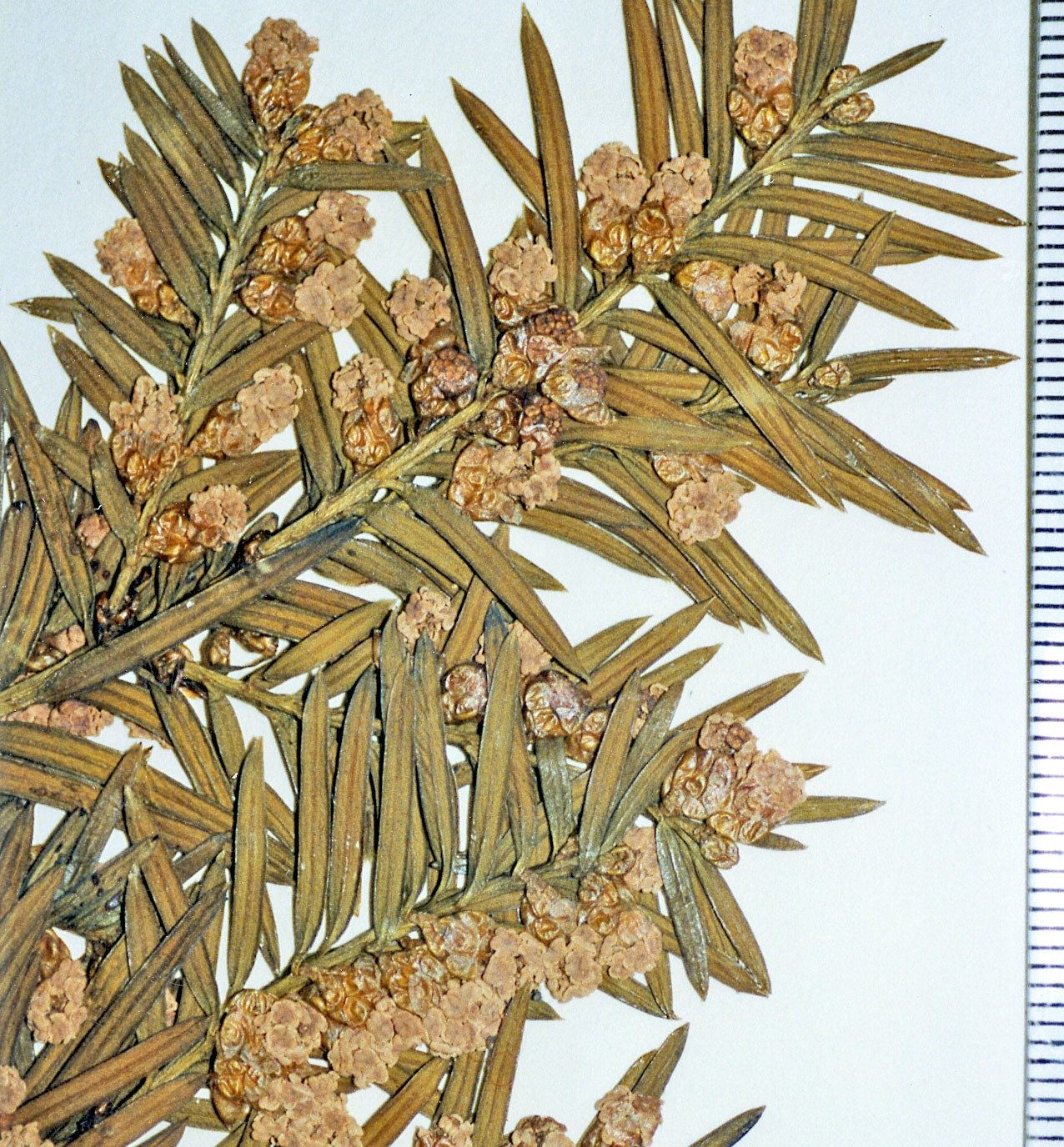
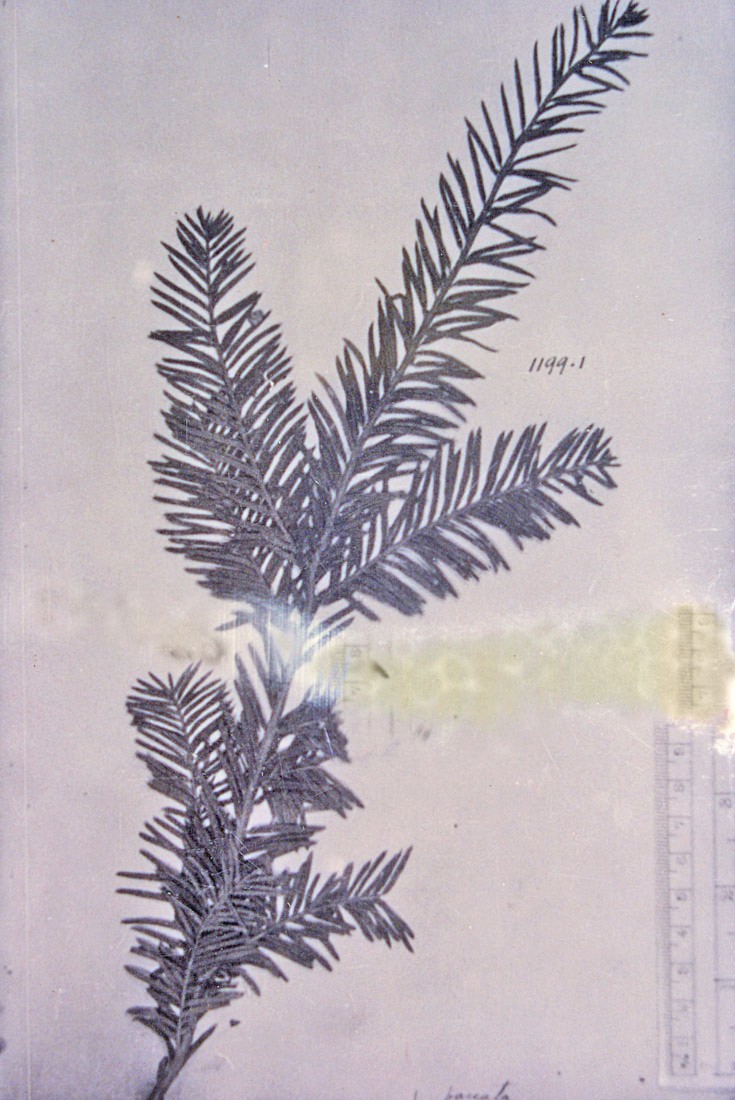
Cross-leaved yew. Distribution: Euro-Mediterranean. This variety is distinguished by the stiff, often straight, branches with erect spreading branchlets and by the olive green leaves that often crisscross more nearer their mid region than base. Representative Specimens—England: Berkshire Dist., Gamble 19866 (K); Dorset, Lytchett Matrager, spreading tree, churchyard, 350 ft, Albarnes 35/1: 025 (BM), similar to specimen in Linnaean Herb. No.1199.1 (BM); Monmouthshire, Lewis 721 (BM); Highclere, Saddam, Jackson (BM). Germany: [Starkenburg Prov., Hessen] Darmstadt, Keller (PH). Italy: Florentino, ex Levier Herb (BM); Cultivated, Fireuze (BH). Romania: Dirmilnepti, 500 m, Mititleu & Barabas (BM); Cajan Pass. Hungary: Vorlarbergia, Feldkirch, 445 m, Schönach, Aust.-Hungar. (US: 966290). Georgia: ca. 20 Km NE of Gagra, Gagrinskii Range of the Caucasus, River Valley, above Lake Ritsa, disturbed subalpine meadow and slopes below, ca. 1600 m, Elias et al. 6747 (NA).
|
||
|
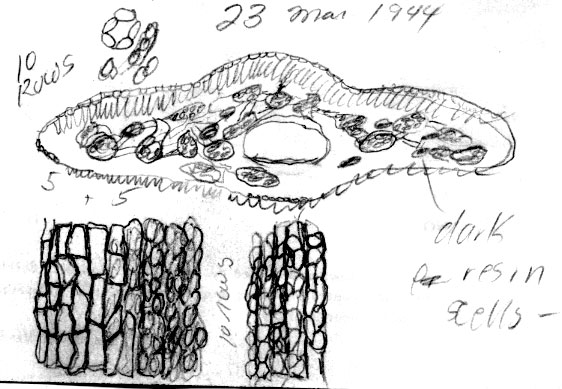
England: Monmouthshire, Lewis 721 (BM). Illustration indicates abaxial leaf margin lacks papillae across 5 cells followed by 5 rows of papillose cells, a stomata band with 10 rows of stomata, and a papillose midrib. The leaf mesophyll was also noted to have reddish parenchyma cells similar to T. contorta. |
England: Berkshire Dist., Gamble 19866 (K). Illustration indicates abaxial leaf margin lacks papillae across 4 cells followed by 4 rows of papillose cells, a stomata band with 11 rows of stomata, and a yellowish papillose midrib. |
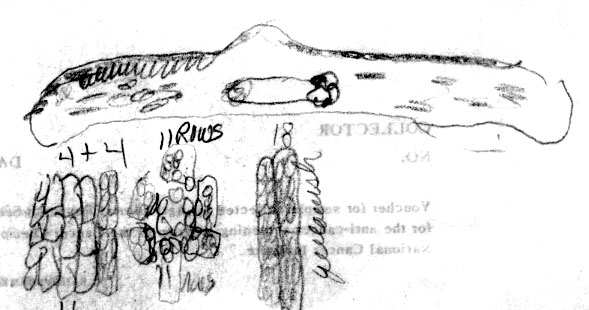
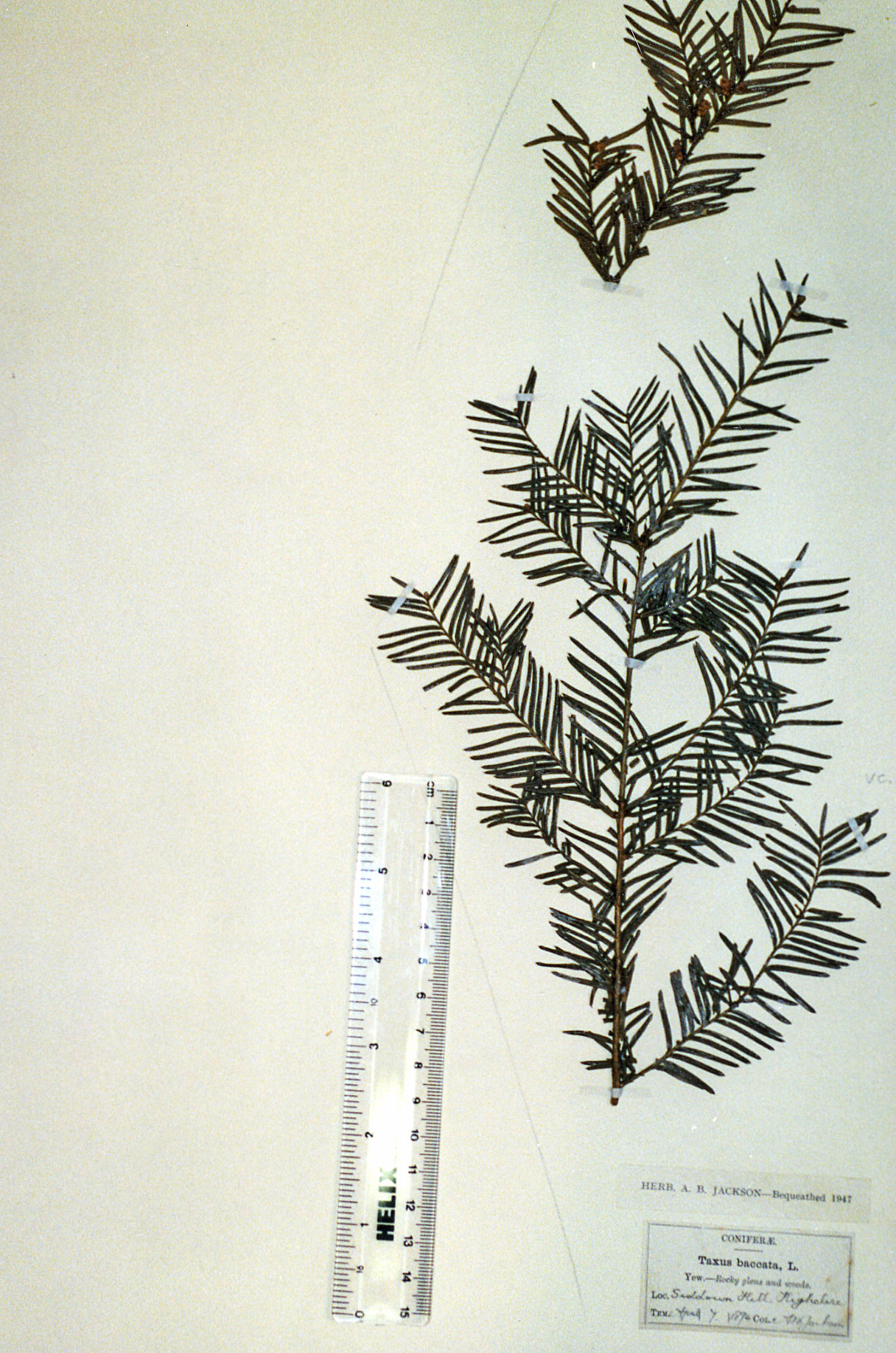
England: Highclere, Jackson yr 1894 (BM). Illustration indicates abaxial leaf margin lacks papillae across 4 cells followed by 9 rows of papillose cells, a stomata band with 8 rows of stomata, and a papillose midrib. |
|
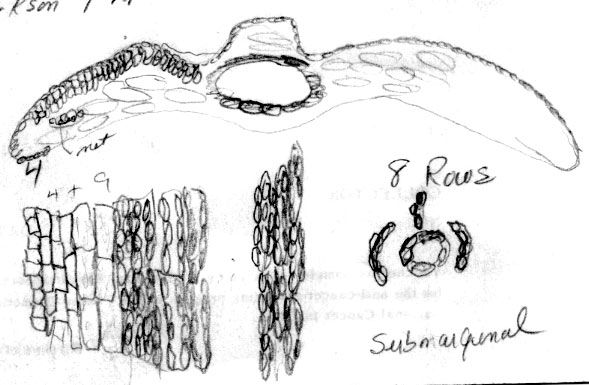
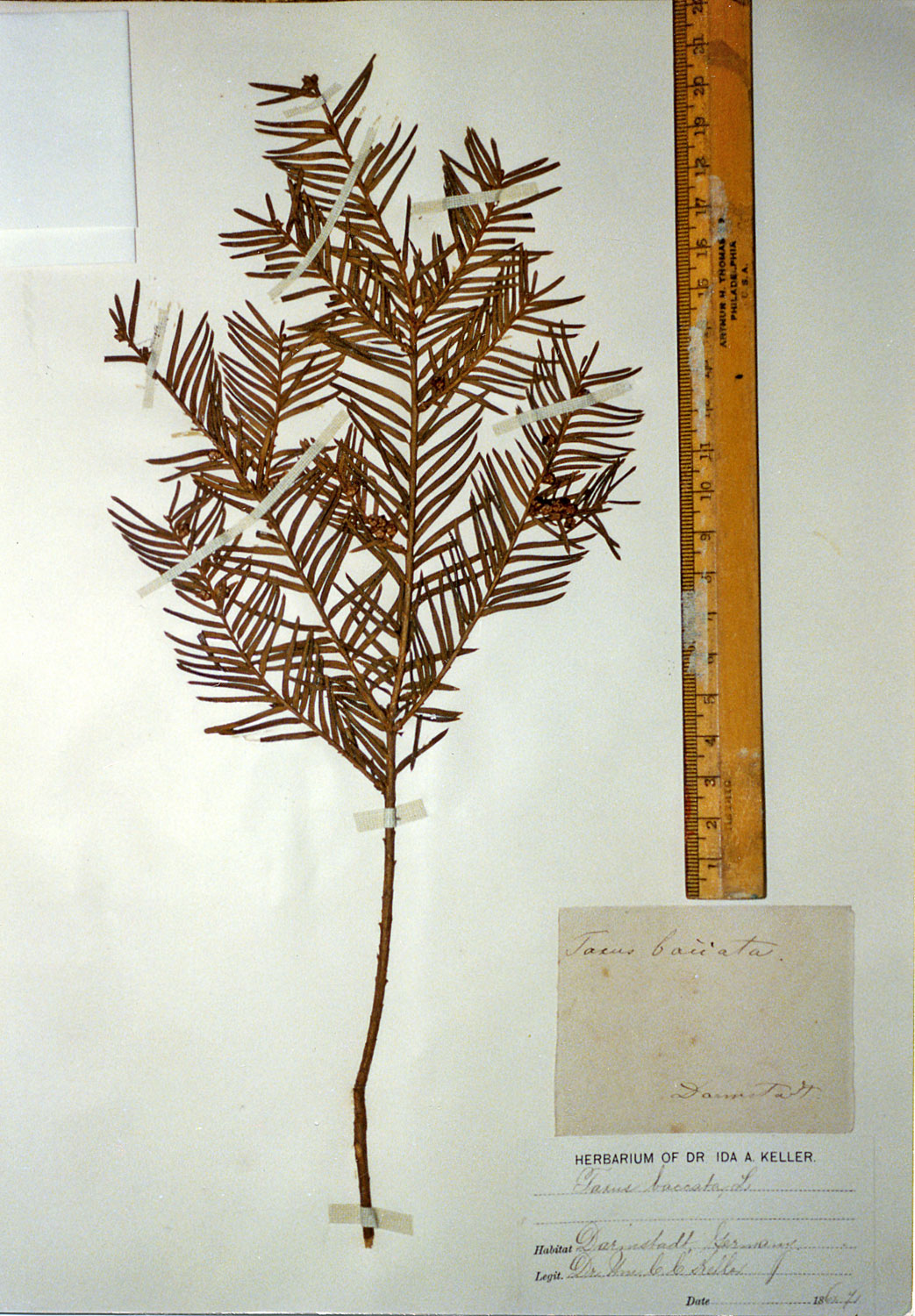
[Starkenburg Prov., Hessen] Darmstadt, Keller (PH). Illustration indicates abaxial leaf margin lacks papillae across 4 cells followed by 16 rows of papillose cells, a stomata band with 7 rows of stomata, and an obscurely papillose midrib 15 cells across. |
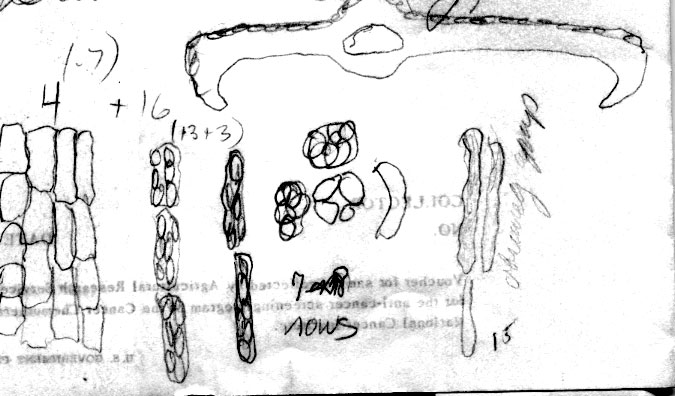
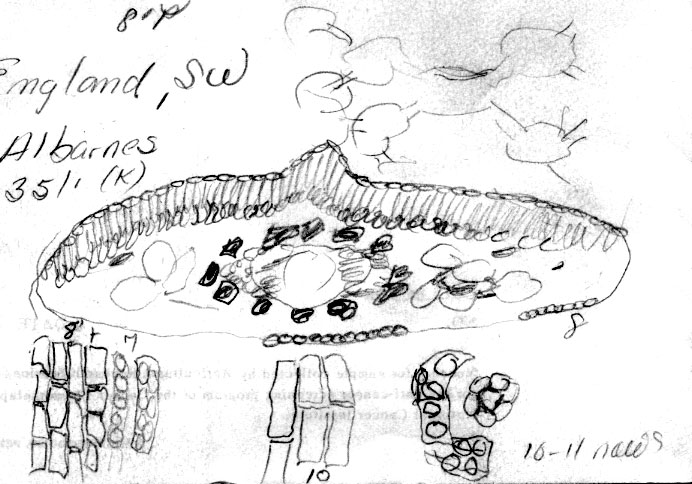
Dorset, Lytchett Matrager, spreading tree, churchyard, 350 ft, Albarnes 35/1: 025 (BM). Illustration indicates abaxial leaf margin lacks papillae across 8 cells followed by 7 rows of papillose cells, a stomata band with 10–11 rows of stomata, and an obscurely papillose midrib 10 cells across. |
Reproduction of a photograph in the Linnaean Herbarium, London, Catalogue no. 1199.1, Taxus baccata.
United Kingdom, Oxford |
|
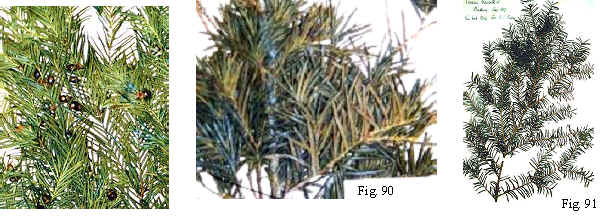
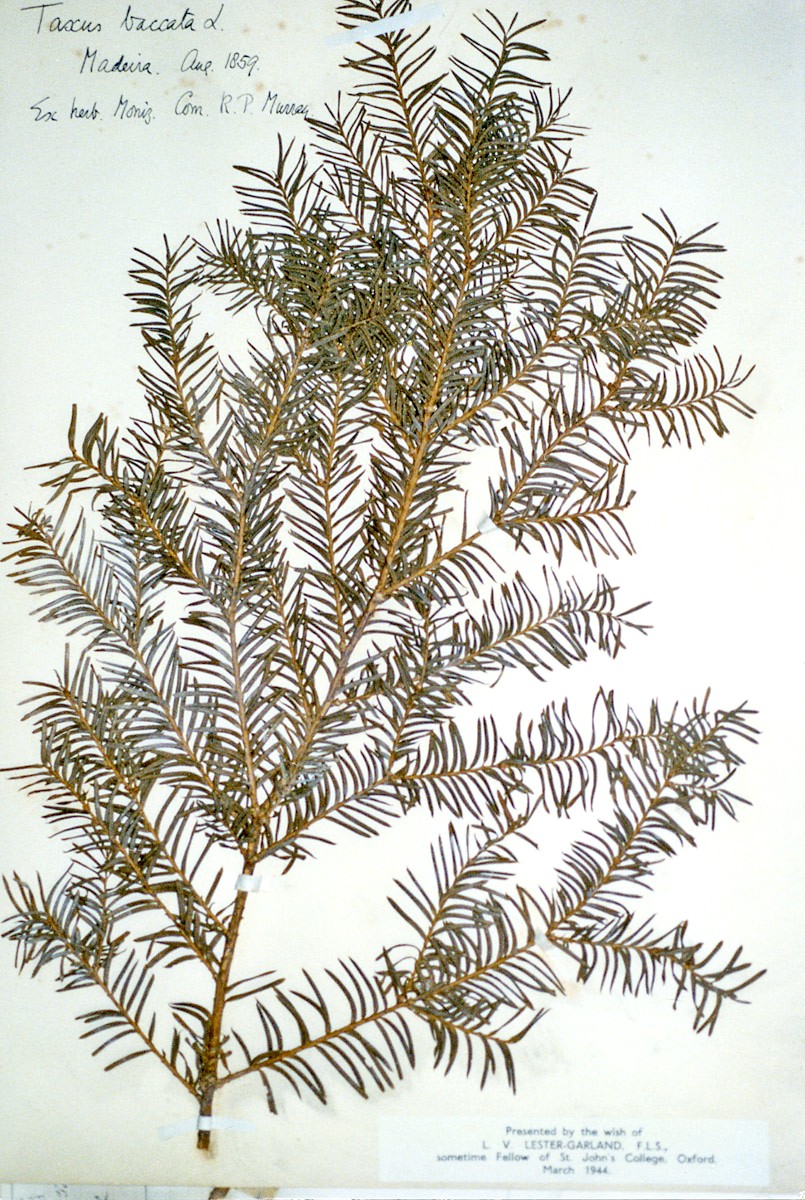
19c. Taxus recurvata var. linearis (Carrière) Spjut (Figs. 89–91), comb. nov. proposed. Taxus baccata [var.] linearis Carrière, Traité gén. Conif. 738. 1867. Taxus baccata f. linearis (Carrière) Beissner, Handb. Nandelholzk. 175. 1891. Reported to occur naturally in the Tatra Mountains (den Ouden & Boom 1965; Krüssmann 1985). Original material unknown. Neotype Proposed—England: Leicestershire , Charwood Forest, in mixed woodland—7 Sep. 1933, Turrill 4903 at K! Branchlets often long, pendulous, dichotomously divided, or with dichotomous divisions subpinnately arranged along a branch, the branchlets mostly of equal length, pale reddish orange or purplish with age; persistent bud-scales dark reddish brown, ca. 1 mm long, spreading with age. Leaves persistent on older branchlets, linear, twisted, falcate, 1–4 cm long, 1–2 mm wide, 150–350 µm thick, dark green and convex above to a rounded midrib that is channeled along base, pale yellowish green and concave below to a rounded midrib, abruptly revolute near margins except in specimen from Turkey, increasingly towards apex in upper one-third of leaf, abruptly tapered and slightly reflexed to an obtuse apex; upper (adaxial) epidermal cells in T-sect. elliptical, 10–15 µm tall, 25–40 µm wide; lower nonstomata epidermal cells smaller in diam., 8–12 µm tall, 10-20 µm wide, numbering (6-) 11–20 between margin and stomata band, mostly rectangular, 2–4× l/w except short rectangular in 1–3 rows near margins, papillose across ½ -¾ of the marginal zone, smooth on 4–5 (-10) rows of cells nearest the margins, usually with obscure papillae on midrib in 1–2 opposite or alternate rows on each cell; stomata 8–10 rows/band. Male bud cones globose ca. 1 mm diam., mature cones not seen. Seed maturing 1st yr branchlets, globose to subcylindric or short conical, 4 mm long, 2–4 mm diam., pale to reddish brown. Narrow-leaved yew. Distribution: Europe (Maderia, England, Germany, Hungary, Bulgaria, Austria), SW Asia (Syria, Turkey).
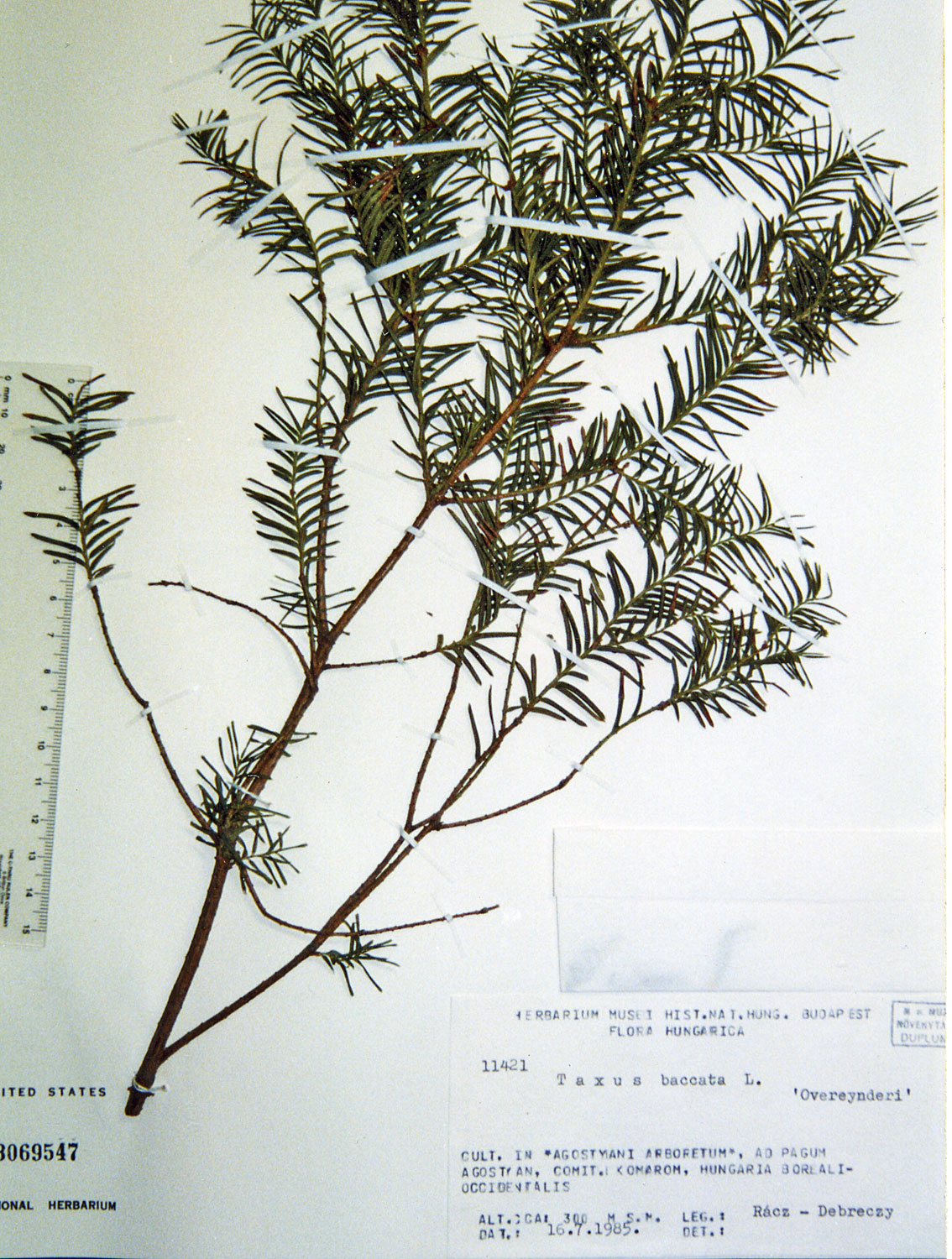
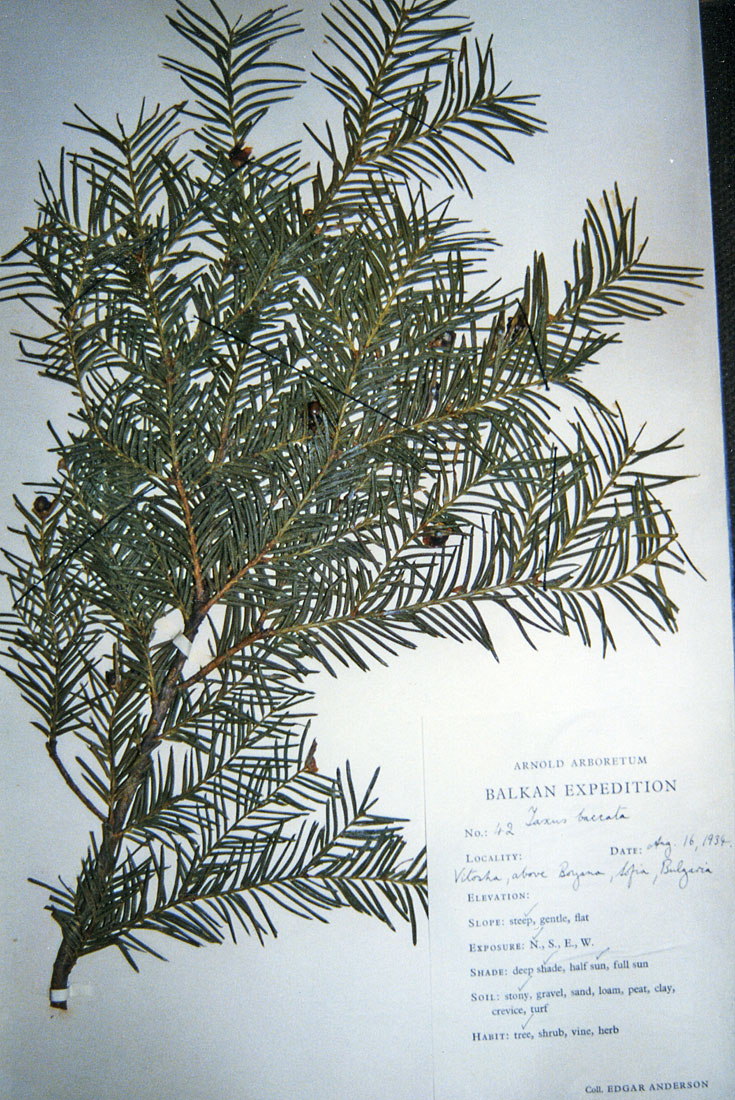
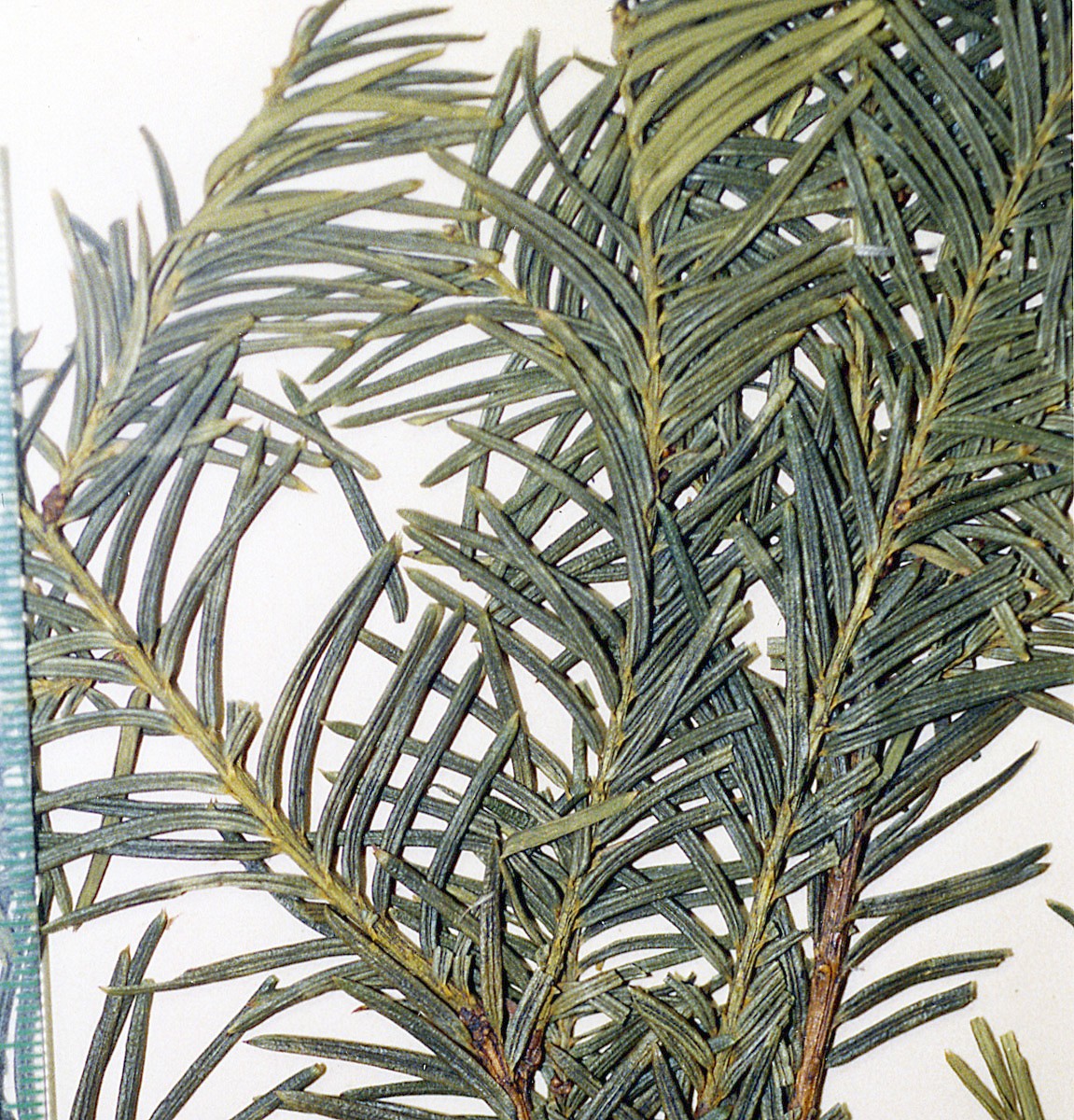
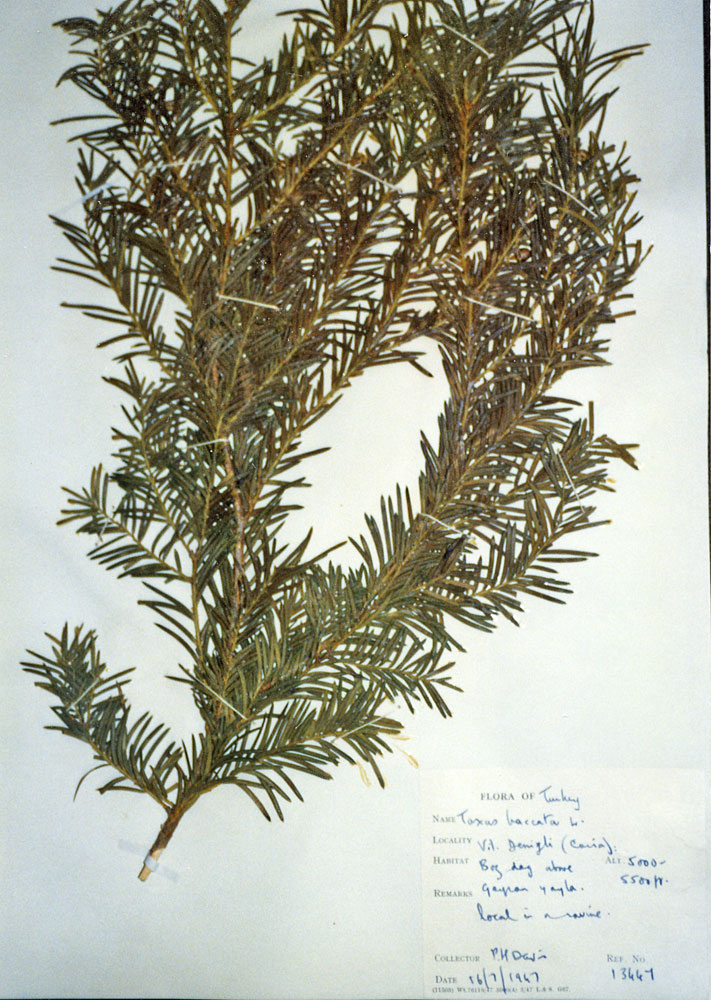
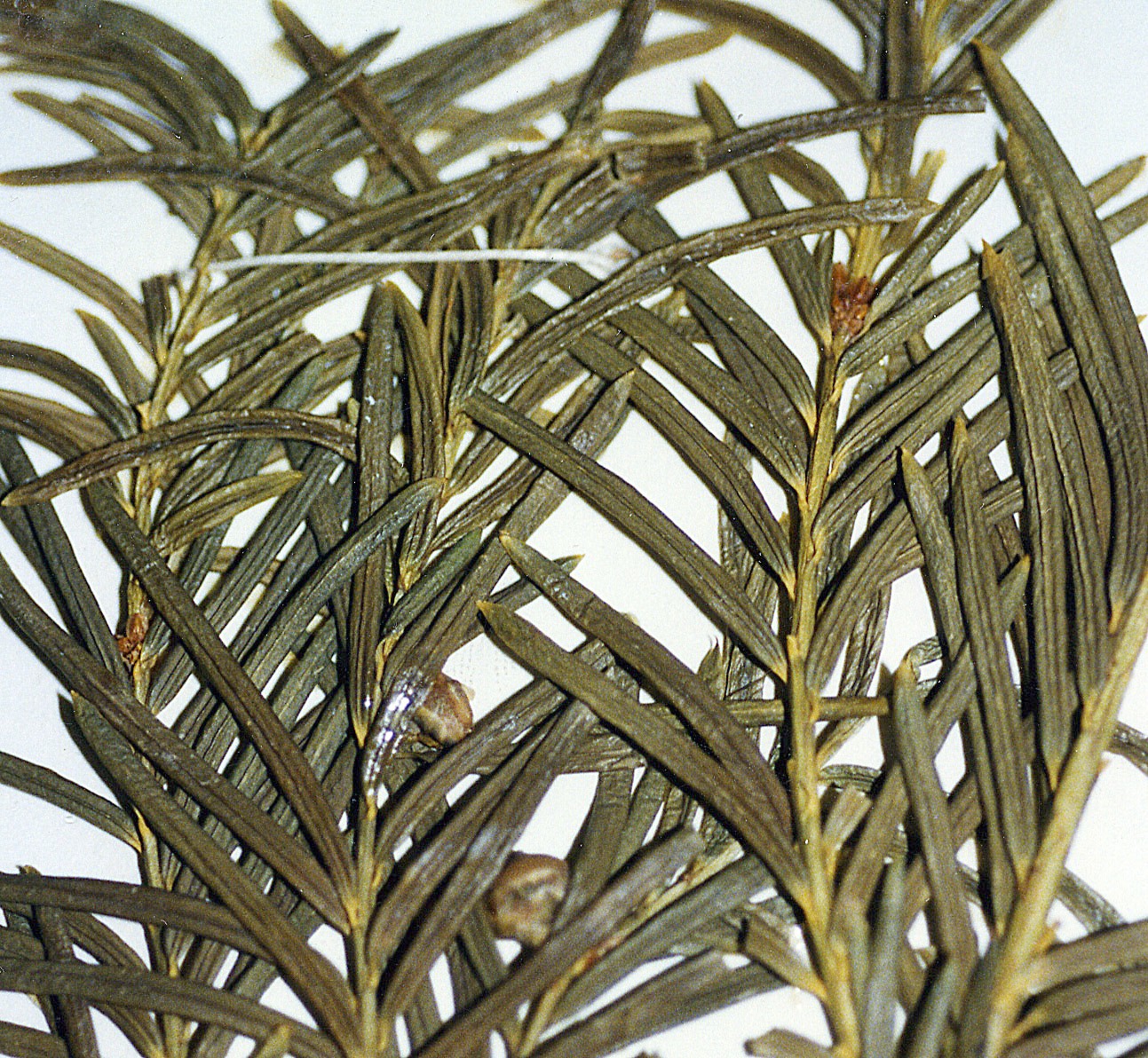
Taxus recurvata var. linearis is identified by the long narrowly linear leaves that twist away from the axis of branchlets as they spread in ±two ranks. It is related to T. recurvata var. recurvata by the leaves appearing strongly convex on the adaxial surface, by the sharp contrast in color between the upper and lower leaf surfaces, dark green above, yellowish below, and by the crisscross leaf arrangement. The phyllotaxy is similar to T. biternata, which differs by the anisodichotomous branching and by the reflexed leaf blades. Taxus baccata var. washingtonii is also very similar and difficult to distinguish; the uppermost leaves of var. linearis do not overlap the branchlet at the base of their blade; thus, the branchlets of var. linearis appear mostly pendulous in contrast to horizontal branchlets of T. biternata and T. baccata var. washingtonii. A specimen collected by Davis from Turkey differs in leaf anatomy and seed characters. Its leaves in transverse section appear thick and rounded along margins as in T. contorta, and like T. contorta its leaf mesophyll has numerous spherical oil cells that, however, were mostly clear instead of reddish as usually preserved in specimens of that species. Unlike T. contorta, leaves are less papillose across the abaxial margin and midrib areas, while the phyllotaxy and the development of leaf stomata in 8 rows indicate a close relationship to T. canadensis. Two seeds that were attached to 1st yr branchlets had a short subconical shape, abruptly tapering to an umbo; this compares with T. umbraculifera var. microcarpa. Perhaps, this specimen is a hybrid between T. canadensis and T. contorta. Representative Specimens—Portugal: Madeira ex Herb. Moniz (K). Hungary: 'Overeynderi', ex Herb. Mus. Hist. Nat. Hung. Budapest, 11421 (US). Austria: Salzburg, Hayer (S: C-2034). Romania: Balkan Exped., Cazan Pass, E. Anderson 102, see Arn. Arb. Harvard Univ. Bull. 35: Series 4, Vol. 3: (K). Bulgaria: Sofia, Vitorh, Anderson 42 (K). Turkey: VA. Jenigli (Caira), 5000-5500 ft, Davis 13667 (K). Syria: Düldül, Mt. Amanos, 5000–7000 ft, Haradjan (K, S).
|
||
|
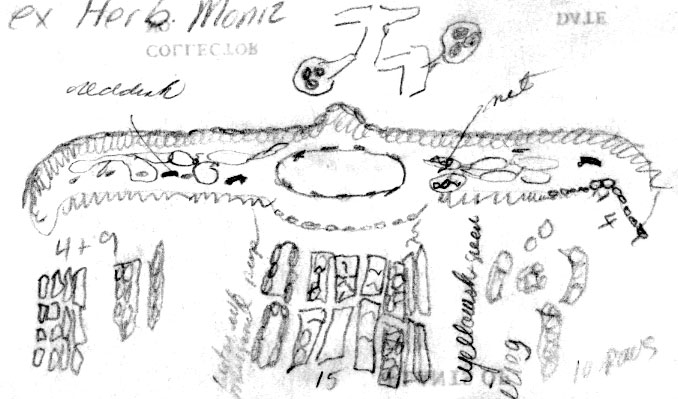
Portugal: Madeira, yr 1859, ex Herb. Moniz (K). Illustration indicates abaxial leaf margin lacks papillae across 4 cells followed by 9 rows of papillose cells, a stomata band with 10 irregular rows of stomata, and a yellowish partially papillose midrib of 15 cells across. Parenchyma cells with enlarged reddish vesicles are drawn separately above the leaf x-section. They are indicated to be reddish in color. |
Hungary-Cultivated: cv. 'Overeynderi', ex Herb. Mus. Hist. Nat. Hung. Budapest, 11421 (US). |
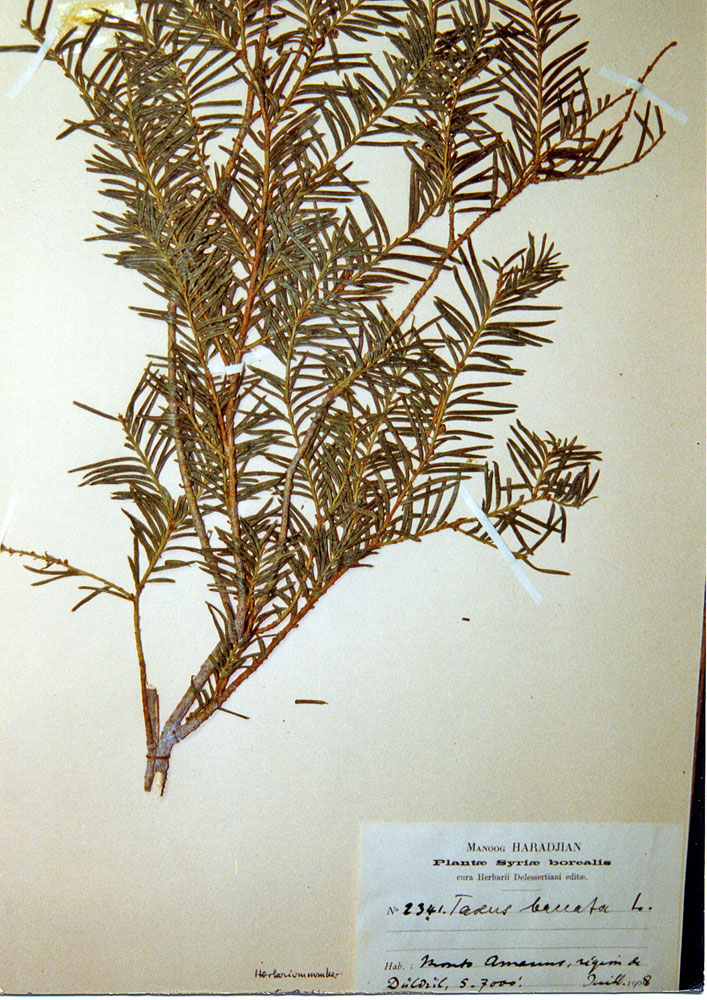
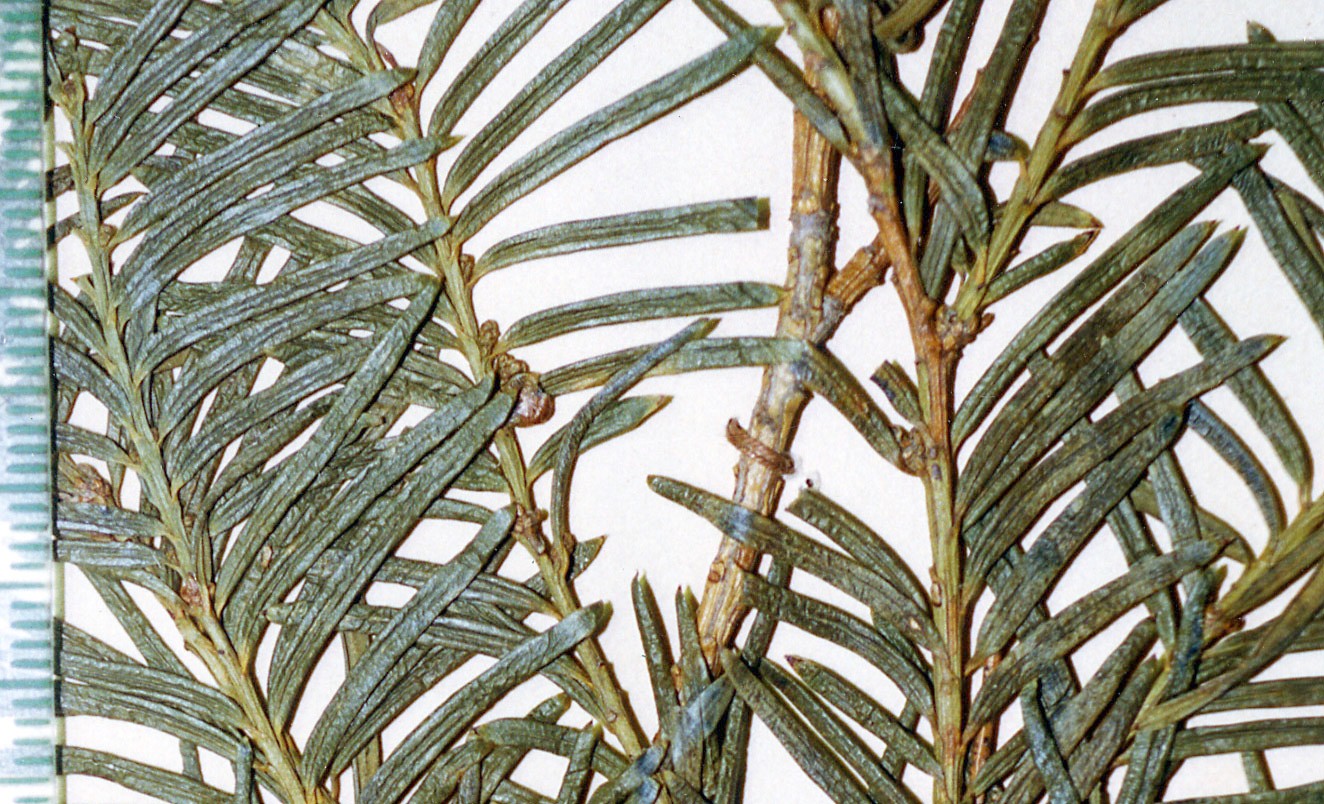
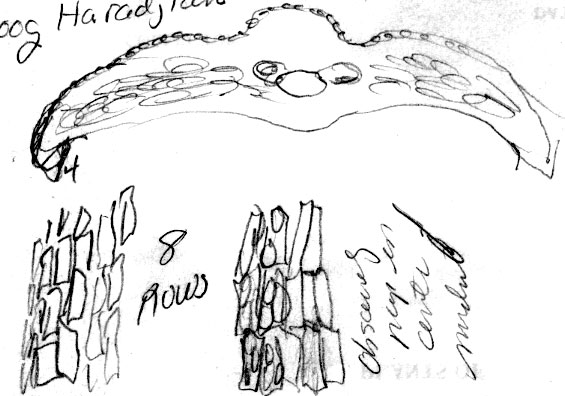
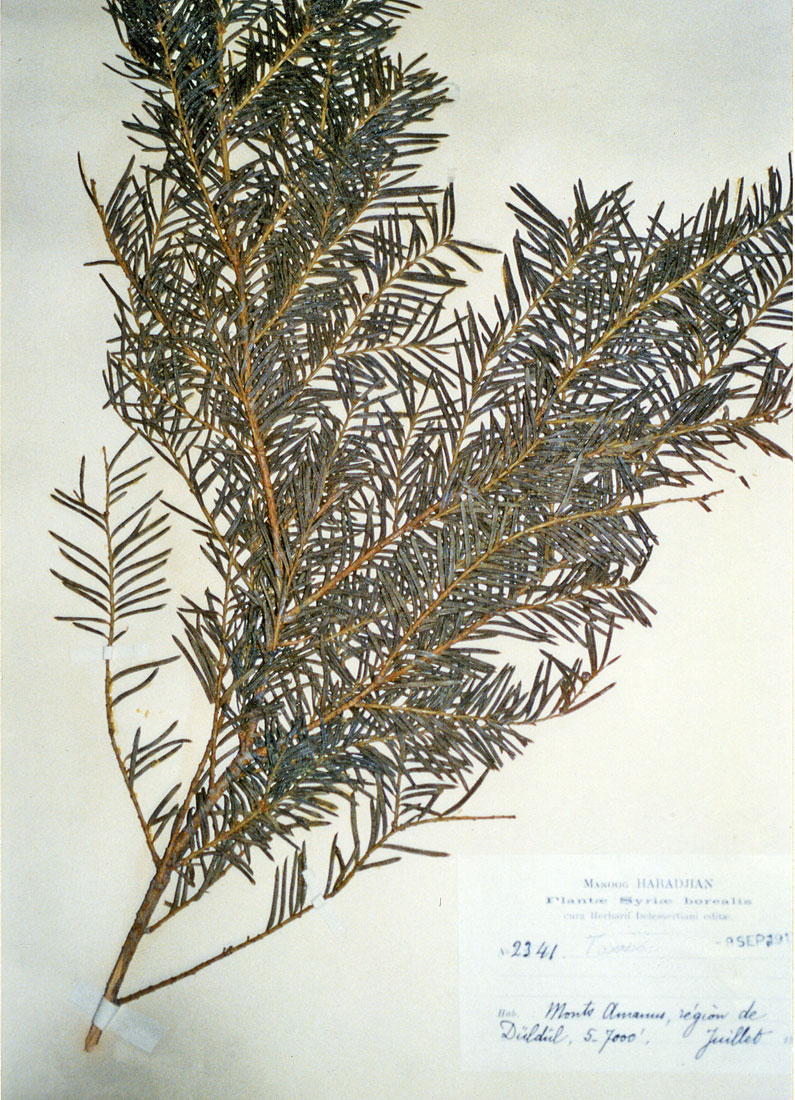
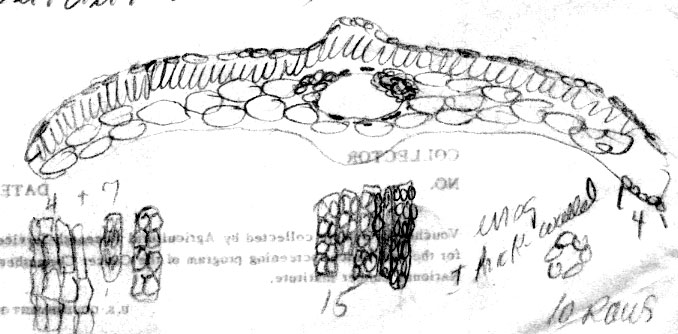
Syria: Düldül, Mt. Amanos, 5000–7000 ft, Haradjan (K-bottom, S-top). Illustrations indicate abaxial leaf margin lacks papillae across 4 cells followed by 7 rows of papillose cells, a stomata band with 8 or 10 irregular rows of stomata, and a partially to entirely papillose midrib of 15 cells across. |
|
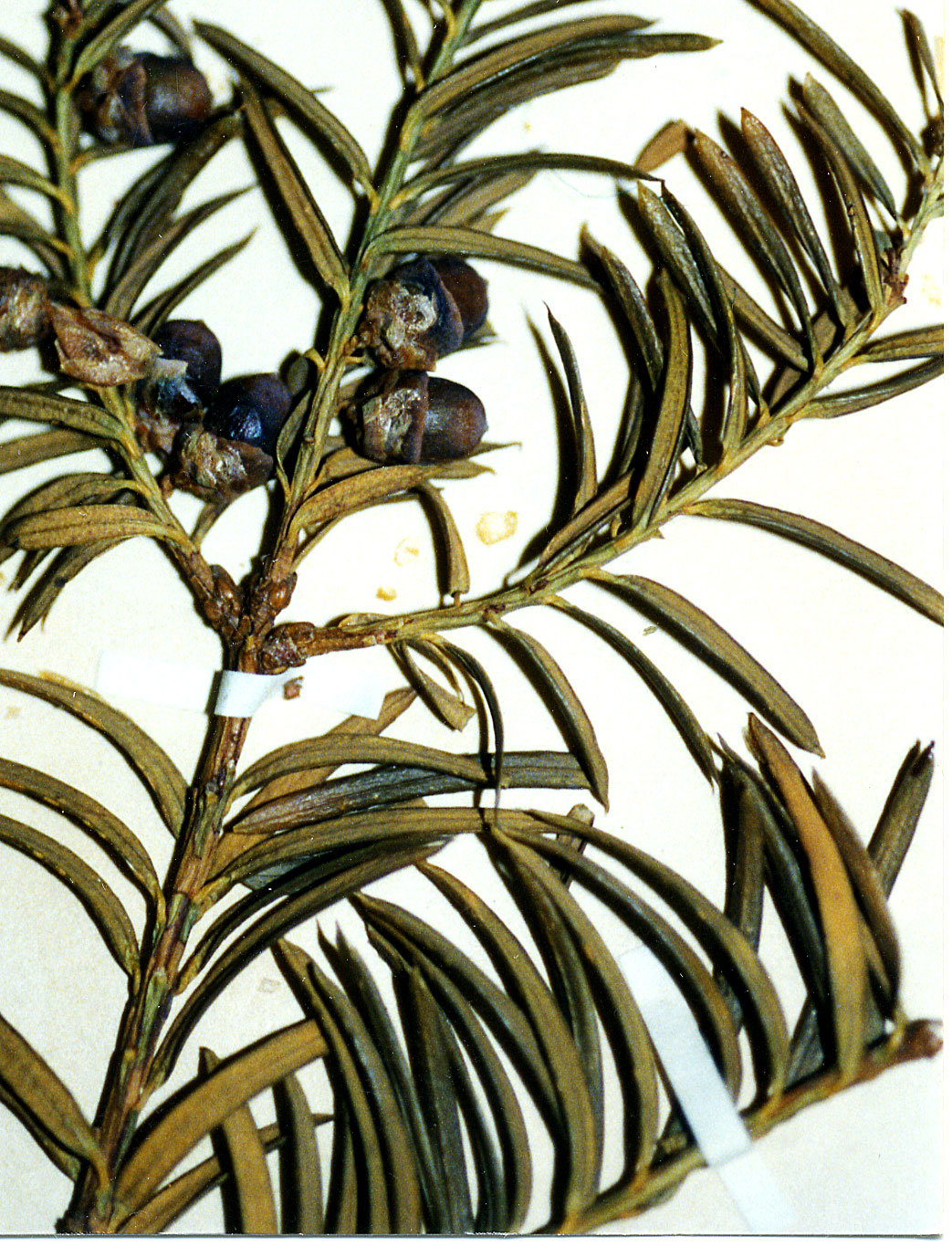
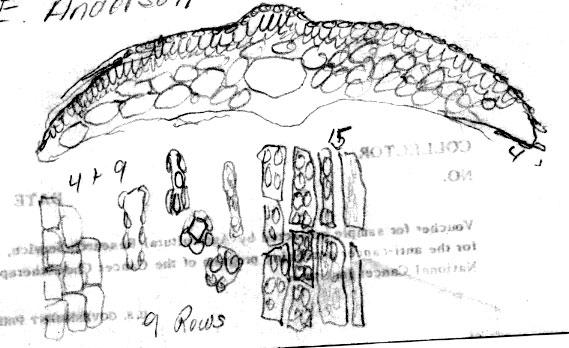
Bulgaria: Sofia, Vitorh, Anderson 42 (K). Illustration indicates abaxial leaf margin lacks papillae across 4 cells followed by 9 rows of papillose cells, a stomata band with 9 rows of stomata, and a partially papillose midrib of 15 cells across. |
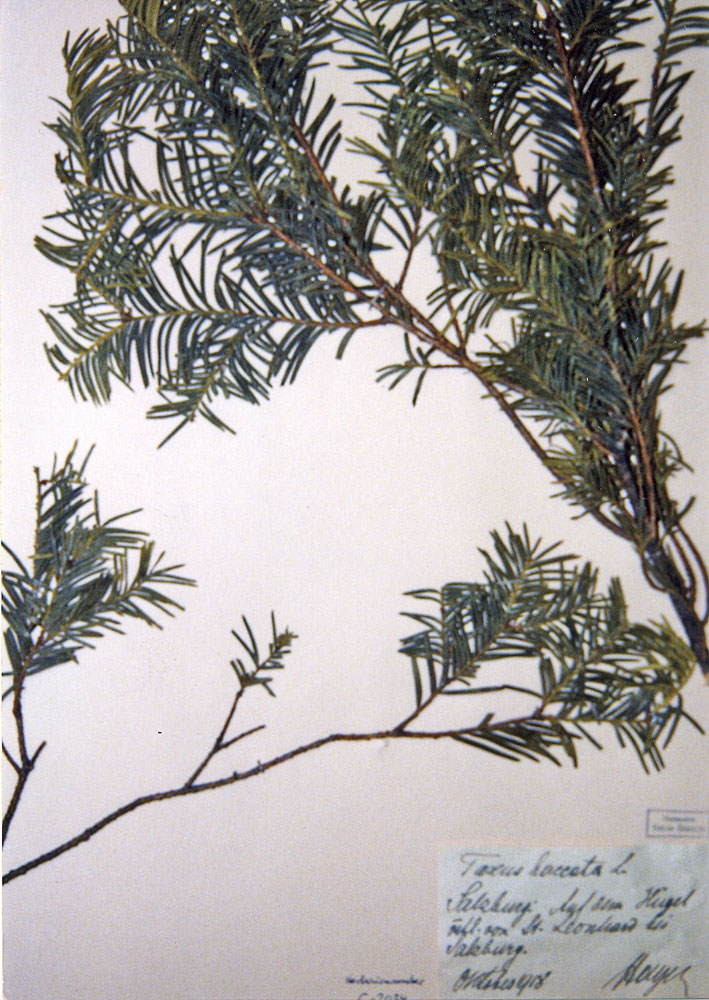
Austria: Salzburg, Hayer (S: C-2034). Illustration indicates abaxial leaf margin lacks papillae across 6 cells followed by 7 rows of papillose cells, a stomata band with 10 rows of stomata, and a mostly smooth midrib. |
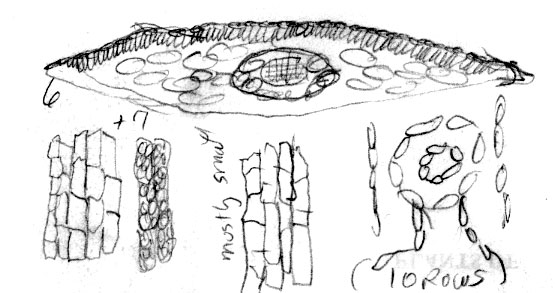
Turkey: VA. Jenigli (Caira), 5000-5500 ft, Davis 13667 (K). Illustration indicates abaxial leaf margin lacks papillae across 8–10 cells followed by 3 rows of papillose cells, a stomata band with 8 regular rows of stomata, and a smooth midrib 13 cells across. The leaf anatomical features suggest a hybrid between T. canadensis and T. recurvata or T. contorta. |