|
Ericameria bloomeri |
Ericameria cooperi |
|
|
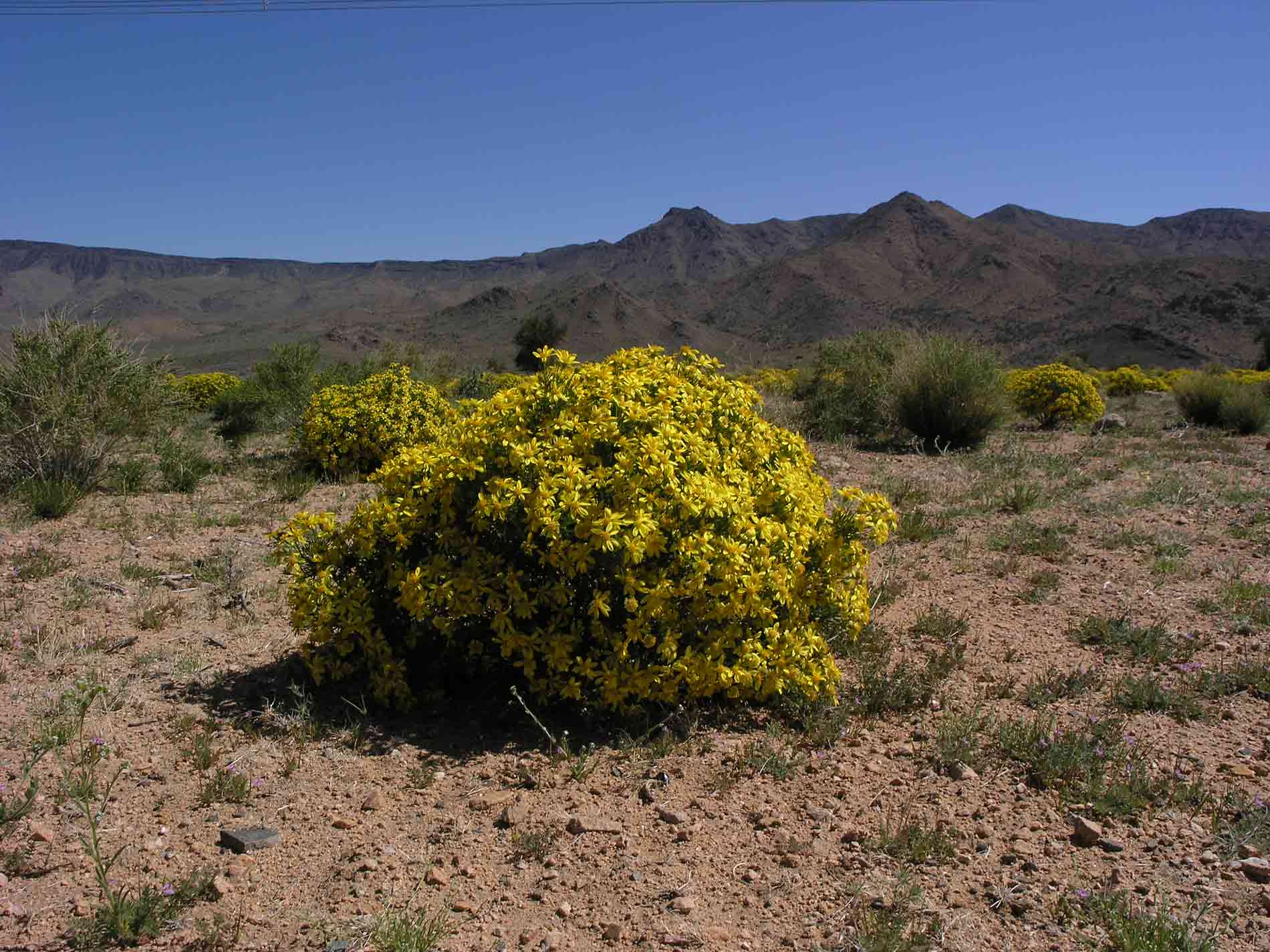
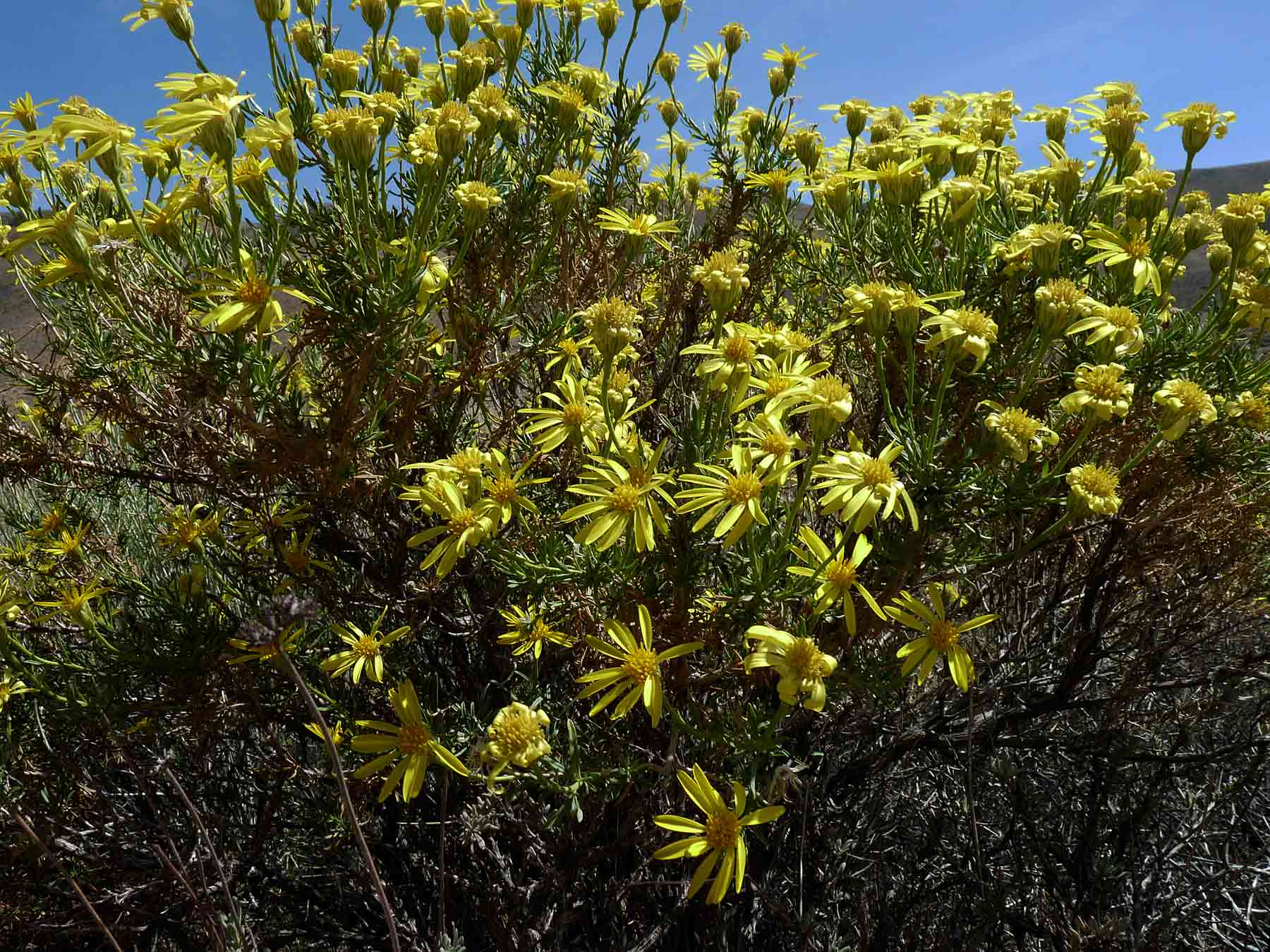
Ericameria cooperi |
Ericameria cooperi |
|
|
Ericameria cooperi
|
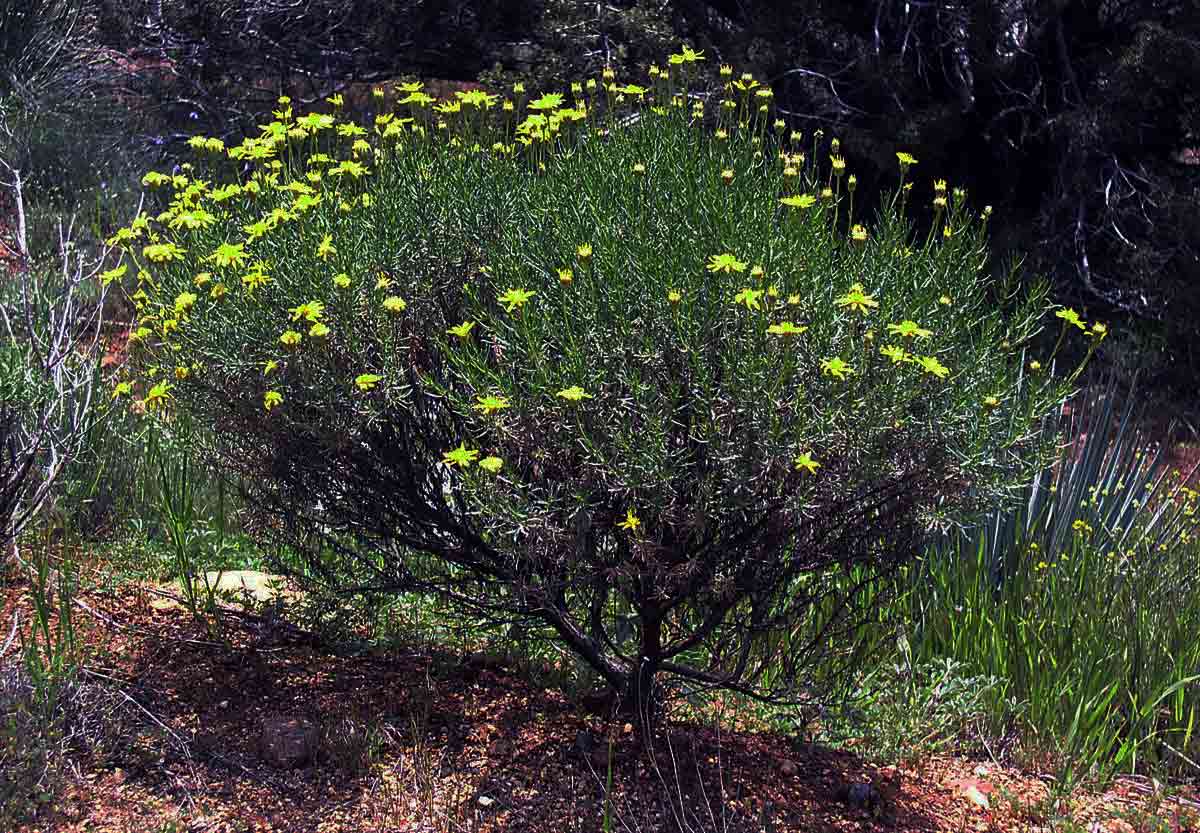
Ericameria cuneata var. spathulata
|
|
|
Ericameria laricifolia
|
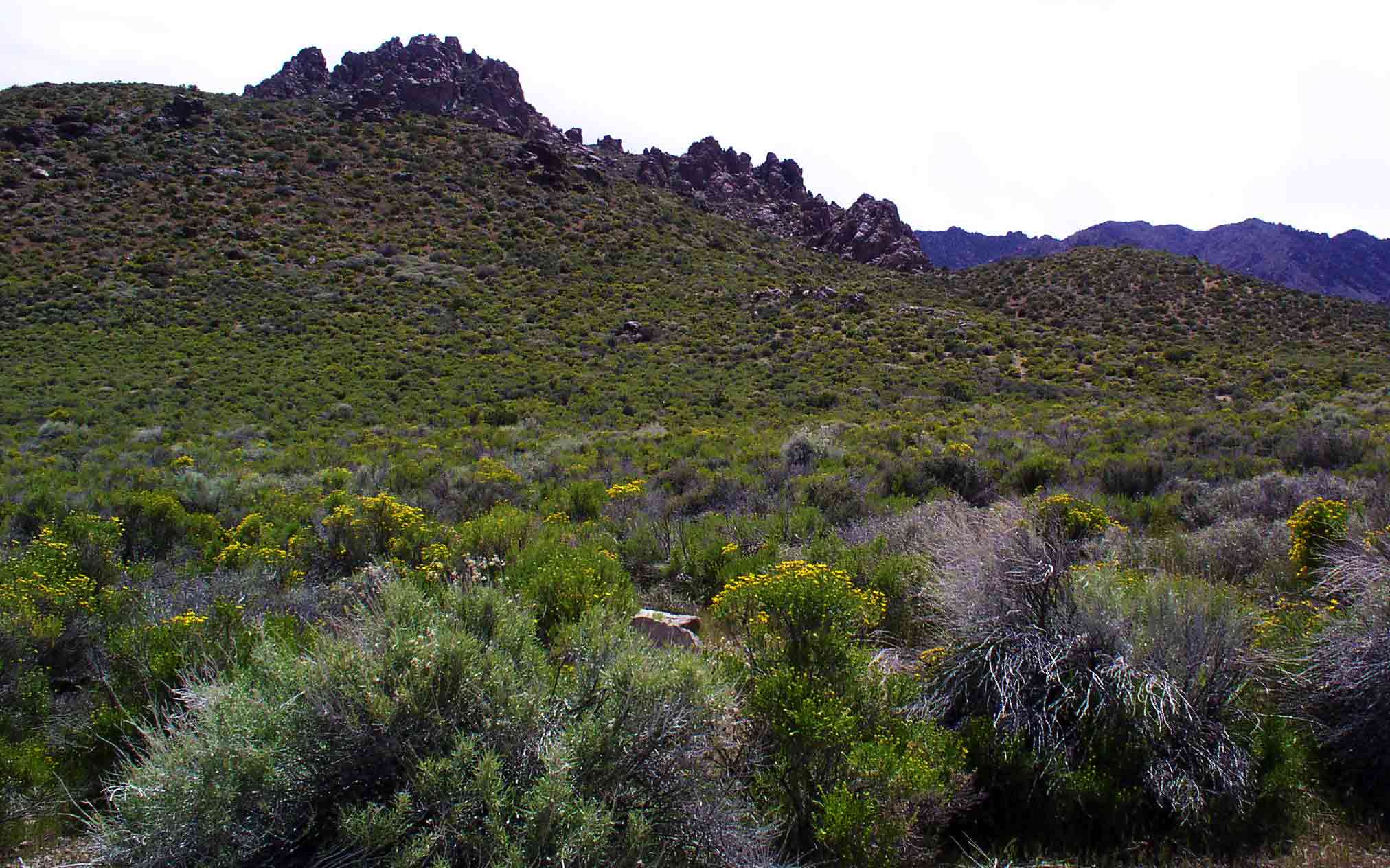
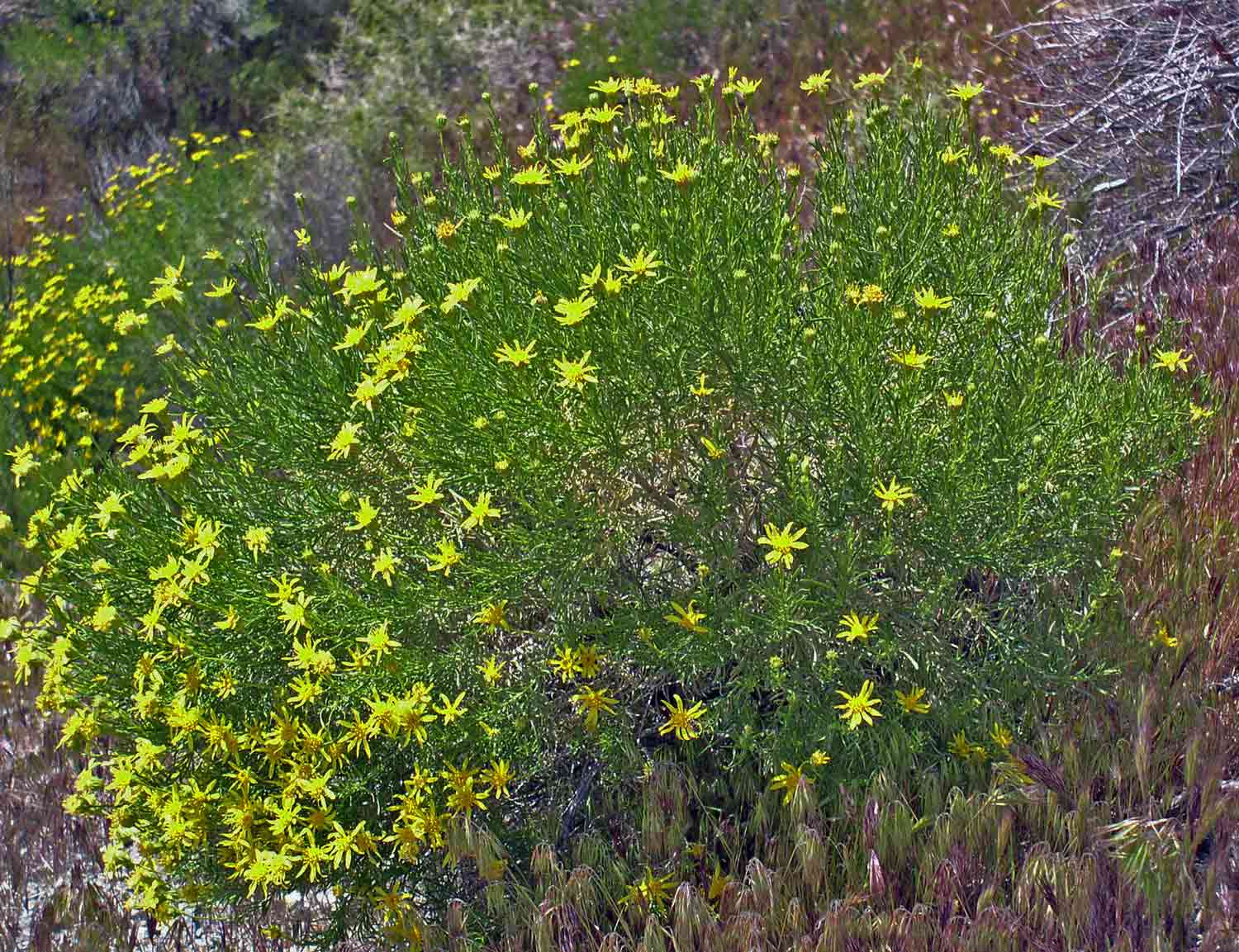
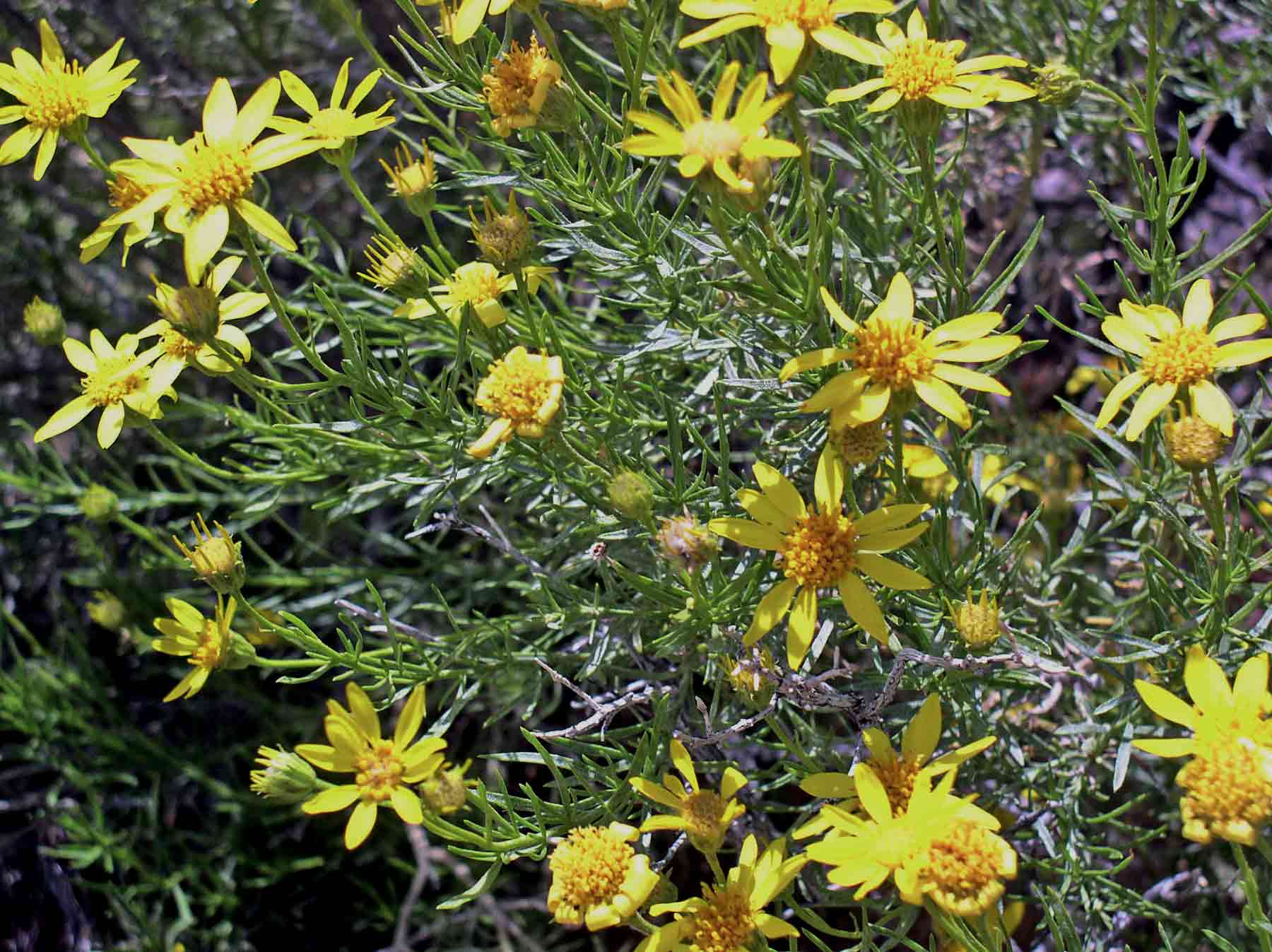
Ericameria linearifolia
|
|
|
Ericameria linearifolia |
Ericameria linearifolia
|
|
|
Ericameria linearifolia
|
Ericameria linearifolia |
|
|
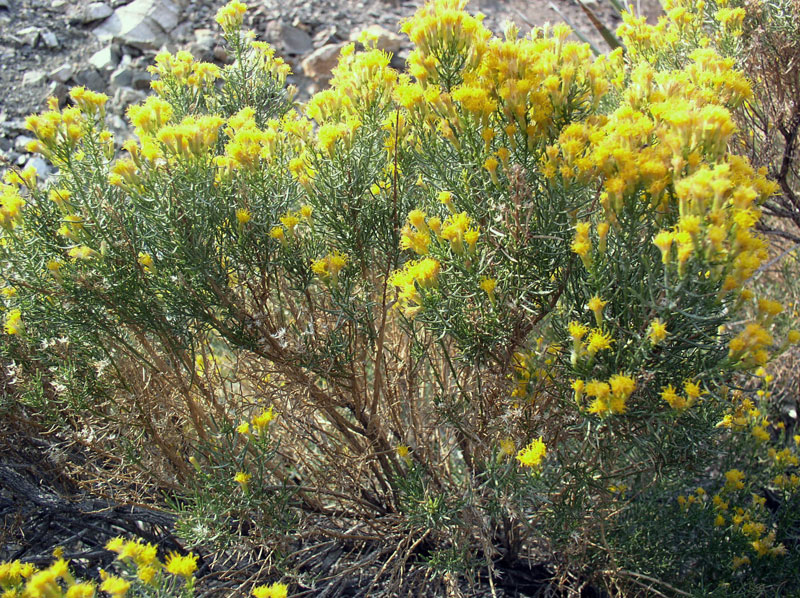
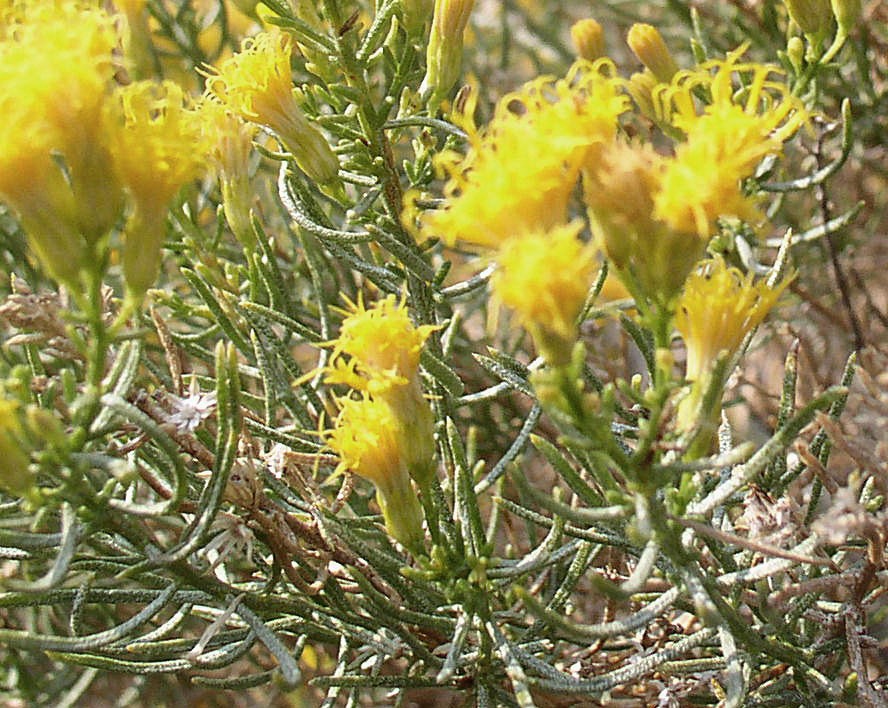
Ericameria paniculata |
Ericameria paniculata
|
|
|
Ericameria paniculata |
|
|
|
Ericameria teretifolia |
Ericameria teretifolia |
|
|
Trees and Shrubs of Kern County (Sep, Dec 2012) Ericameria Shrubs with entire alternate leaves, the leaves usually resinous or glandular pitted; involucral bracts variable, aligned in vertical ranks, or overlapping in one or more graduated series, often whitish or scarious along margins, or only green along the midrib, sometimes thickened or swollen near apex; cypselae with numerous long bristles bearing short barbs along each bristle; pericarpia relatively short in contrast to the longer bristles; 36 species recognized in the genus, 34 in western U.S. (Urbatsch et al. 2006, FNA: 20), 10 in Kern County. Key to Ericameria (excludes E. nauseosa placed in Chrysothamnus) 1. Leaves needle-like, narrow, stiff, thick or inrolled from margins (channeled)............... 2
1. Leaves flat or
folded lengthwise and upwards (keeled), or ribbon-like
2. Flower heads
closely subtended by leaves, often intergrading into involucral
2. Flower heads
usually on branchlets with shorter leaves distant and
3. Flowers yellow; rim of Kern Plateau............... .......................... Ericameria bloomeri 3. Flowers white; Indian Wells Valley................................................ Ericameria albida
4. Young leaves mostly curved or arched upwards along the blade............................... 5
4. Young leaves
curved downwards near apex, but may ascend upwards
5. Leaves spreading
<60⁰,
mostly upcurved, or straight to flexed, or 5. Leaves spreading >60⁰ and/or curved along the blade upwards, <3.5 cm................. 6
6. Leaves 0.3–1.5 cm,
involucral bracts flat, green with hyaline margins;
6. Leaves 1.0–3.5 cm,
involucral bracts with a swollen gland near
7. Leaves curved
downward (arched) from near the stem; flower heads
7. Leaves curved
downwards near apex, sometimes also arched, especially
8. Flowering in the
spring; flower heads solitary on a terminal
8. Flowering in the
summer to fall; flower heads crowded terminally
9. Leaves widest near
the mid region, recurved and narrowed
9. Leaves widest near
apex, not recurved, abruptly tapered to a
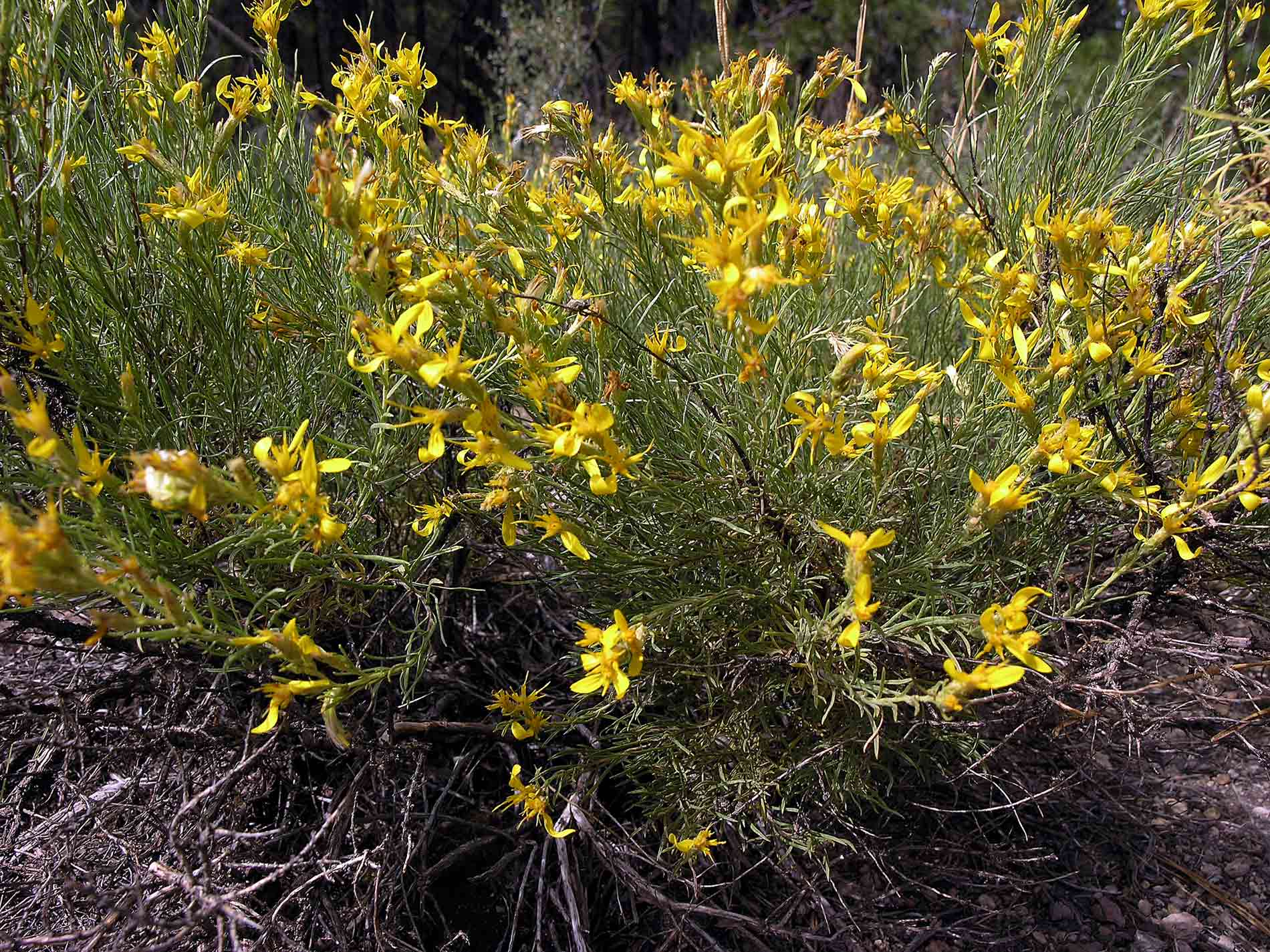
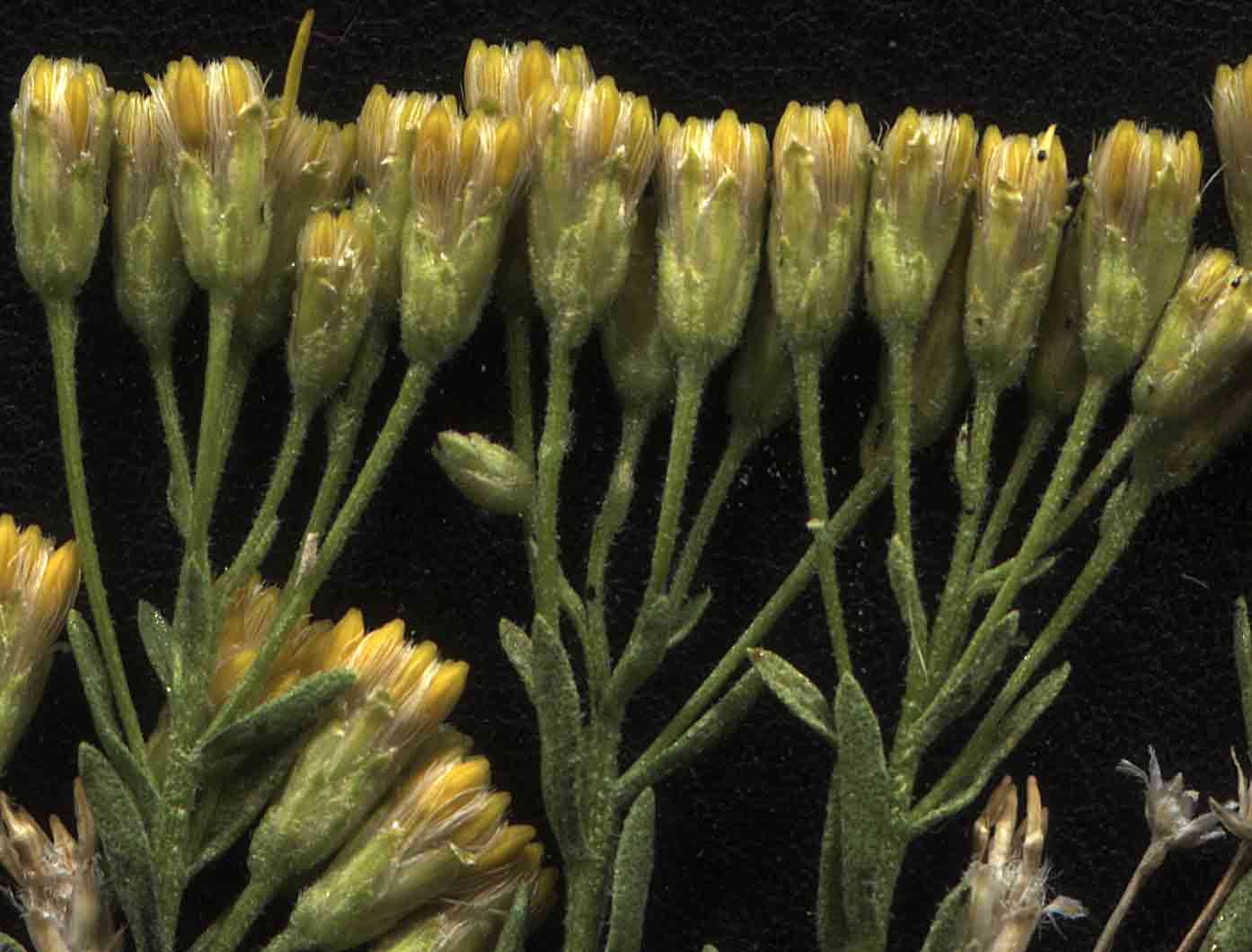
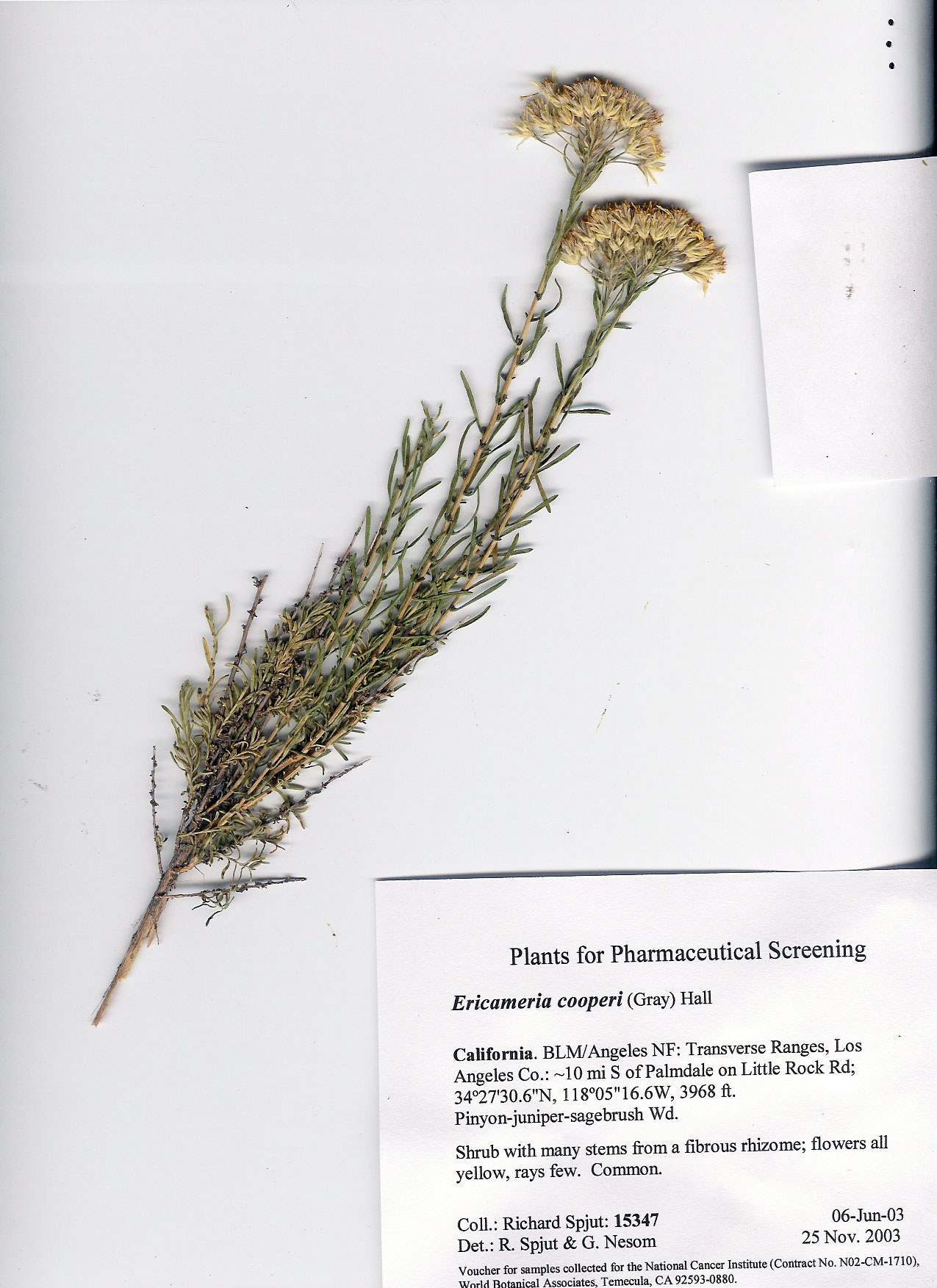
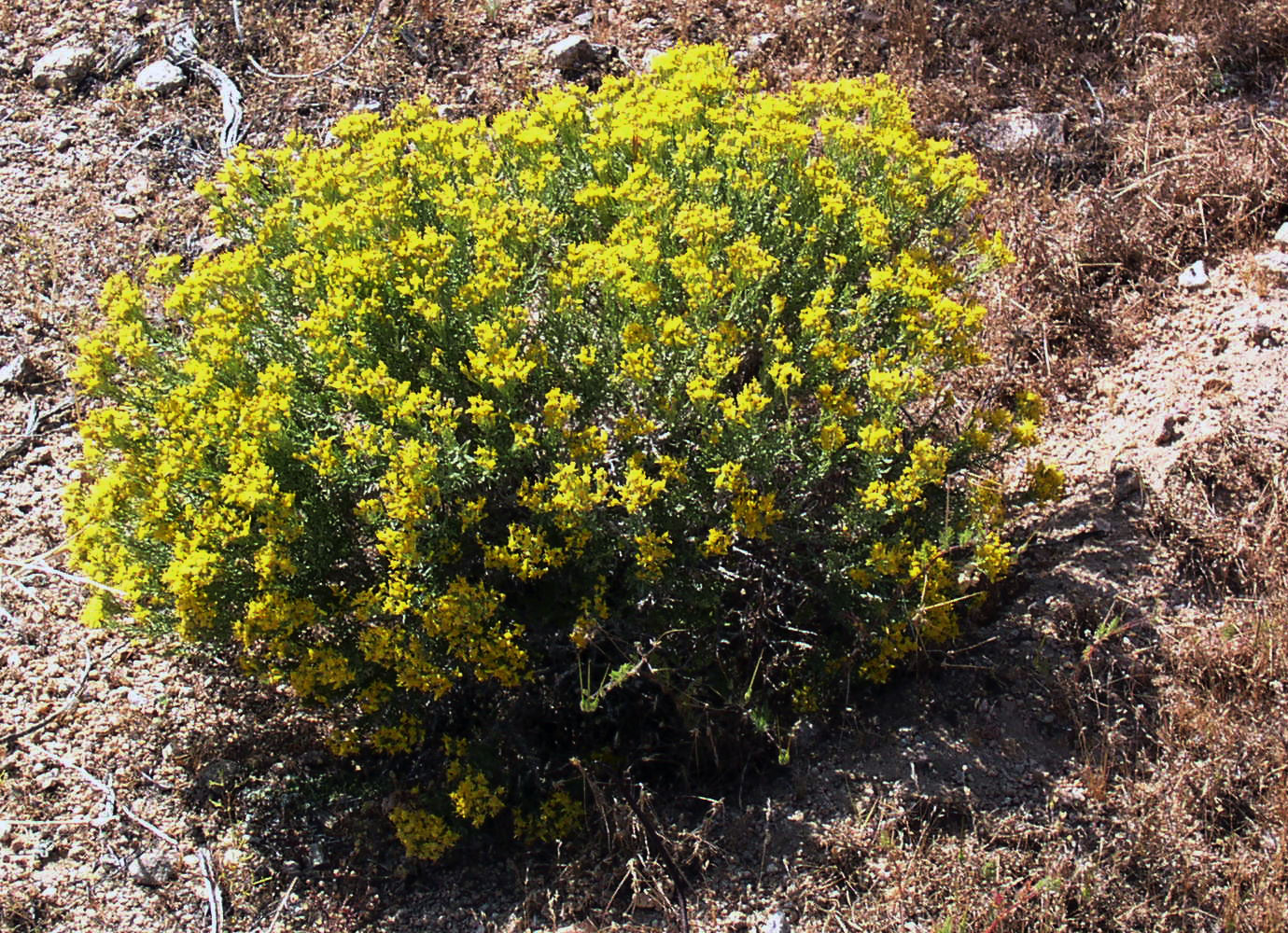
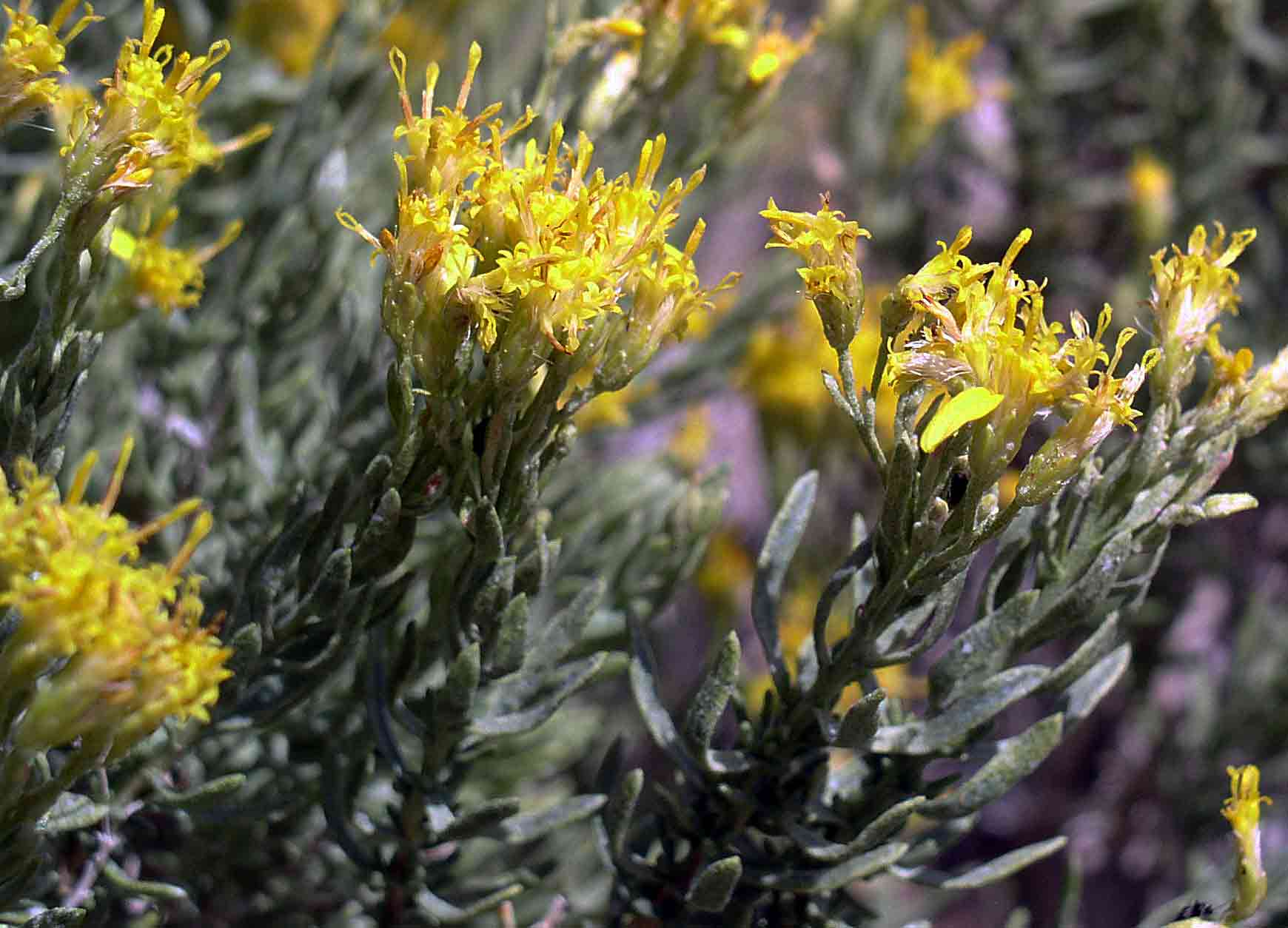
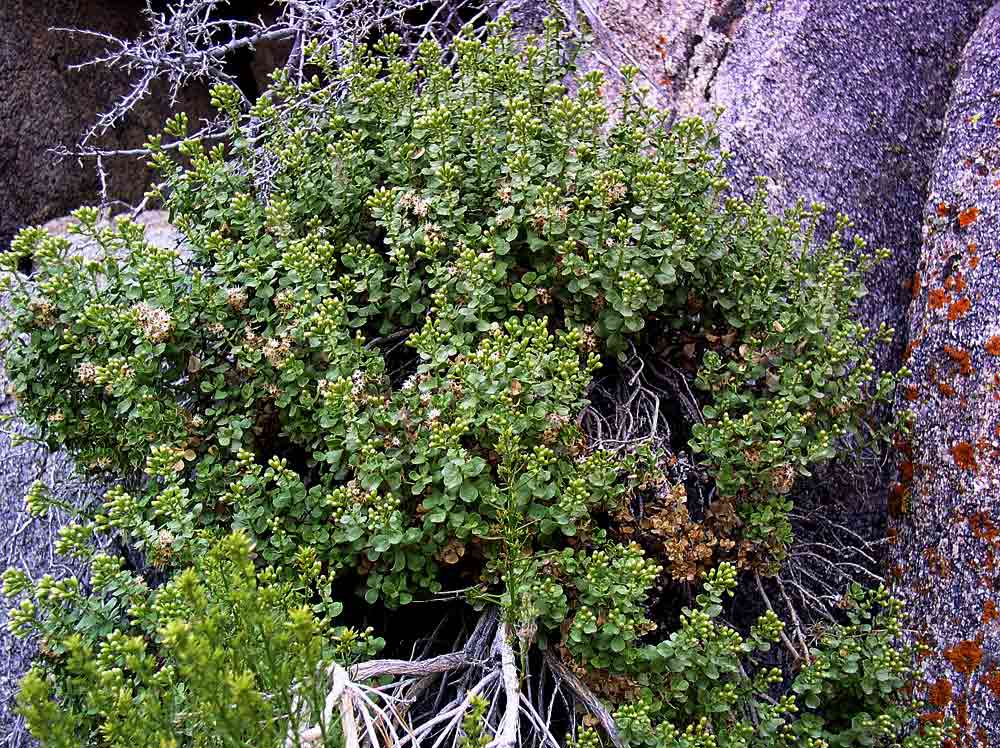
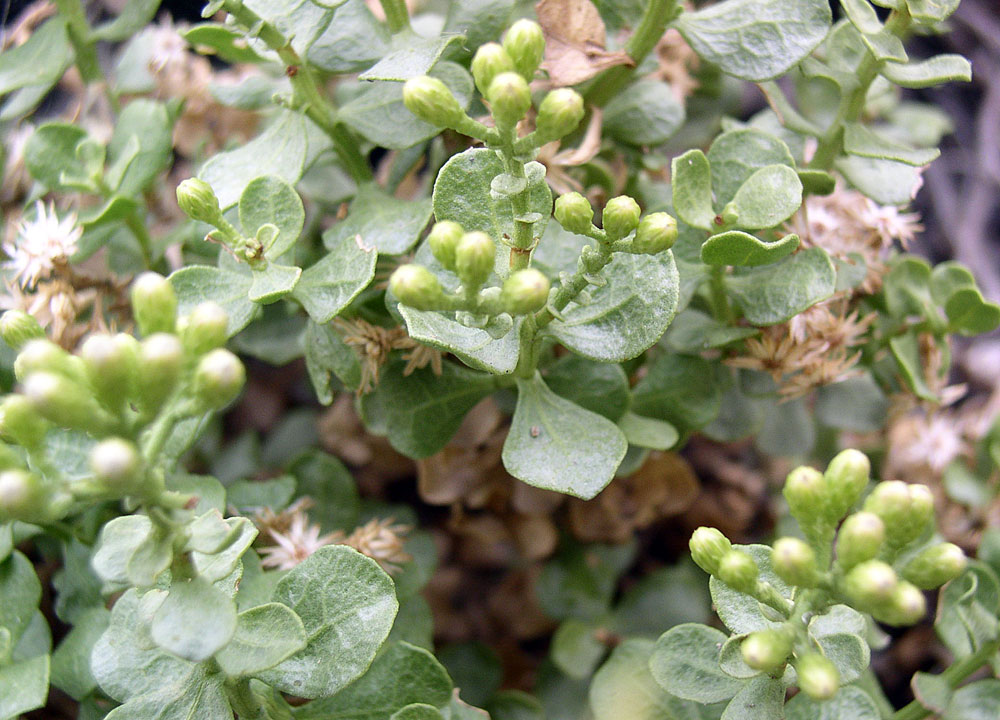
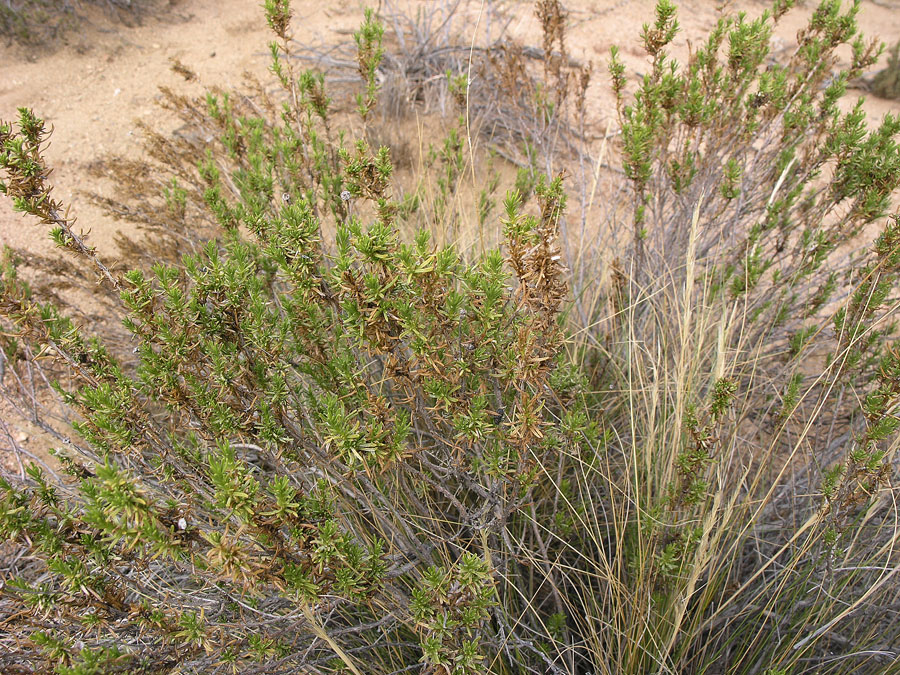
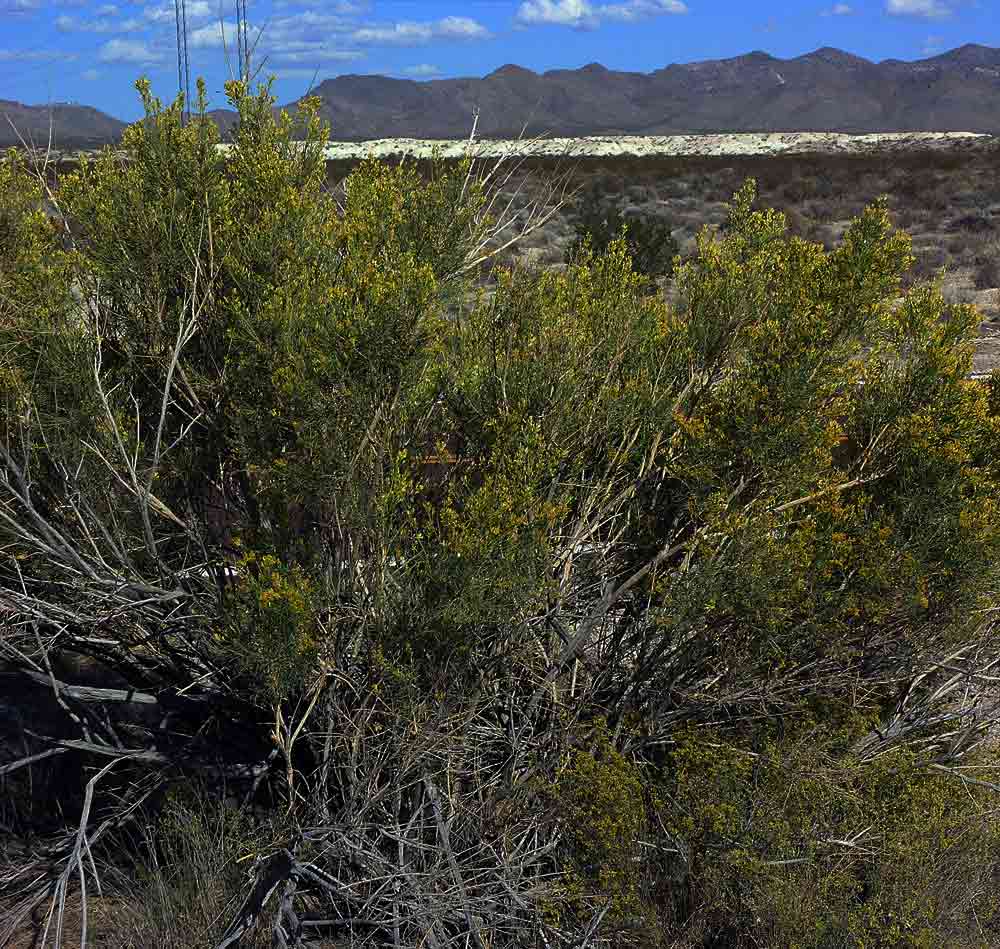
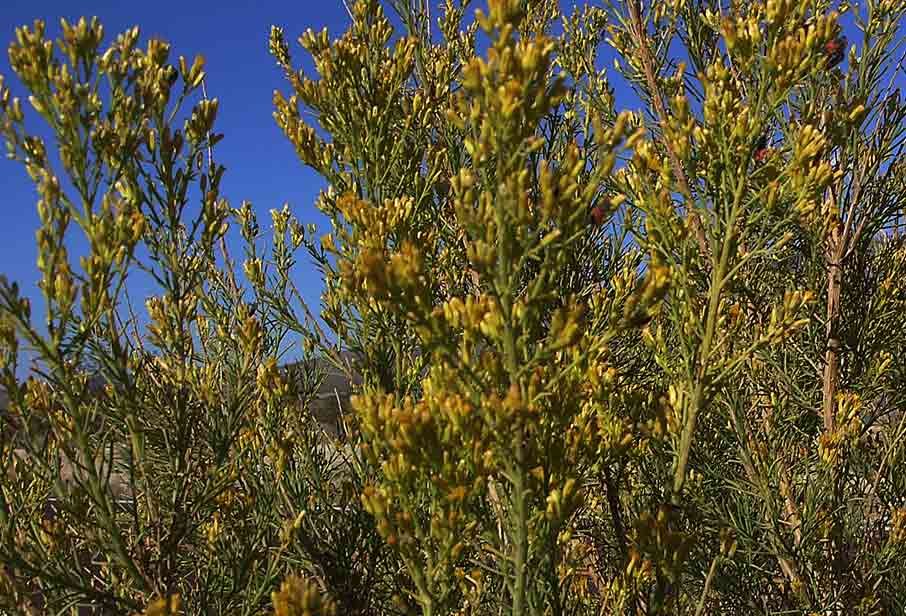
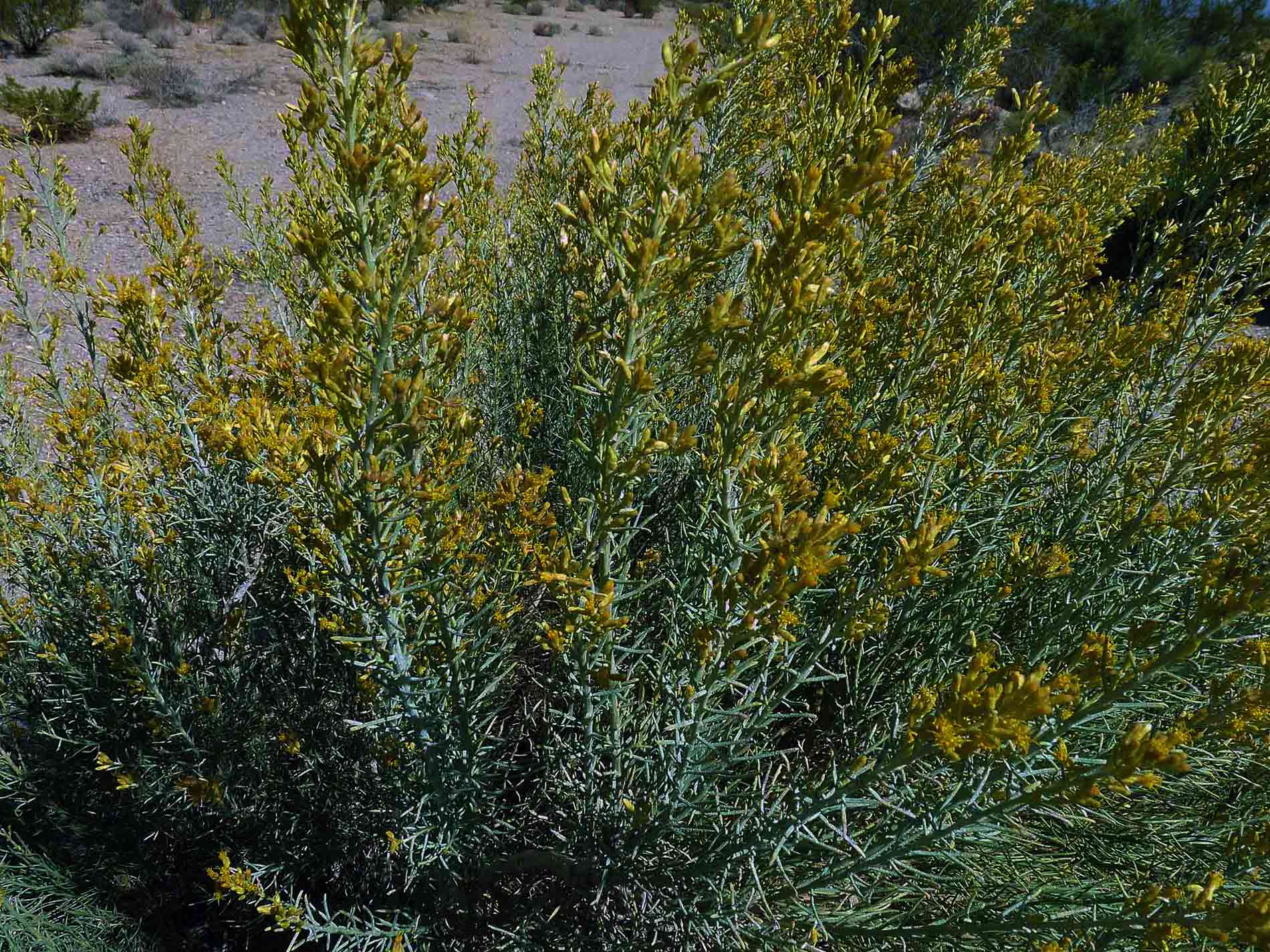
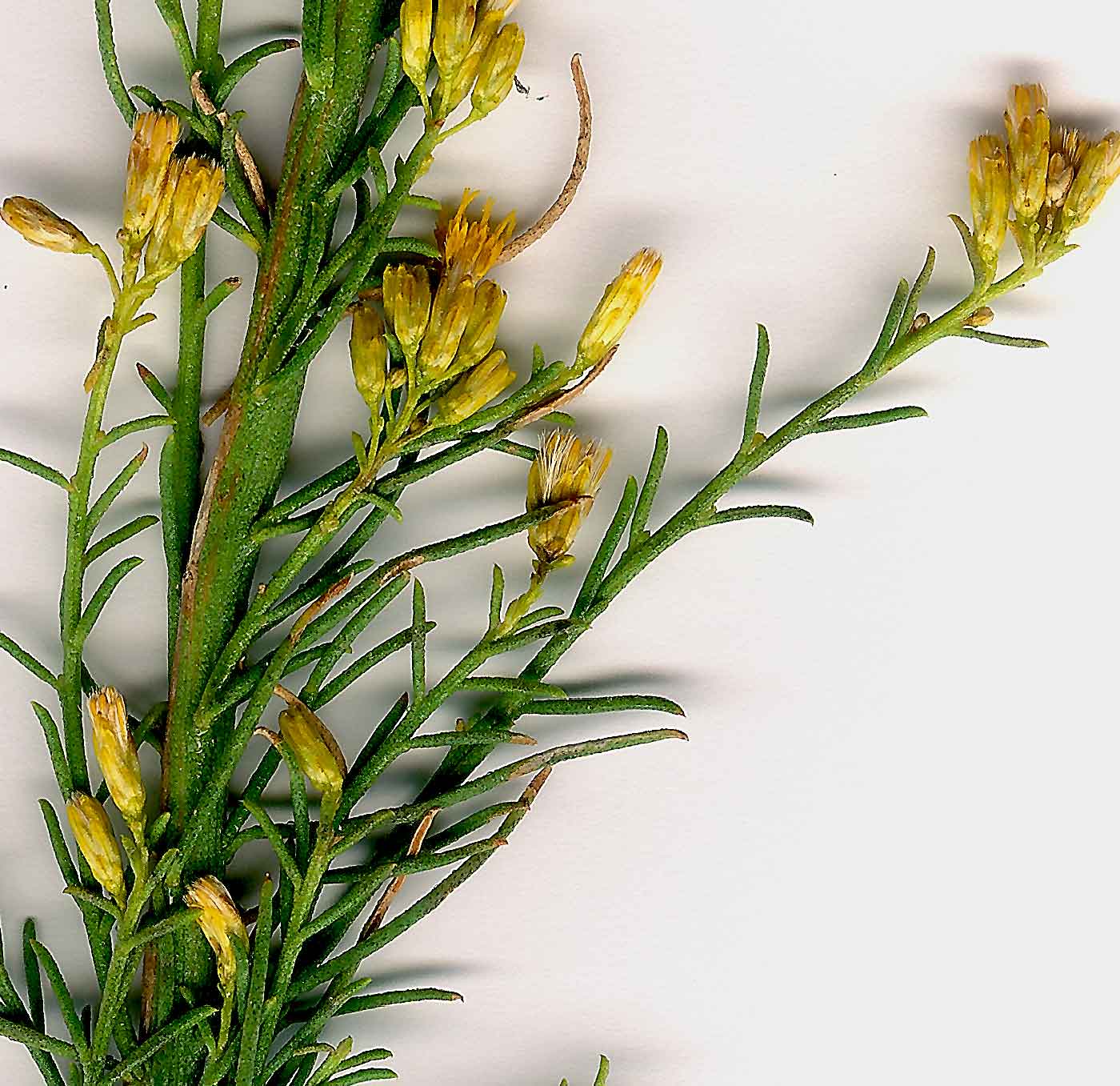
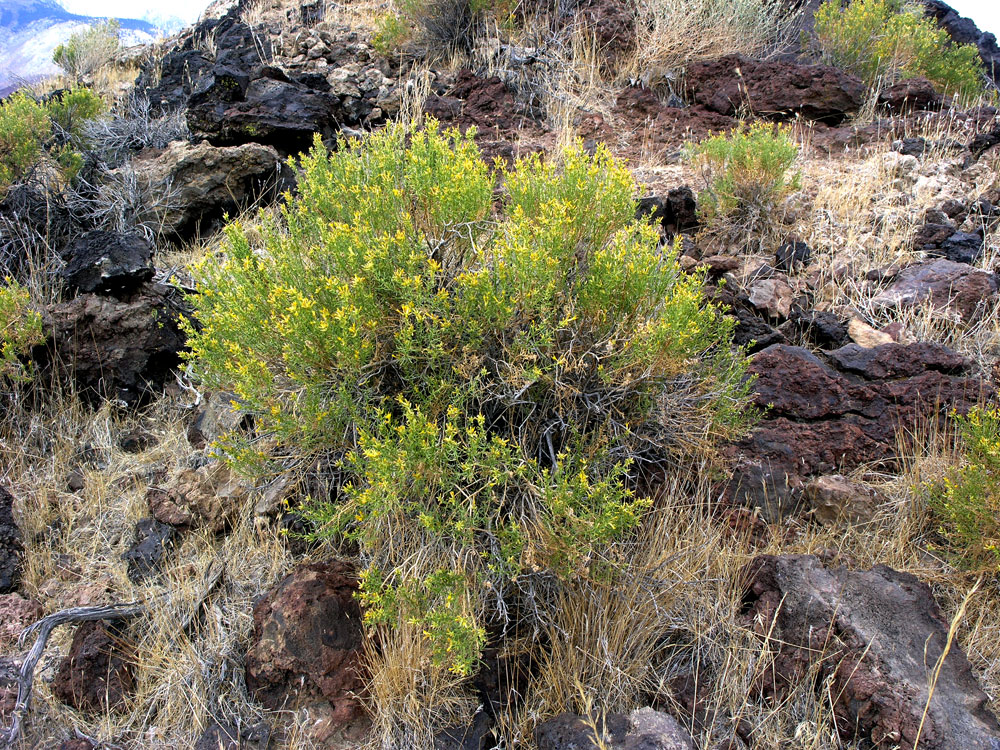
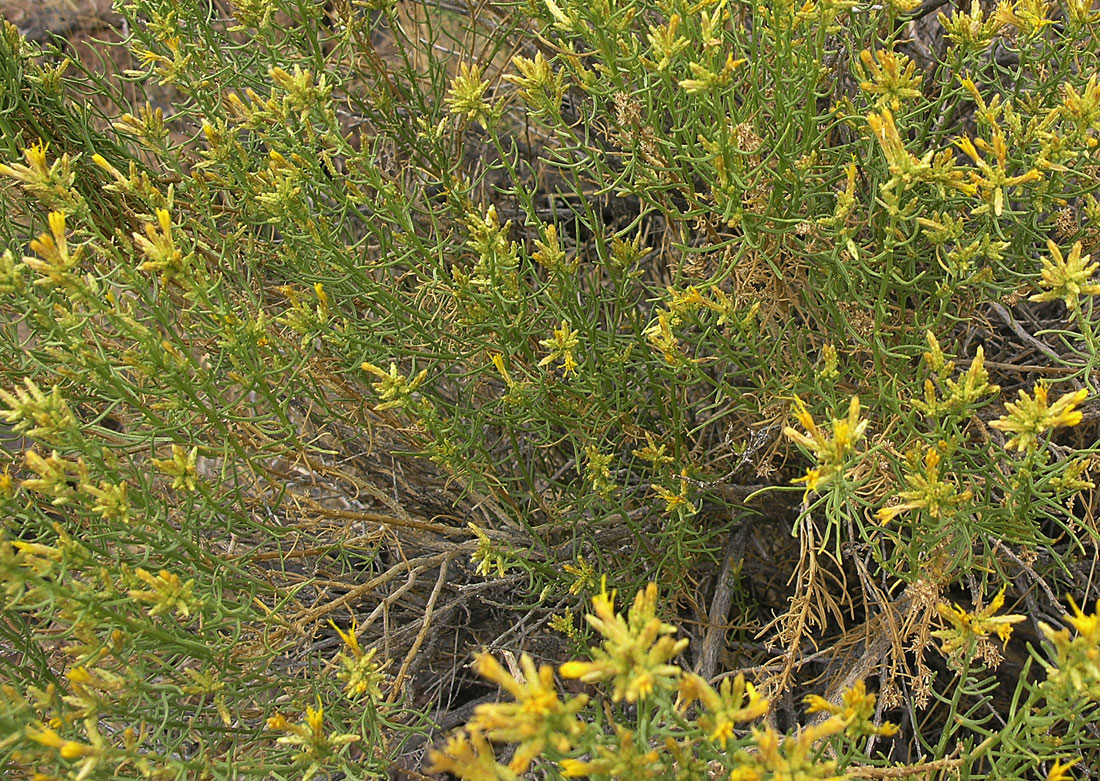
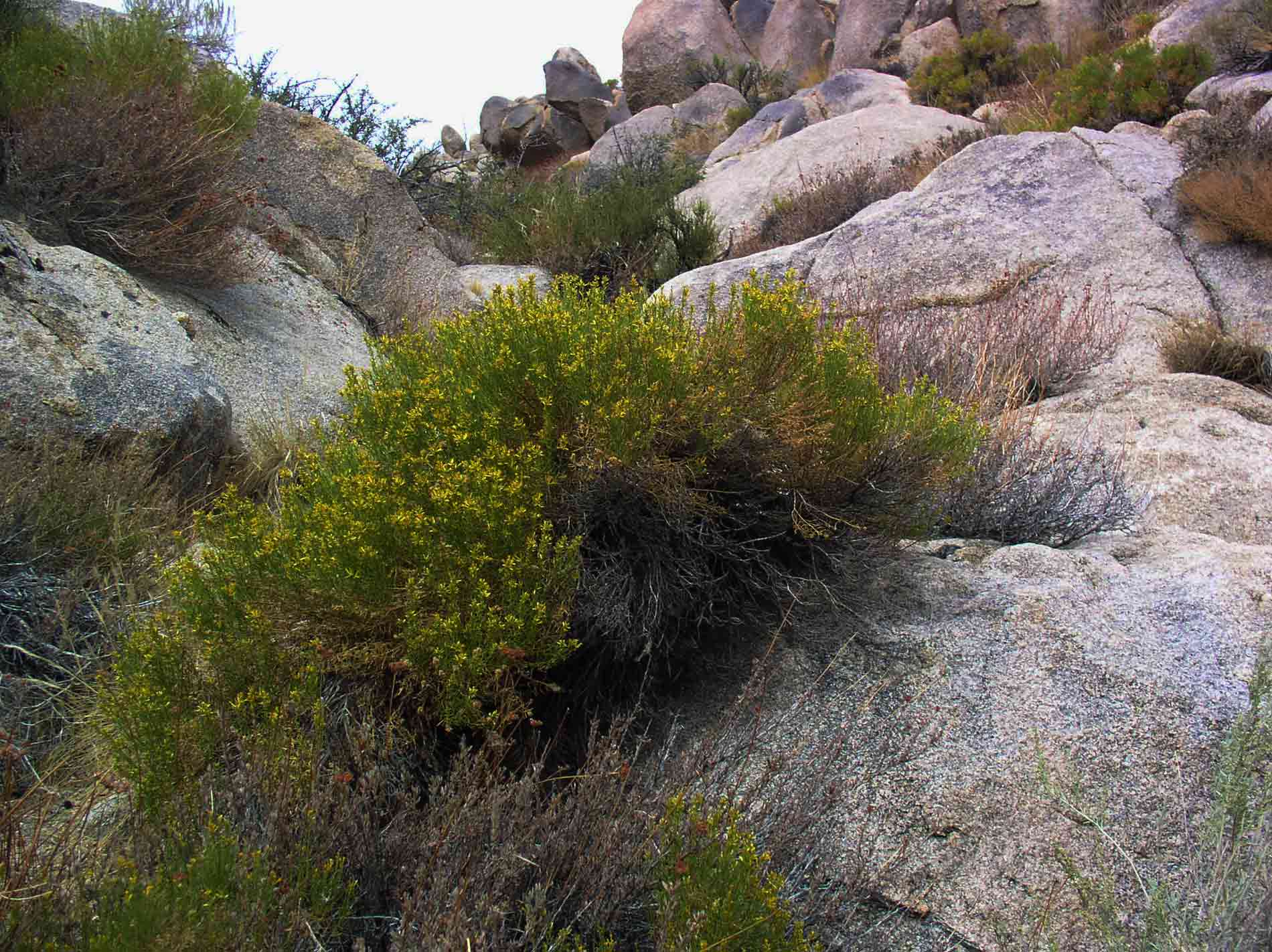
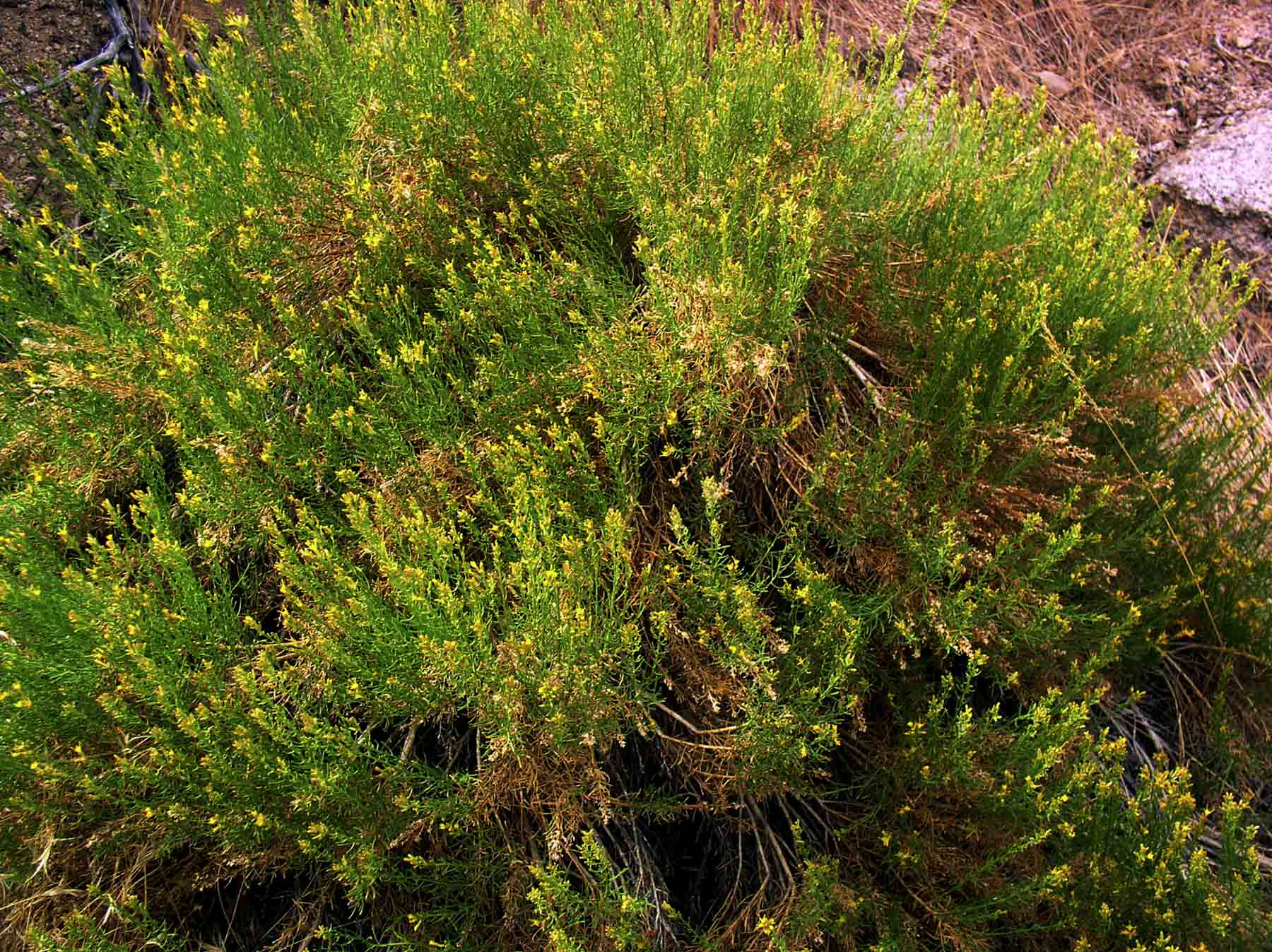
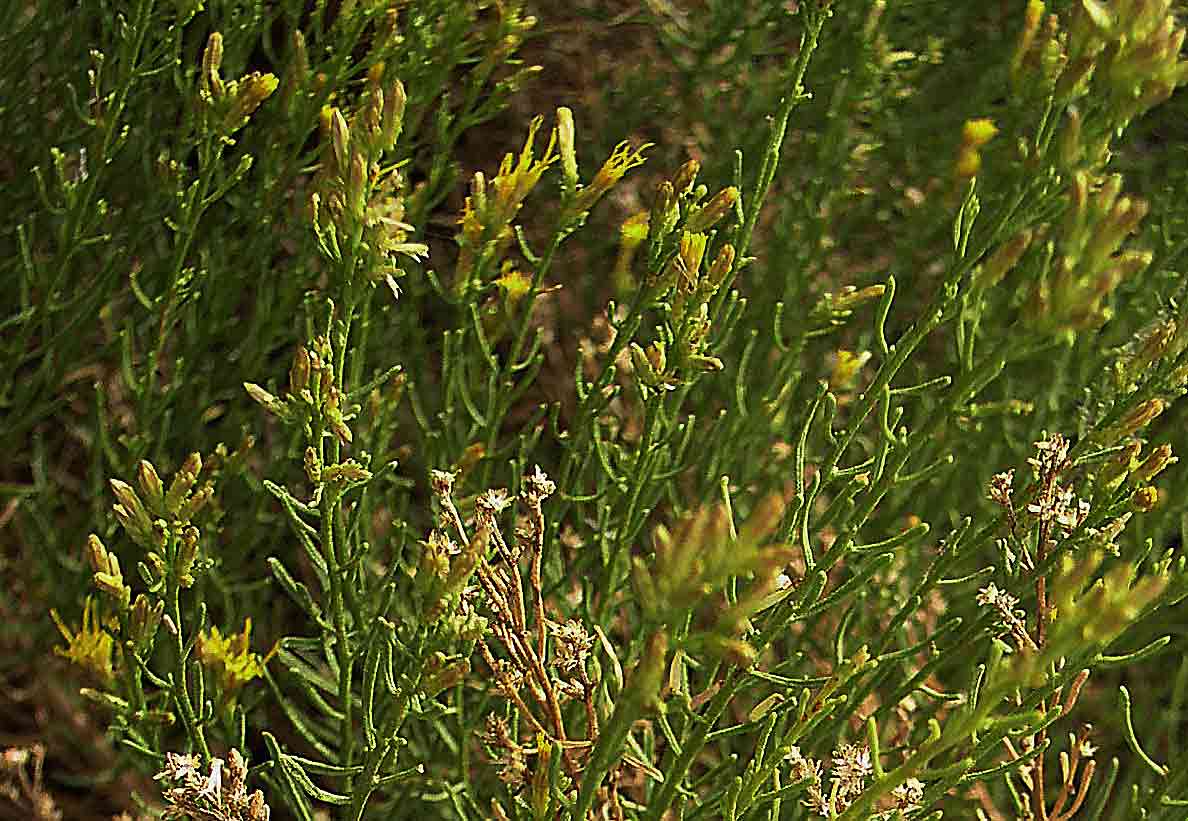
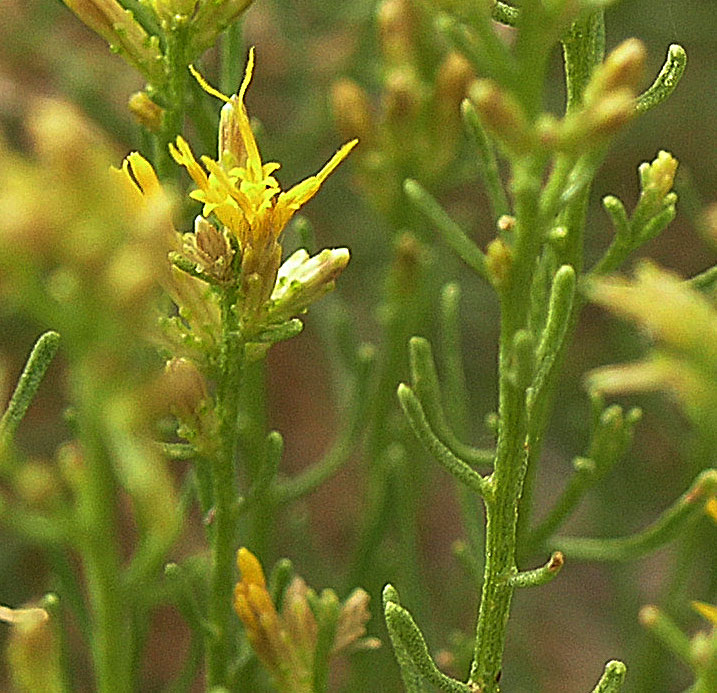
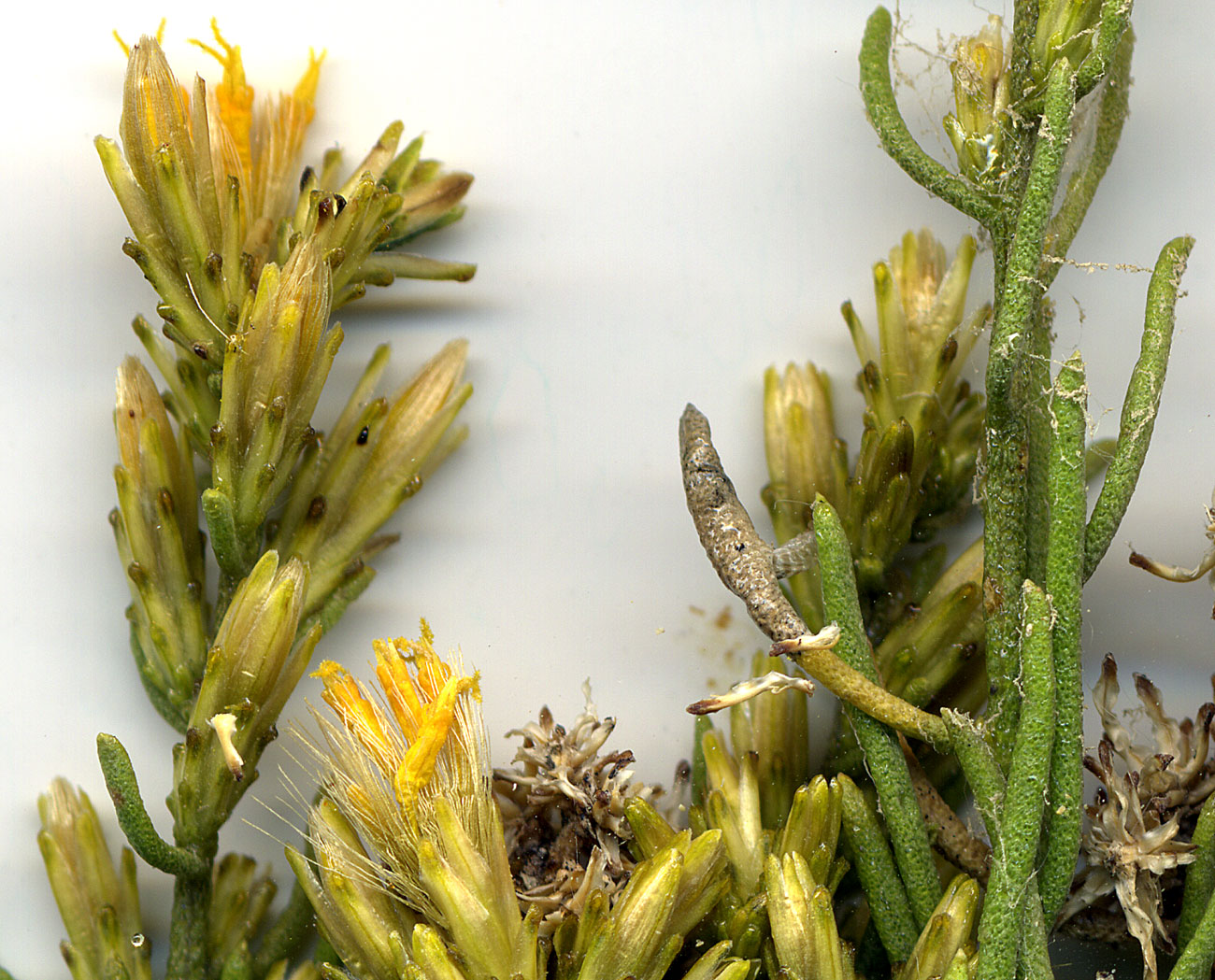
Ericameria albida (Bigelovia albida M. E. Jones ex A. Gray 1882) L.C. Anderson 1995 [Chrysothamnus albidus Greene 1895]. White flowered rabbitbrush. Aromatic white-barked shrub to 1.5 m, with numerous branches from a common point, glabrous and resinous; leaves needle-like, 1.5–3 cm, the shorter ones in axillary fascicles, glandular pitted. Flowering Aug–Nov; heads generally 5 on radiating peduncles <1 cm at ends of branches, with 4–7 flowers, all disk type, white. Rare, dry saline or alkaline sandy or silt soils; 1,000–4,000 ft; Owens Valley and Death Valley Region, California and western Nevada. Type from Wells, NV. Kern Co.: North Mojave Desert region, Indian Wells Valley, 2,200 ft; 35⁰39'N, 117⁰34'W, 671 m (CCH: Prigge, 8 Aug 1993). Ericameria arborescens (Linosyris arborescens A. Gray 1859) Greene 1894 [Haplopappus arborescens (A. Gray) H. M. Hall 1919]. Golden fleece. Large shrub, 0.5–3 m, branches clustered and erect (fastigiate); young stems green and striate; leaves crowded along upper stems, spreading and up-curved, long threadlike (linear), 2.5–9 cm × 2 mm, resinous, glandular pitted; flowering Aug–Nov; flower heads 3–8 near ends of branchlets, 18–23 flowers per head, all disk type, surrounded by an involucre 4–5 mm high, the bracts graduated in 4–5 ranks, sword-shape or narrower, tapering to an acute or more slender tip; cypselae with fragile bristles ~3 mm long. Generally, 300–4,000 ft in the Outer Coast Ranges from southern Oregon to Transverse Ranges in Ventura Co., and at higher elevations in the Sierra foothills, to 5,900 ft in the southern Sierra Nevada (Piute Mt.). Type from California without specific location. Kern Co.: “Occasional in the dense chaparral on Blue Mountain west of Glennville; scarce in the chaparral on the north end of Piute Mountain and on the east slope of the Greenhorn Range” (Twisselmann; 1,800 m CCH), Long Canyon, fairly common on burn with cypress, occasional on E side of drainage mid- to low elevations (Keeler-Wolf 1990). Ericameria bloomeri (Haplopappus bloomeri A. Gray 1865) J.F. Macbride 1918. Bloomer's goldenbush. Shrub to 1 m high and broad, often broader than high, with many slender stems from well-developed woody base or trunk; leaves wide spreading, long narrow, slender, 2–6 cm, 0.5–3 (-7) mm wide, twisted or curved, with or without sessile glands; flowering Jul–Oct; disk flowers 4–13 (-20), rays 1–5(-7), or sometimes none; involucral bracts in 3–6 graduated ranks, green near the tips, otherwise straw colored except for the outer being mostly green. Sandy and rocky soils of open flats in coniferous forests, 3,500–9,000 ft. Southern British Columbia to southwest Idaho, to the Sierra Nevada of California and western Nevada. Type from Mt. Davidson, NV. Kern Co.: “known from the rim of the Kern Plateau east of Fay Creek Canyon” (Twisselmann). Ericameria cooperi (Bigelovia cooperi A. Gray 1873) H.M. Hall 1907 var. cooperi [Haplopappus cooperi H. M. Hall 1928]. Cooper's goldenbush. Low rounded shrub with numerous ascending to erect leafy branches, to 1.5 m, with alternate scattered needle-like leaves and shorter leaves in fascicles that persist to the winter; leaves sometimes wider above the mid region and channeled along the upper midrib, 3–15 mm long, to 2 mm wide, resinous, glandular pitted; flowering Mar–Jun; flower heads on short peduncles, up to 2 cm, predominantly with 4–7 (-14) disk type flowers and with 1–2 ray flowers commonly present, all yellow; involucre 4–6 mm high with 10–14 loosely imbricate bracts in 2–4 ranks. Fruit: cypselae with white bristles and hairy ribbed pericarpia, ~ 2 mm long. Locally common on rocky slopes and mesas in the Yucca zone of the Mojave Desert, 2,600–5,700 (-6,600) ft, to Mexico, western Texas and Washington Co. Utah. Type from eastern slopes of the Providence Mts., CA. Kern Co.: “Occasional, sometimes locally common, from the higher elevations of the creosote bush association to the pinyon woodland on the desert-facing slopes of the mountains, west to Kelso Canyon” (Twisselmann), 305–1,584 m (CCH). One other variety in Baja California. Ericameria cuneata var. cuneata ([H]aplopappus cuneatus A. Gray 1873) McClatchie 1894. Wedgeleaf goldenbush. Low rounded glutinous shrub, lower parts of branches leafless, leaves crowded on new growth, distinctly short and wide, inverse heart-shaped (cuneate), 6–25 mm long, 3–15 mm wide; flowering late Aug–Dec; heads 1–6 or more crowded near apex of branches; involucre of flower heads 4–12 mm high with 20–40 bracts in 4–6 or more ranks. Fruit: cypselae with white bristles and a 4-angled hairy pericarpium. Among boulders on steep rocky slopes, or rock faces of cliffs, 3,300–9,000 ft; Coast and Peninsular Ranges to Baja California, Sierra Nevada across the deserts to southern Nevada, Arizona and southwestern New Mexico. Type from Sierra Nevada, Bear Valley, CA. Kern Co.: “Occasional around rock outcrops in all the woody Upper Sonoran associations, infrequently to the high arid summits in the Jeffrey pine forest.” Very common above 8,000 ft around Lookout Point in the Piute Mountains (Twisselmann), 609–2,500 m (CCH). Var. spathulata (A. Gray) H.M. Hall differs in having stalked leaves with slightly larger blades, Temblor Range, Kern Canyon, Cross Mt., Caliente Creek, 5 mi south of Mojave, 457–1,523 m (CCH). Ericameria gilmanii ([H}aplopappus gilmanii S.F. Blake 1939) G.L. Nesom 1990 Gilman's goldenbush. Low rounded intricately branched shrub to 40 cm with stiff channeled twigs, short recurved solitary leaves, and with fascicles of leaves; leaves widest above the mid region, resinous, folded lengthwise along the mid region, abruptly narrowed to a pointed apex, 6–12 mm × 2–3 mm; flowering Aug–Sep; heads solitary to several or more on branched peduncles, narrowly bell-shaped, 7–9 mm high, with 15–18 disk flowers and 4–6 ray flowers, all pale yellow to white; involucral bracts in 4–6 ranks, recurved near tips. Cypselae with yellowish bristles and silky hairy pericarpium. Uncommon, pinyon-juniper woodland, bristle cone pine forest and white fir-Jeffrey pine forest, 7,100–11,000 ft, Inyo-White Mts., Panamint Mts., eastern Sierra Nevada. Type from Telescope Peak, Panamint Range. Kern Co.: East slope of Owens Peak and east face of Spanish Needle, 2,256–2,500 m (CCH). Ericameria linearifolia ([H]aplopappus linearifolius DeCandolle 1836) Urbatsch & Wussow 1979]. Interior goldenbush, narrowleaf goldenbush. Evergreen shrub about waist high with many erect stems and clustered twigs arising from a common node; leaves usually ribbon-like or needle-like (hybrids?), linear, 1–4 cm × 1–2.5 mm, alternate or in fascicles, resinous, glandular pitted. Flowering usually in the spring (Mar–May); old flower scapes (peduncles) persist with a few leaves, extending beyond the densely leafy stems, heads solitary with 18–60 disk flowers and 13–18 ray flowers. Cypselae with white bristles and a white hairy ribbed pericarpium. Chaparral, woodlands, desert scrub below 6,000 ft; Inner Coast Ranges to Baja California across the mountains to southern Utah and western Arizona. Narrow-leaf goldenbush scrub provisionally recognized in MCV2. Type from California without specific location. Kern Co.: “Common,” “often extensive colonies in the Temblor and San Emigdio ranges and locally on the lower slopes of the Tehachapi Mountains” (Twisselmann), 488–1,789 m (CCH). Ericameria linearifolia-Eriogonum fasciculatum Shrubland Alliance proposed (Magney 2010, Tejon Ranch Conservancy Tri-Centennial). Photo taken from Bitter Creek Reserve. Ericameria nana Nuttall 1840. Intricately branched rounded aromatic shrub < 50 cm, leaves needle-like or narrow and wider towards apex, ending in a sharp point, to 2 cm, solitary and in fascicles, channeled (involute) along upper surface, resinous but obscurely glandular pitted. Flowering Jul–Nov; flower heads at ends of crowded peduncles < 6 mm, 4–8 disk flowers per head surrounded by 1–7 ray flowers. Common in the Great Basin Desert; rare in California, dry rocky plains, cliffs, and crevices in Mono and Inyo Cos, Pinyon-Juniper Woodland, 6,890– 9,186 ft. A reported occurrence from Kern Co. along Hwy 178, 6.0 mi northwest of Hwy 14, 1,371 m (CCH) does not agree with eco-geographical data for the species. Ericameria palmeri (Haplopappus palmeri A. Gray 1876) H. M. Hall 1907 var. pachylepis (Munz 1935) G. Nesom 1989 [ssp. pachylepis H.M. Hall 1928]. Palmer's goldenbush. Diffusely branched shrub 0.5–1.5 m high and broad; branches not crowded, spreading or ascending becoming recurved with increasing length in age; leaves alternate and crowded along stems, with additional shorter leaves in fascicles, needle-like, reflexed or down-curved, 8–12 mm, resinous, glandular pitted; flowering Jul–Dec; flower heads solitary on short ascending peduncle-like leafy branchlets, several or more sometimes aggregated near end of a main branch; involucre 6–7 mm with 16–25 bracts in 4–5 vertical ranks, bracts green with blister-like swellings in upper half; disk flowers 5–10, ray flowers 1–6. Cypselae with white brownish tinged bristles 4–5 mm, pericarpium with 4–7 hairy ribs, 3–4 mm. Common on sandy or clay soils up to 2,300 ft, coastal sage scrub, southern Ventura Co. and Santa Catalina Is., east to desert border. Palmer’s goldenbush scrub provisionally recognized in MCV2. Type from summit of Box Springs Grade near Riverside, CA. Kern Co.: San Emigdio Range, Salt Creek Canyon (CCH), “rare on a sandy flat at 3,375 ft” (Twisselmann); Long Canyon, “uncommon on marble outcrop mid elevations (Keeler-Wolf 1990). Ericameria paniculata (Bigelovia paniculata A. Gray 1873) Rydberg 1917 [Chrysothamnus paniculatus (A. Gray) H. M. Hall 1907]. Black-banded rabbitbrush, black-stem rabbitbrush. Shrub with many stems from base, mostly erect, 1–3 m high and to 2 m broad, fastigiately branched; older stems white powdery (mealy), resinous, younger stems green or whitish green; leaves needle-like, 1–3 cm, glandular pitted, resinous and sometimes mealy, often with black fungus bands, recurved near the apex, ending in a sharp point; flowering Jun–Dec; short floriferous branches often arising well below the mid region of a stem and developing continuously to stem apex; involucres subcylindric, 5.5–9 mm with 13–20 bracts in 3–5 almost vertical ranks, the first (lower-most) bracts shorter than upper, heart-shaped (ovate), the upper 3× longer, with parallel margins before tapering abruptly to apex, membranous with a midnerve evident, with 5–8 yellow disk flowers. Cypselae with brownish white bristles ~6 mm long and a ribbed hairy pericarpium ~5 mm long. Rocky desert plains and washes below 8,000 ft from Tehachapi to southwestern Utah and Arizona. Black-stem rabbitbrush scrub recognized in MCV2 when >5% absolute cover in the shrub canopy with no other shrub >50% relative cover. Type from California without specific location. Kern Co.: “Occasional in canyons and along washes and fans on the desert,” “known from the sparse pinyon woodland in Chimney Creek Gorge northeast of Onyx” (Twisselmann), 662–1,036 m (CCH). Ericameria teretifolia (Linosyris teretifolia Durand & Hilgard 1854) Jepson 1925 [Chrysothamnus teretifolius H. M. Hall 1907]. Rounded-leaf rabbitbrush, needleleaf rabbitbrush. Medium-size rounded shrub with numerous ascending to erect stems, fastigiately branched, 0.5–1.75 m; older stems with brownish to gray slightly furrowed bark, young stems green, resinous; leaves alternate, needle-like, 1–2.5 cm; curved upwards, resinous, densely glandular pitted, terminating in a blunt point; flowering Aug–Nov; flower heads often 8–12 densely clustered near apex of branches; involucres narrow cylindric with 4–5 ranks of bracts, the bracts with conspicuous swollen terminal green to blackish brown glands; flowers all disk type, 4–7 per head. Cypselae with terminal white bristles ~5 mm, pericarpium stake-like, 4 mm, hairy. Rocky slopes, canyon walls, in the higher deserts, 3,200–8,000 ft, creosote shrub, Yucca and pinyon-juniper woodlands, White Mts. south to Santa Rosa Mts., east to Utah and Arizona. Needleleaf rabbitbrush scrub recognized in MCV2 when ≥ in occurrence to other shrub species. Type from 'mountains around Tejon Valley' which possibly “refers to the arid hills at the head of Cottonwood Canyon east of Tejon Pass” (Twisselmann). Kern Co.: “Occasional at the lower elevation of the desert-facing slopes and canyons of the mountains southwest to the Tehachapi Mountains (Twisselmann), 640–1,524 m (CCH).
References on Pharmacological Activity in Ericameria Murilloa, J. I., R. Encarnación-Dimayuga, J. Malmstrømb, C. Christophersenb and S. G. Franzblau. 2003. Antimycobacterial flavones from Haplopappus sonorensis. Fitoterapia 74(3): 226–230. “Crude extracts of Haplopappus sonorensis (A. Gray) S.F. Blake (Asteraceae), showed activity against Mycobacterium tuberculosis H37Rv. By assay-guided fractionation, 5-hydroxy-3,7,4′-trimethoxyflavone (1), 5,7-dihydroxy-3,4′-dimethoxyflavone (2) and 5,4′-dihydroxy-3,7-dimethoxyflavone (3) were identified as the antimycobacterial principles. Compound 2 was the most active compound. ” Zhou G. X., E. M. Wijeratne, D. Bigelow, L. S. Pierson 3rd, H. D. vanEtten HD and A. A. Gunatilaka. 2004. Aspochalasins I, J, and K: three new cytotoxic cytochalasans of Aspergillus flavipes from the rhizosphere of Ericameria laricifolia of the Sonoran Desert. J. Nat. Prod. 2004 Mar;67(3):328–332. “Bioassay-guided fractionation of a cytotoxic EtOAc extract of Aspergillus flavipes occurring in the rhizosphere of Ericameria laricifolia resulted in the isolation of three new cytochalasans, namely, aspochalasins I (1), J (2), and K (3), and four known cytochalasans, aspochalasins C (4), D (5), and E (6) and TMC-169 (7). The structures of compounds 1-3 were established on the basis of extensive 1D and 2D NMR spectroscopic analysis. All compounds exhibited weak to moderate cytotoxicity against NCI-H460, MCF-7, and SF-268 cancer cell lines, but none showed significant selectivity.” |
||