| The genus Lycium
includes from 75–90 species most often found in washes of seasonally dry climates
of
North America (~20 spp.), Africa (~25 spp.), Eurasia (~10 spp.) and South
America (~30 spp.). Species of Lycium can be generally recognized by the tangled spiny branches with relatively short linear
alternate leaves in fascicles, but the differences among species is tentative because
the taxonomic features as they compare to type specimens are not clear.
Species in other genera with similar vegetative features include Prunus fasciculata and Peraphyllum ramosissimum .
Taxonomic differences are often based on differences in the length of the calyx, or calyx lobes, but it should be recognized that the calyx often enlarges in fruit. Lycium cooperi is recognized by the fruit appearing bilobed to constricted near apex; however, fruits do not always develop in many species and flowering, which usually occurs after rain, can be ephemeral. The relative length of the corolla as it is seen exserted from the calyx appears to have taxonomic value, but is generally not employed; Lycium andersonii, for example, may be identified by floral features of the relatively long exserted curved floral tube in contrast to a short calyx. Other differences are seen in leaf succulence and pubescence, the latter seems to be a relatively minor feature for the recognition of L. fremontii. Species interpretations also vary. For instance, plants in the Mojave Desert with linear-terete leaves may be regarded as a variety of L. californicum (Kearney & Peebles, Arizona Flora, Univ. Calif. Press, 1951), or may be referred to L. andersonii (CalPhotos).
Trees and Shrubs of Kern County (Feb 2013)
Lycium. Much-branched spiny stemmed shrubs, occasionally with a definite primary trunk; leaves usually narrow and short (<10x longer than wide), elliptical to widest near apex, deciduous, usually in fascicles. Flowers axillary on short pedicels, solitary or in 2’s or 4’s; calyx short tubular or bell-shaped, often ruptured as fruit matures; corolla funnel-form with 4–6 short lobes, white, yellow or greenish with purplish veins;. Fruit: baccate or drupaceous. As many as 100 species (including Grabowskia, Phrodus), seasonally dry subtropical to tropical and semi-arid regions; none reported used medicinally in Moerman, one reported active in the NCI antitumor screen prior to 1982, L. acutifolium E. Mey. ex Dunal stems from South Africa, confirmed activity in P-388 Leukemia; active agents unknown. Key to Lycium Leaves somewhat needle-like to bladder-like (fleshy swollen)....................................... 2
Leaves somewhat scoop-shaped, paddle-shaped, or
tongue-shaped............................. 3
2. Corolla tube extended beyond leaves and beyond calyx (tube and lobes)
2. Corolla tube scarcely beyond leaves and calyx (tube and lobes),
3. Corolla lobes spreading to reflexed and also revolute, mostly white;
3. Corolla lobes flaring, not reflexed, not revolute; fruit not
constricted,
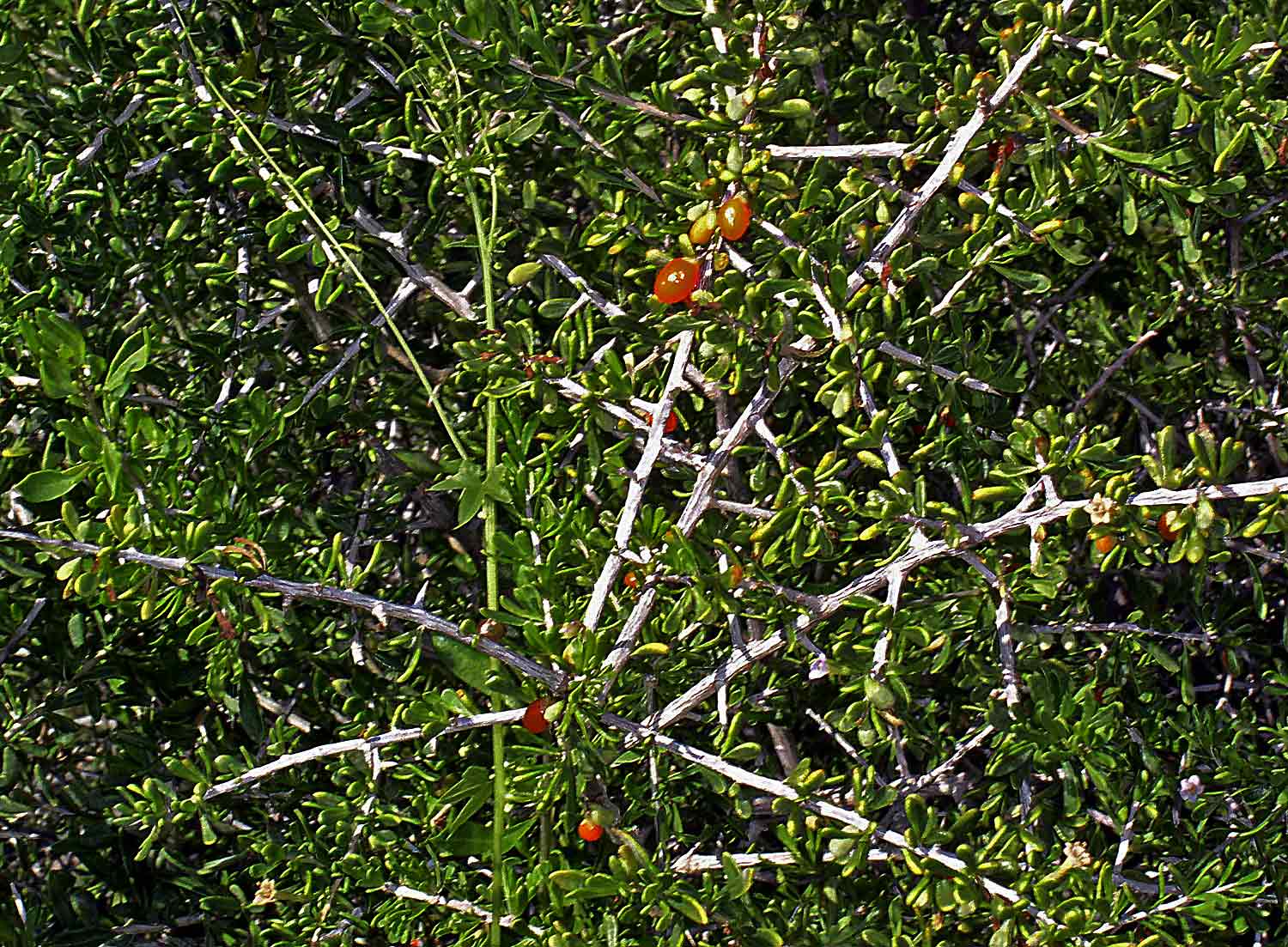
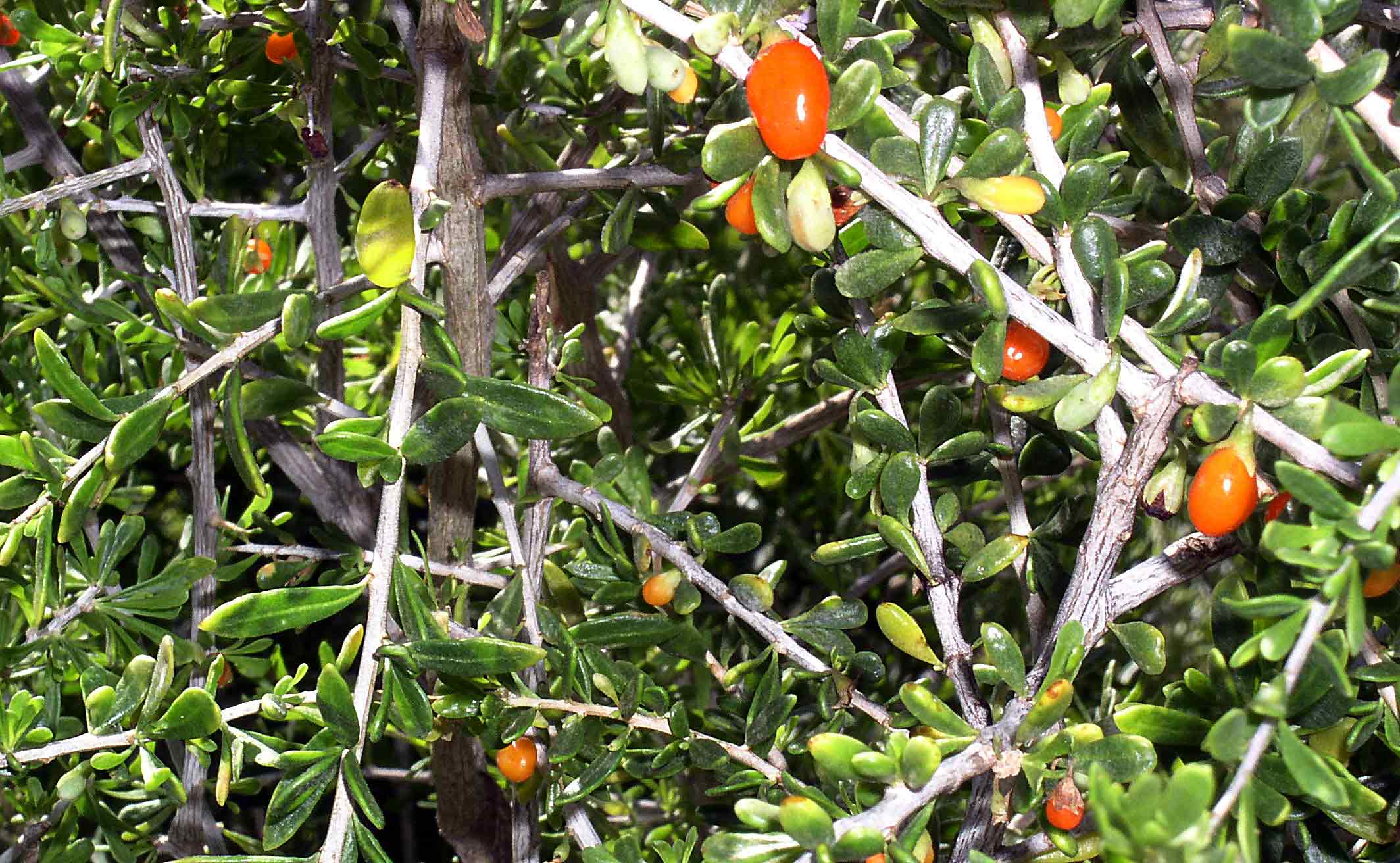
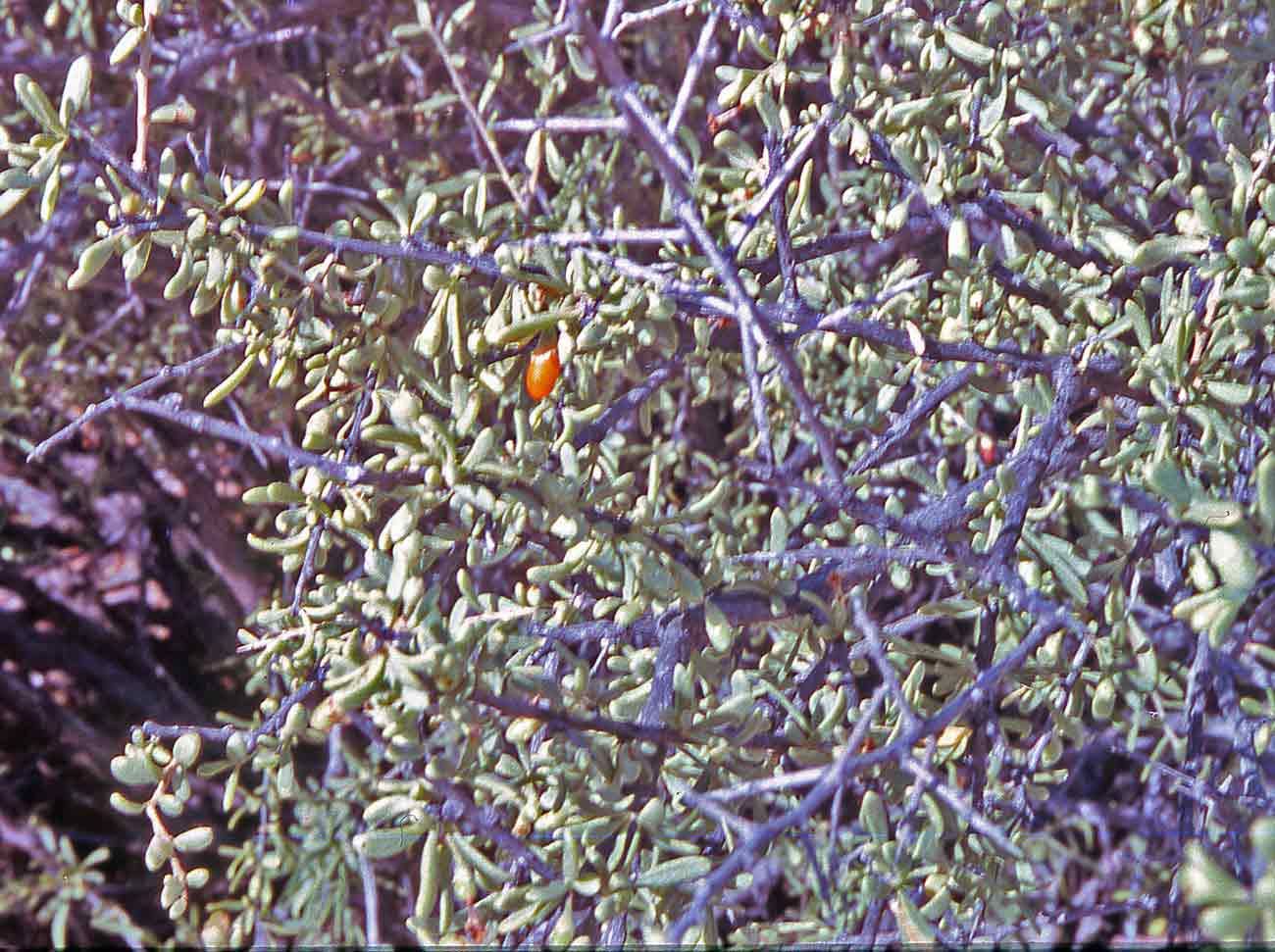
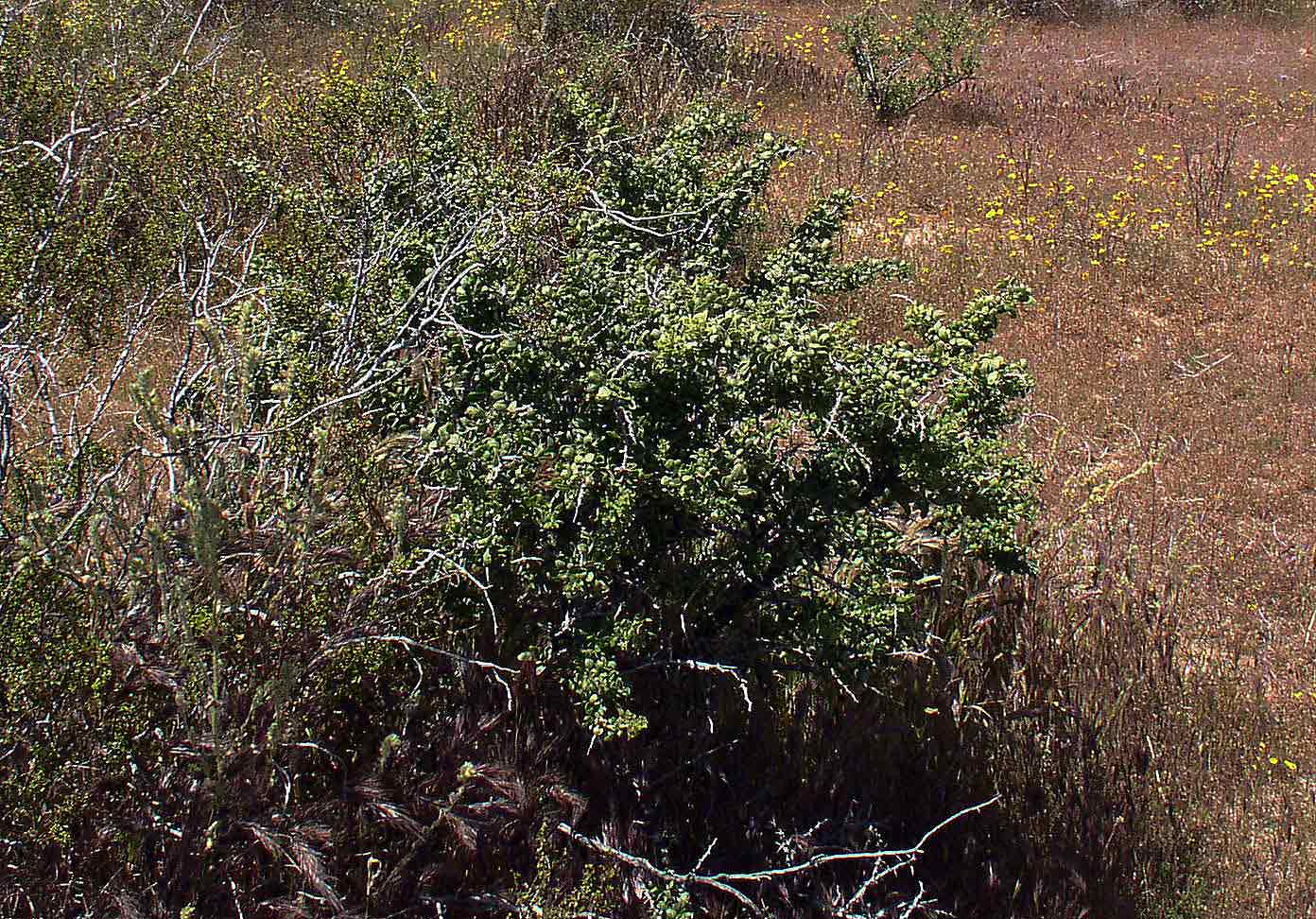
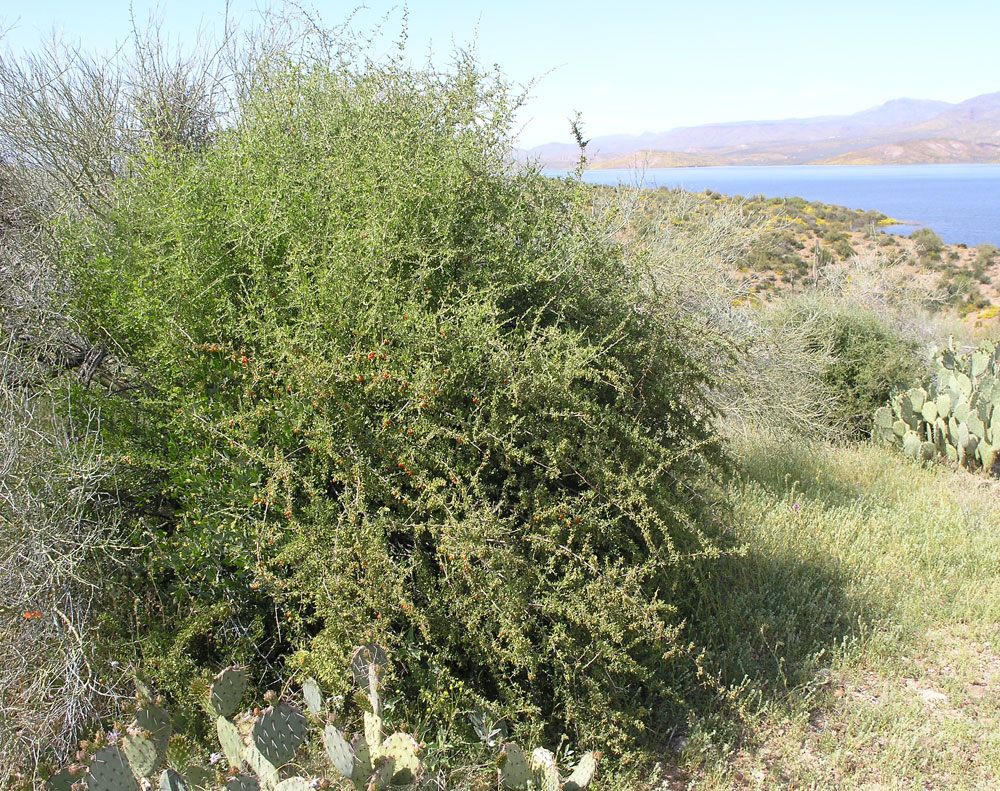
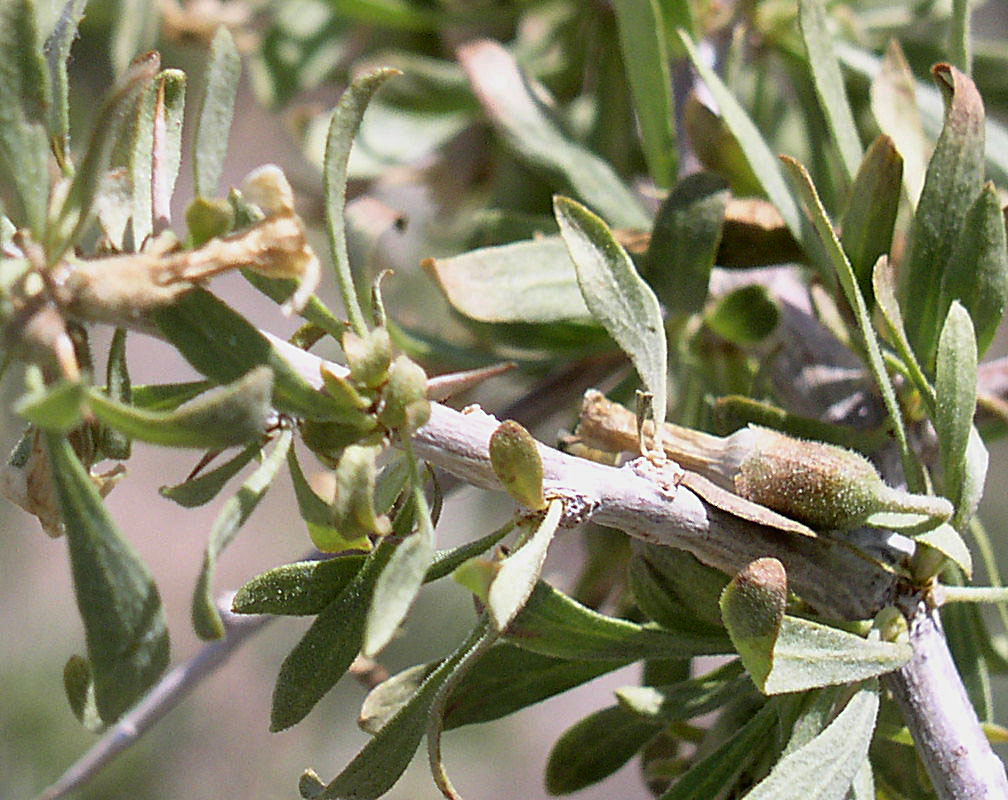
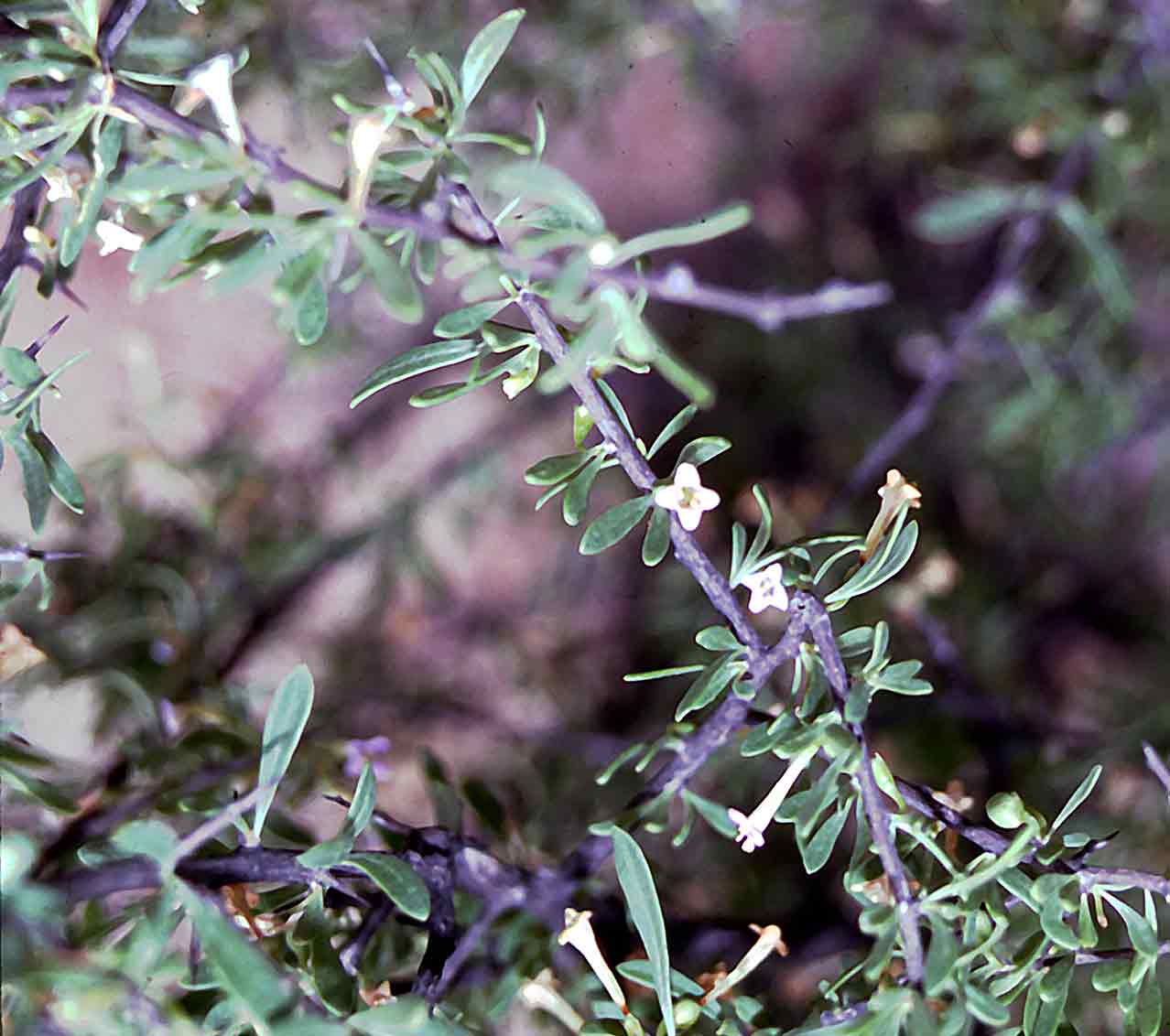
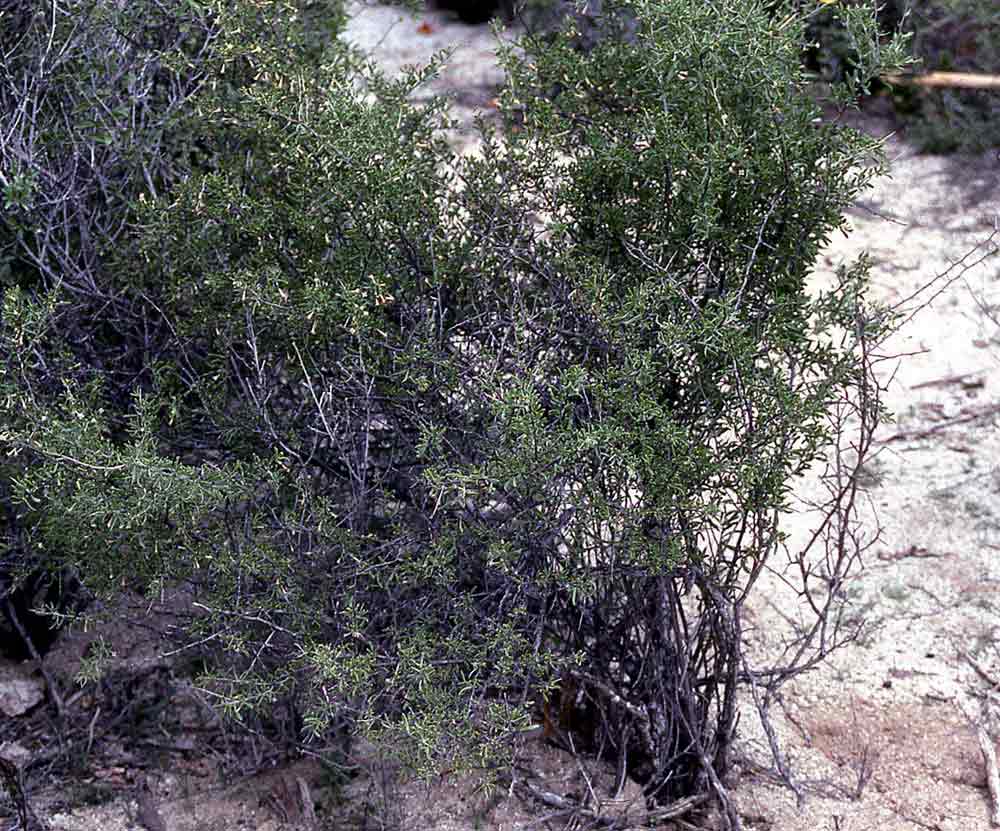
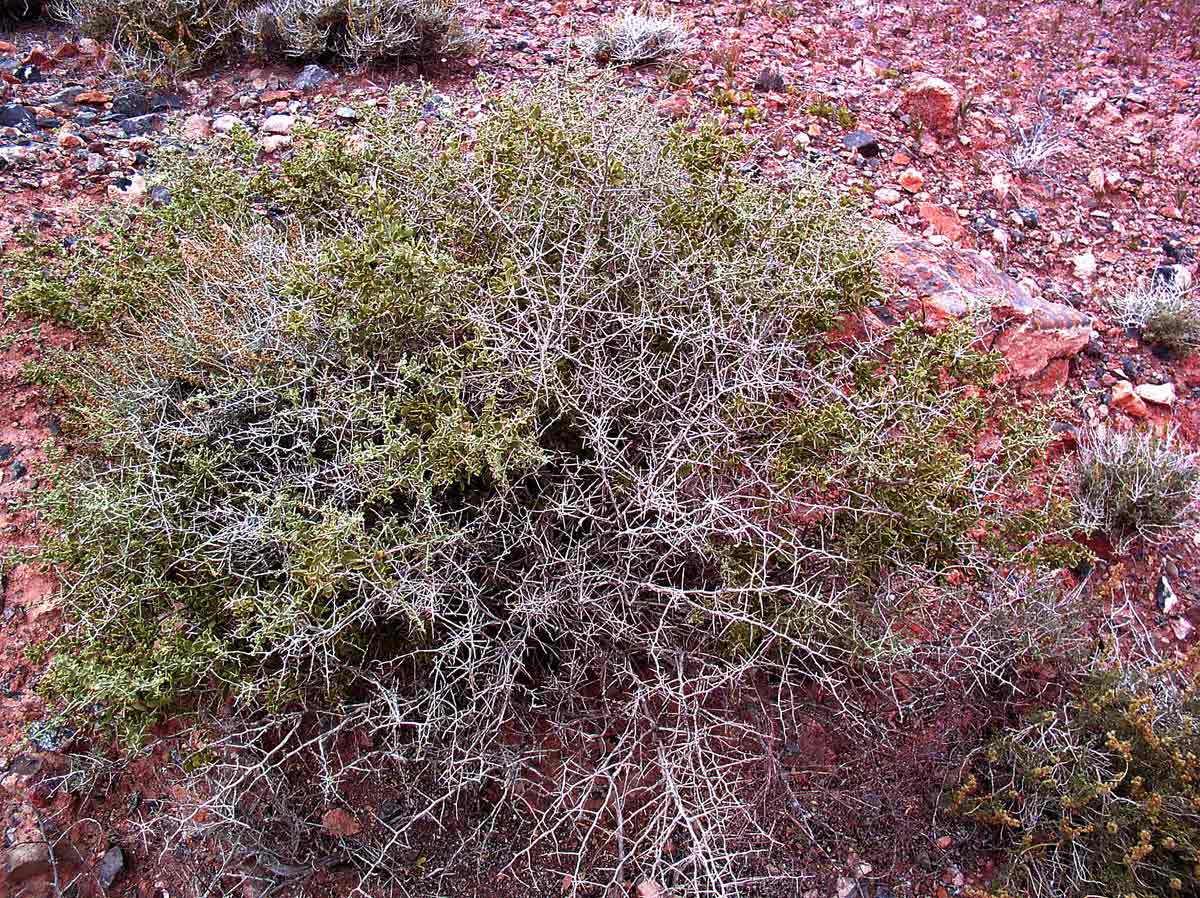
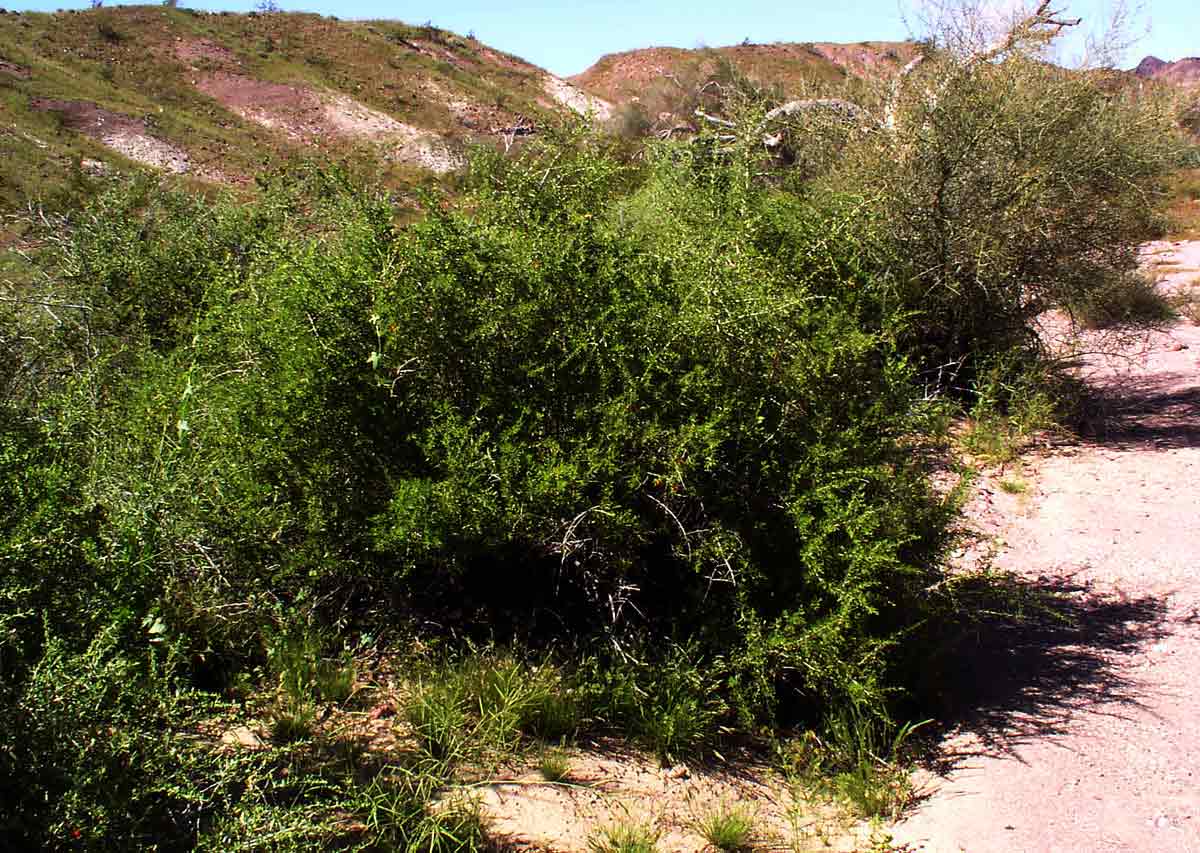
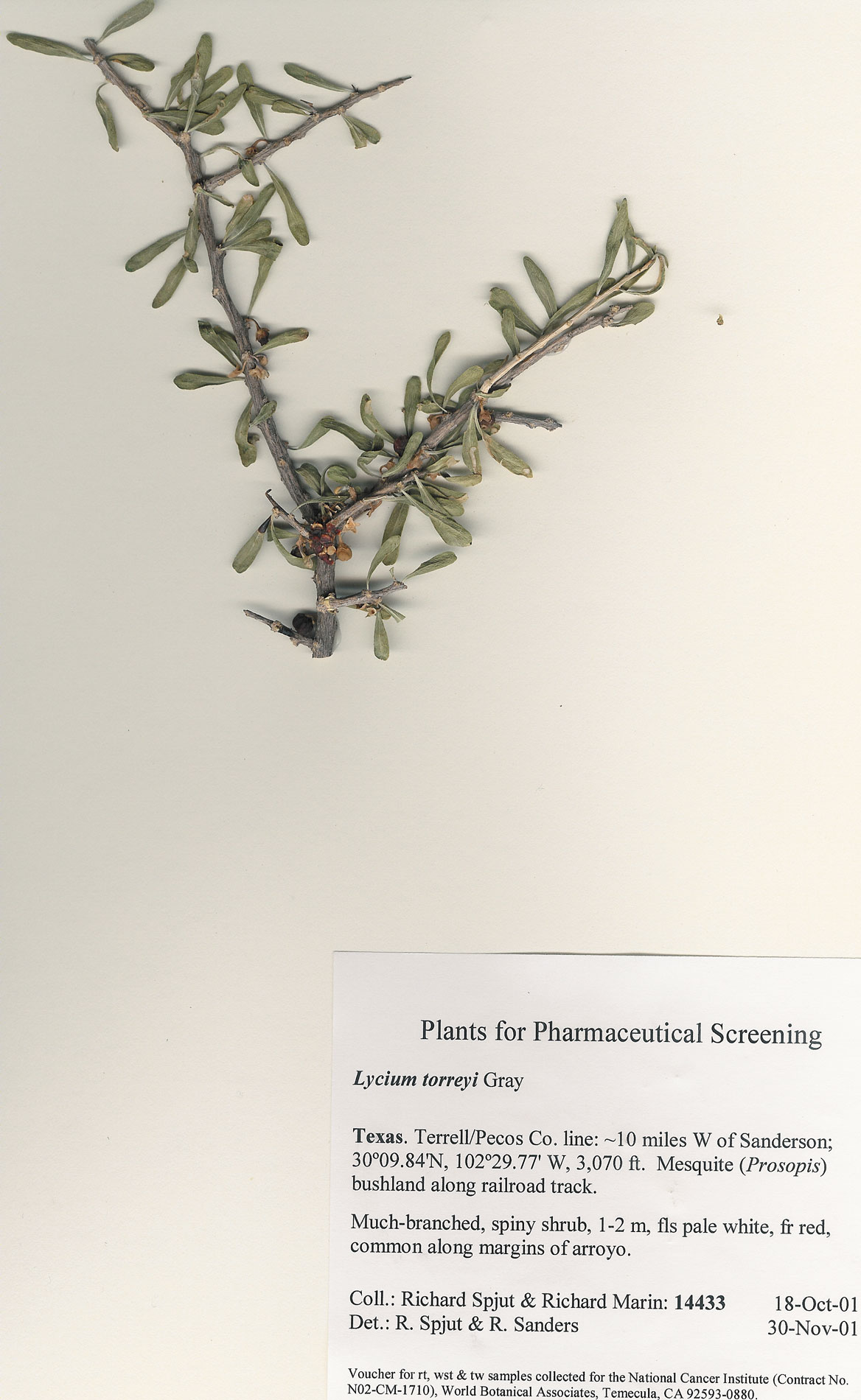
Lycium andersonii A. Gray 1868. Box
thorn. Spiny shrub much like Prunus fasciculata in habit and
leaves, differing by the red berry fruit (as well as floral anatomy).
Stems numerous from base, spiny, arched, branching frequently, to 3 m
high; leaves usually fascicled, needle-like to bladder-like and
succulent, Lycium brevipes Bentham 1844, differs by the corolla scarcely exceeding leaves and by shorter calyx lobes (<2 mm). One record in CCH reported the species from 6 miles northwest of California City (UCD). This is probably L. andersonii. Lycium brevipes occurs mainly south of the Transverse Ranges, California south into Baja California. Type from Magdalena Bay, Baja California Sur.
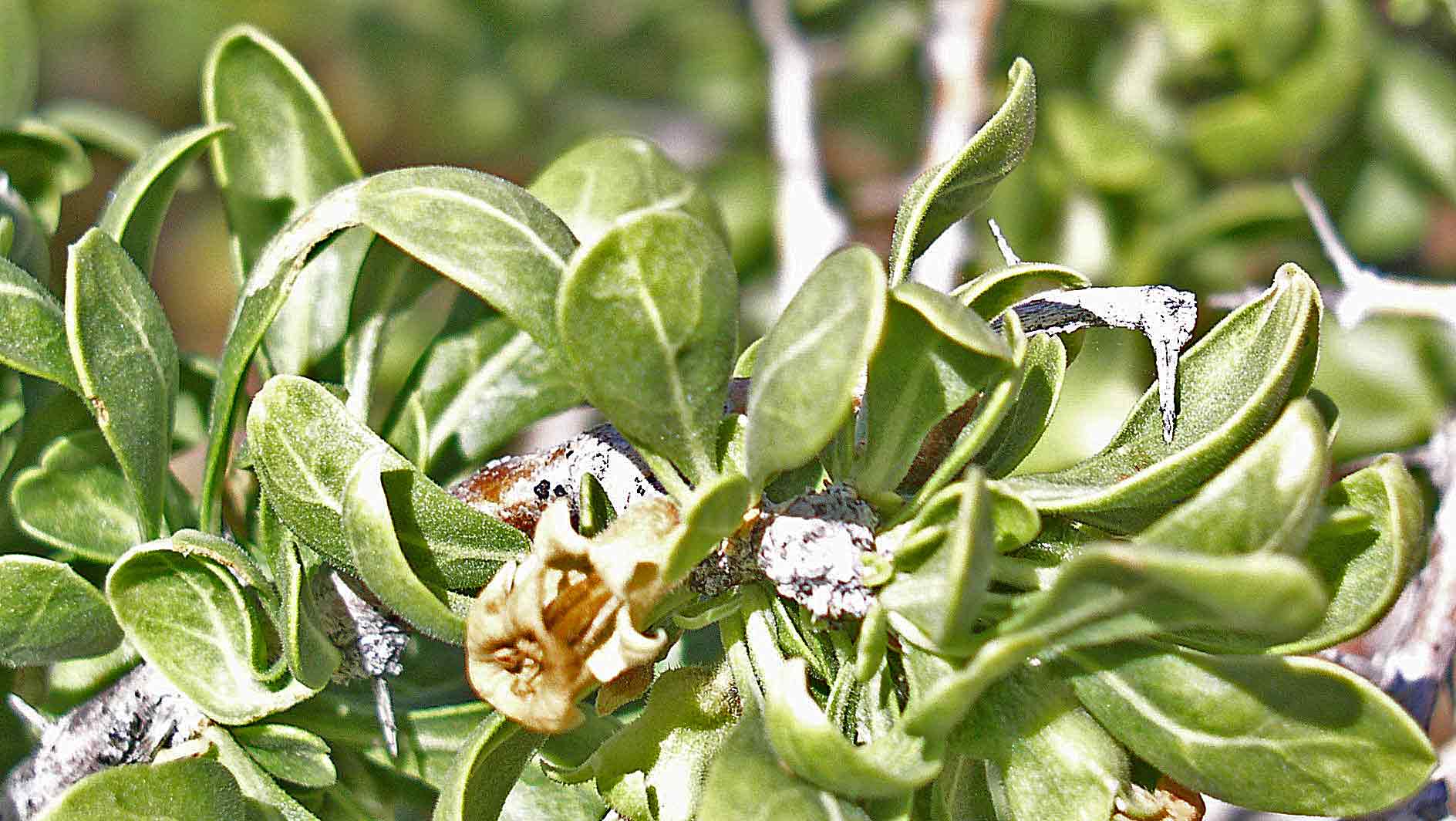
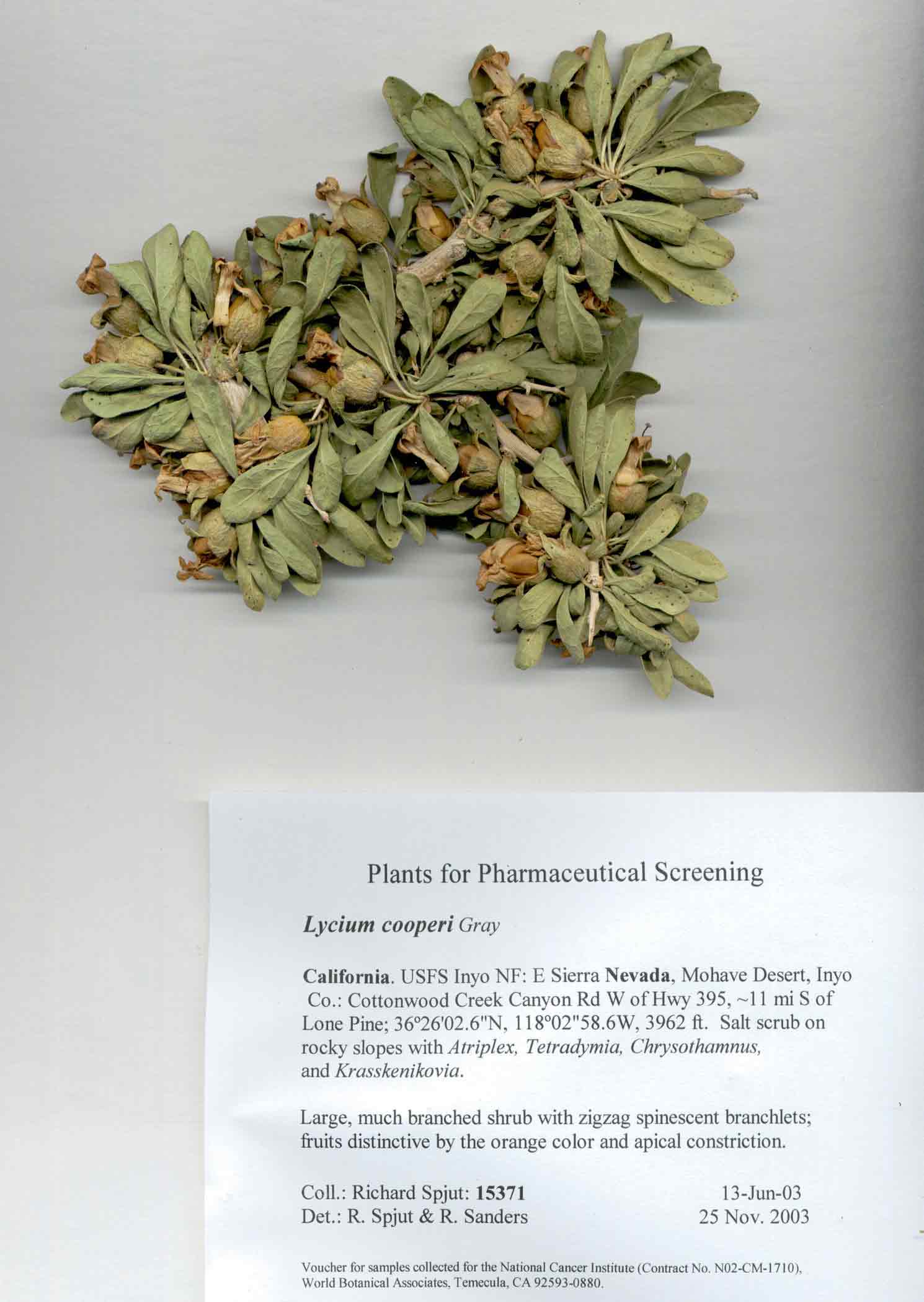
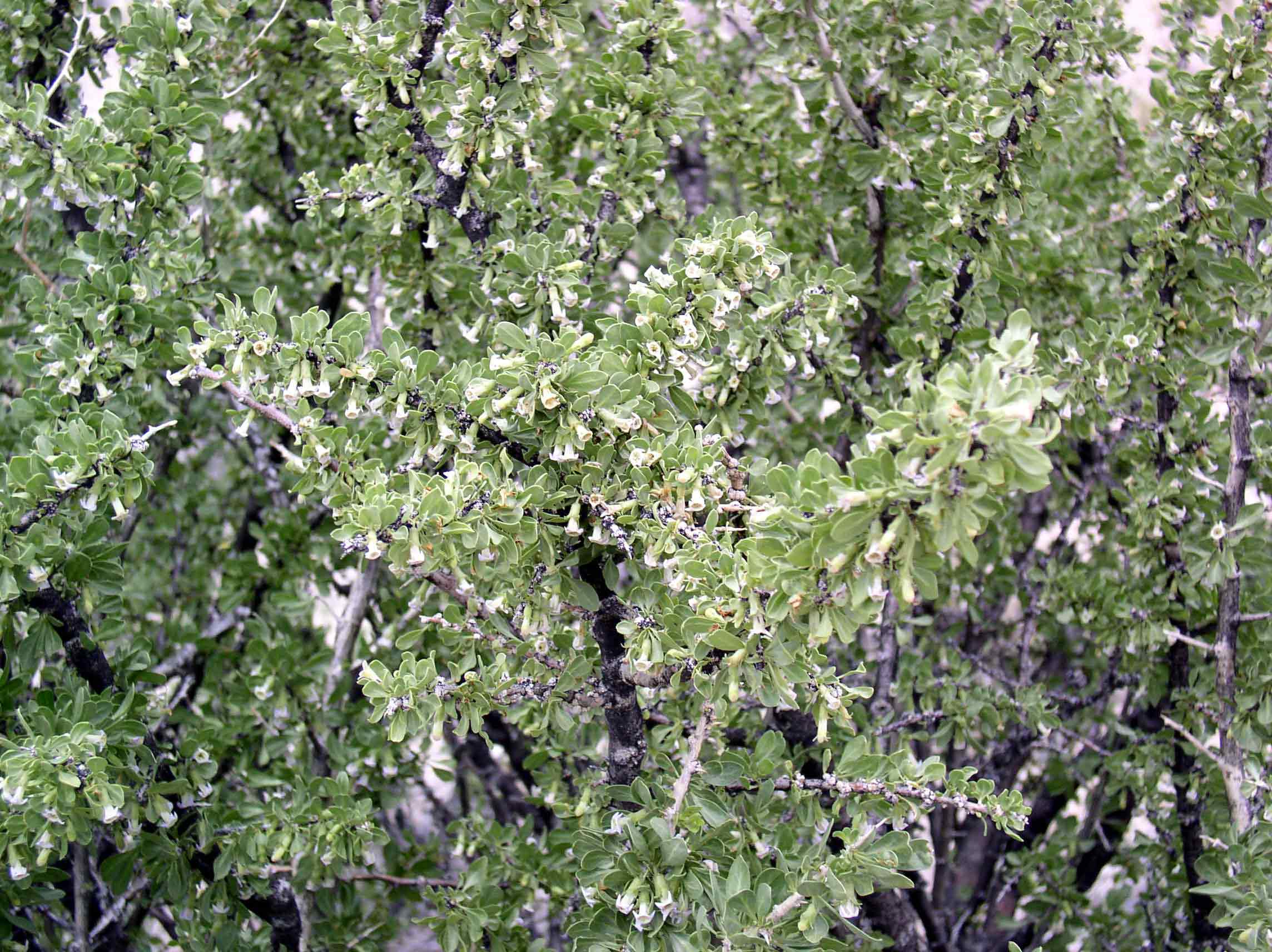
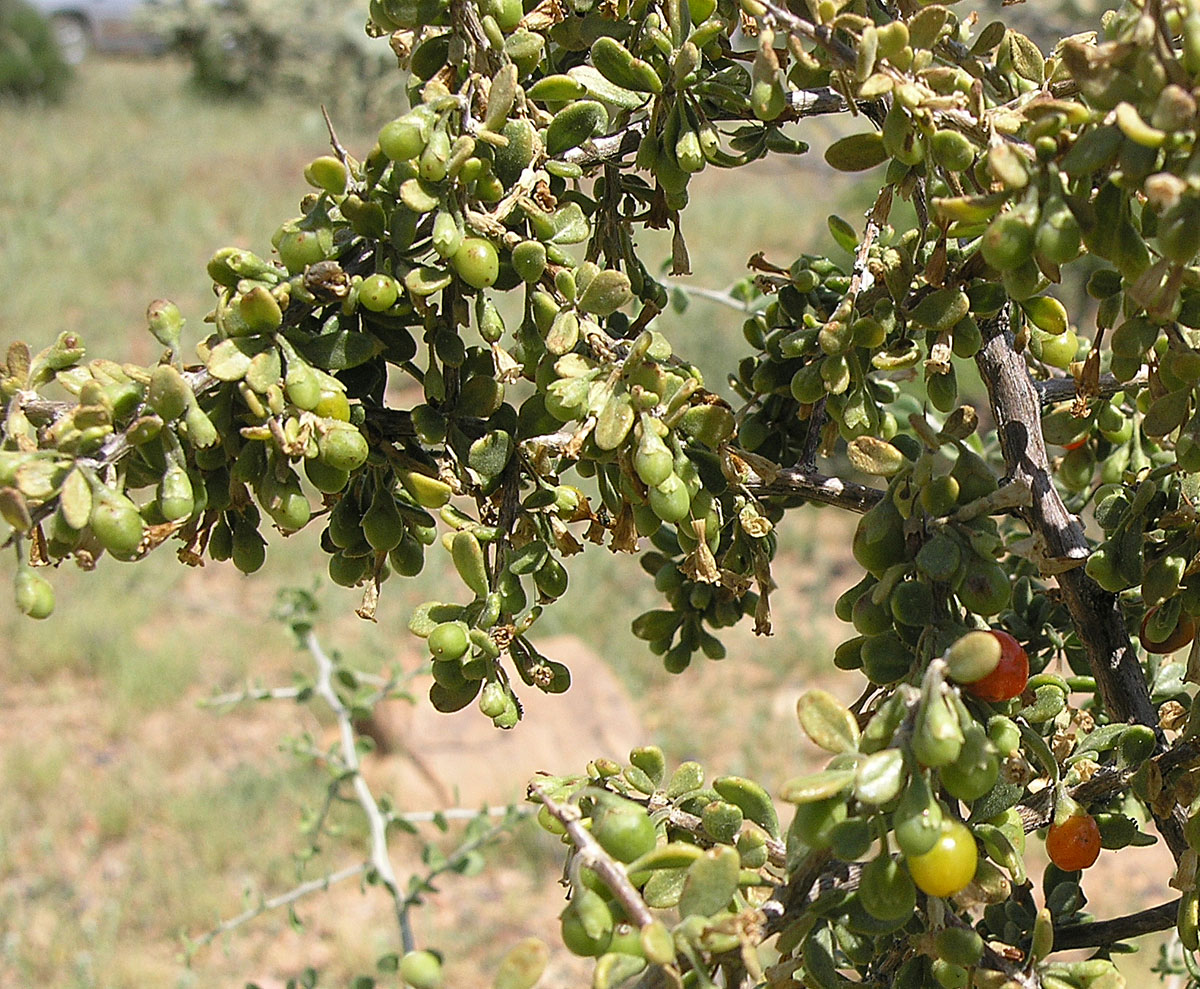
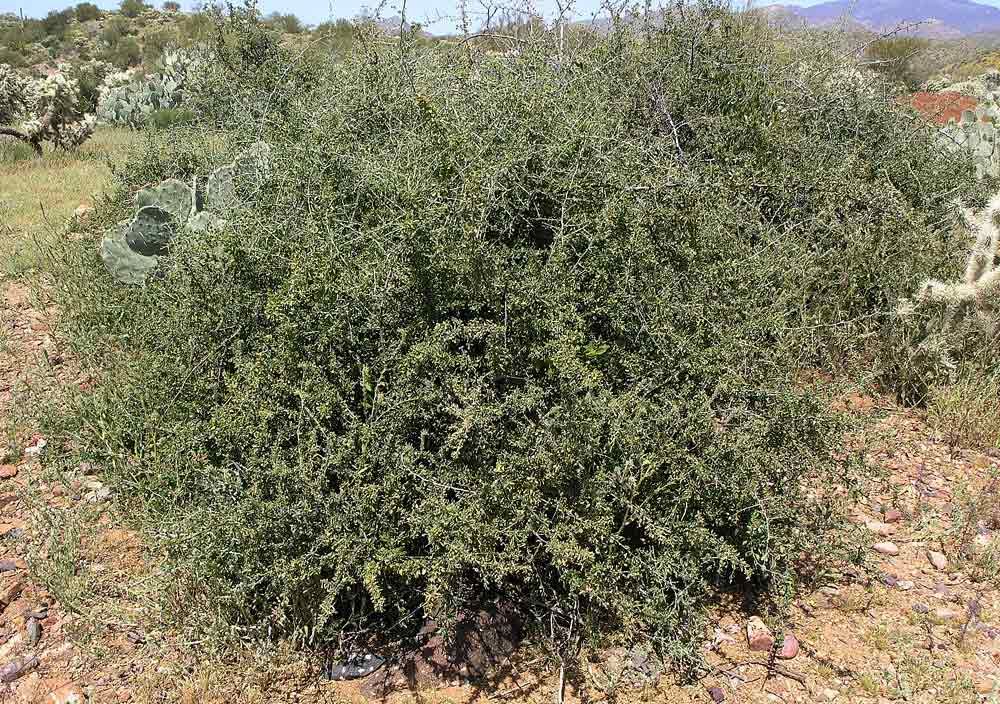
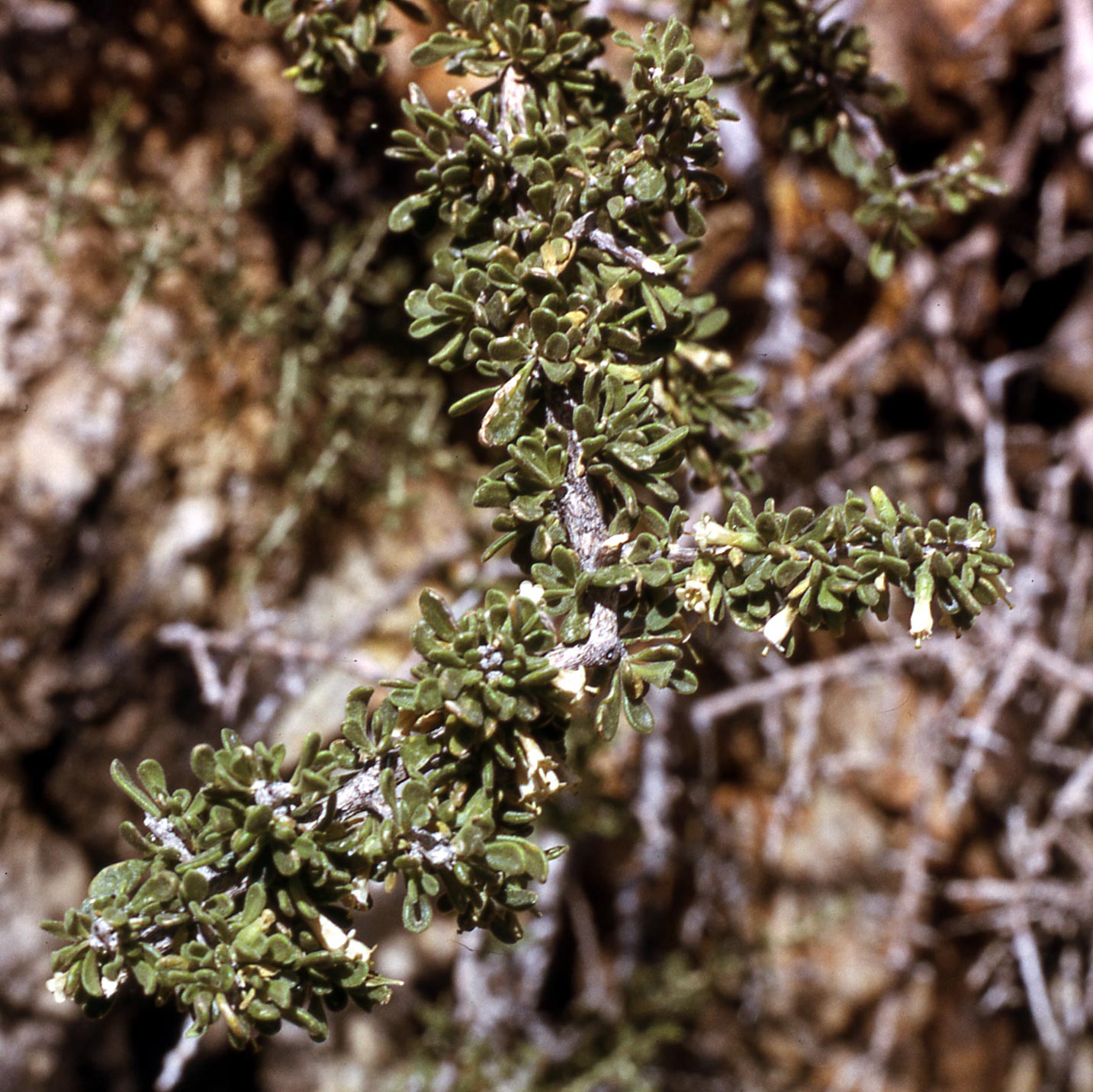
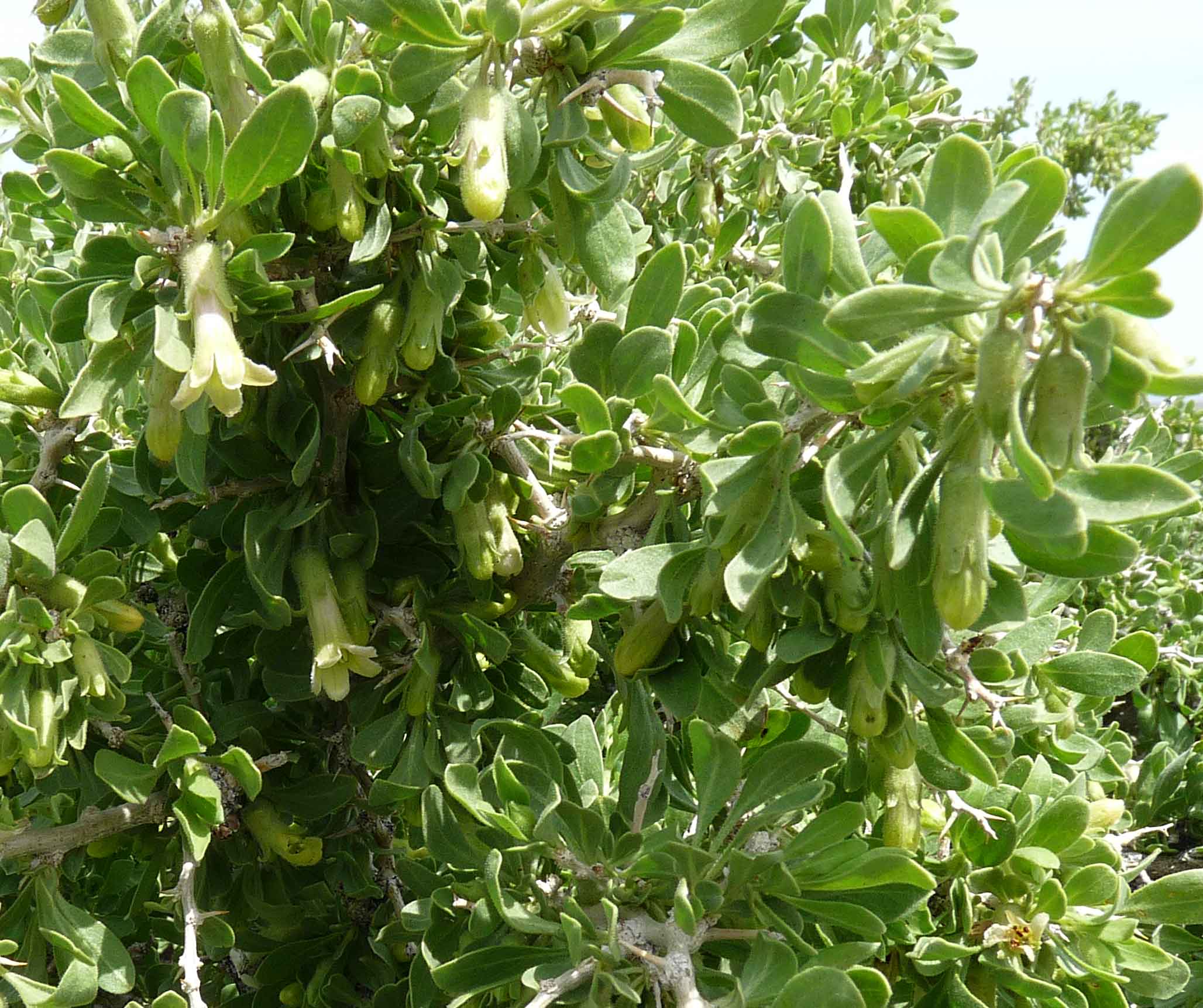
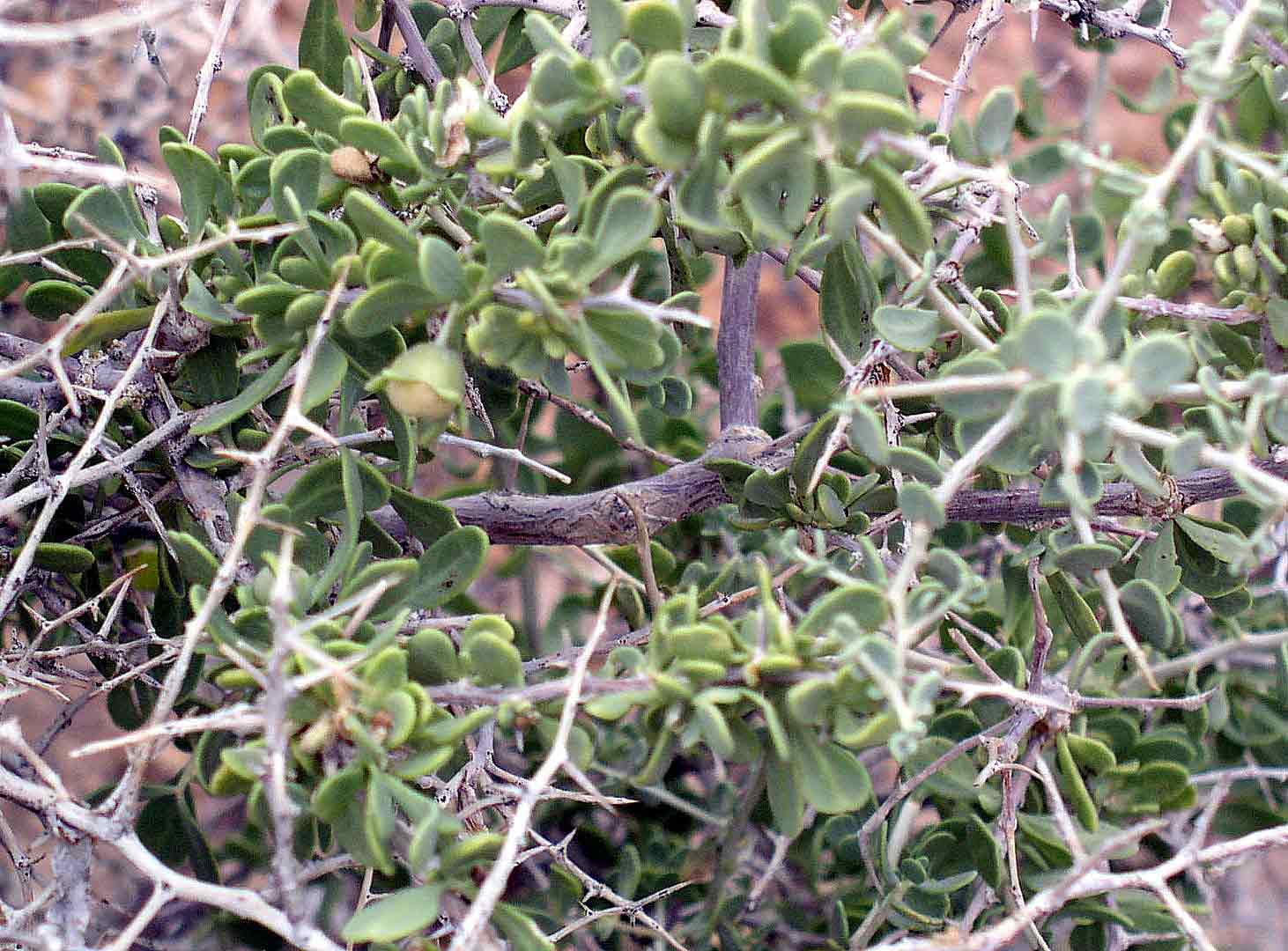
Lycium cooperi A. Gray 1868.
Peach-thorn. Spiny shrub with thick spiny arching stems to 3.5 m
high, branching frequently; leaves tongue-like in fascicles, 1–3 cm
long, grayish green, minutely glandular hairy, balding (glabrous) in
age; flowers Mar–May, white, greenish striped on the inside tube, the
tube cylindric, exserted twice the length of bowl-like 5-toothed calyx,
with 5 spreading to reflexed lobes curled inwards along their margins;
fruit drupaceous, greenish yellow, constricted and 3-lobed in the upper
third at the internal horizontal partition. In development, the
constriction shifts upward by elongation of the ovary The fruit of Lycium cooperi, commented on by Jepson, is distinctive for the apical transverse partition, dividing the upper third of the fruit into two separate fertile cavities. The lower fertile part is also divided but only longitudinally by the axile partition. The species is related to South American and southern Mexico species that have been treated in the genus Grabowskia, and to another monotypic genus in the Atacama Desert, Phrodus, which its apical divided portion of the fruit does not produce seeds. Levin et al. (2011), however, concluded based on relationships involving “two nuclear regions (granule-bound starch synthase and nitrate reductase) and four plastid spacer regions (trnH-pbsA, trnDGUC-trnT GGU, rpl32-trnLUAG, ndhF-rpl32)” that these genera should be lumped with Lycium. Lycium pallidum is also closely related but apparently does not have the apical partition. Lycium pallidum Miers 1854 var. oligospermum C. L. Hitchcock 1932, Much-branched spiny shrubs 1–2 m, often wider than tall; branches often flexuous, glabrous or sparsely hairy; leaves glaucous, 1–5 cm, widest above middle; flowers Mar–May, from leaf axils, single or in 2’s or 3’s, pendulous on slender pedicels 4–16 mm; calyx cup-shaped to bowl-shaped, blue-glaucous, divided half-way or more; corolla white to lavender purple, most commonly greenish with purple veins, tube funnel-form, 8–12 mm expanding to flaring lobes 1/5 to 1/3 length of tube. Fruit baccate, firm, green to purplish in California (JM2), red in the typical variety, ~1 cm, 2–3 seeded. Desert grassland, riparian areas, chaparral, pinyon-juniper woodland below 7.500 ft, mostly endemic to California. Type from Barstow, CA. Kern Co.: Dune ridge in the vicinity of Bakersfield [H. L. Bauer, 25 Mar 1928, RSA [CCH]. Other locations just outside Kern Co., ~15 miles west of Barstow and 4.5 miles north of Trona. Similar to L. cooperi in shape of the flowers and leaves, differing in corolla lobes flaring, not recurved along margins, having lavender veins, and by the glaucous foliage and purplish to greenish or white fruit without sutures. Jepson regarded the variety as the thorniest shrub in the central Mojave Desert. The typical variety has larger flowers to 18 mm, reddish fruit with more seeds, 4–50, occurring from Colorado and Utah south to Nuevo Leon, Mexico and west to Arizona and southern Nevada, most common in Arizona, type from Santa Fe Creek, NM. Pharmacological and Taxonomic References Levin, R., A. G. Bernardello, C. Whiting and J. S. Miller. 2011. A new generic circumscription in tribe Lycieae (Solanaceae). Taxon 60: 681–690. Zhang M., H. Chen, J. Huang, Z. Li, C. Zhu and S. Zhang. 2005. Effect of Lycium barbarum polysaccharide on human hepatoma QGY7703 cells: inhibition of proliferation and induction of apoptosis. Life Sci. 76(18): 2115–2124. “Lycium barbarum polysaccharide (LBP), extracted from Lycium barbarum that is a kind of traditional Chinese herb, is found to have anticancer activity. In this study, the effect of LBP on the proliferation rate, cell cycle distribution and apoptosis in the human hepatoma QGY7703 cell line were investigated. The effects of this compound were also tested on the concentration of calcium in cells. LBP treatment caused inhibition of QGY7703 cell growth with cycle arrest in S phase and apoptosis induction. The amount of RNA in cells and the concentration of intracellular Ca2+ were increased. Moreover, the distribution of calcium in cells was changed. Taken together, the study suggests that the induction of cell cycle arrest and the increase of intracellular calcium in apoptotic system may participate in the antiproliferative activity of LBP in QGY7703 cells.”
|
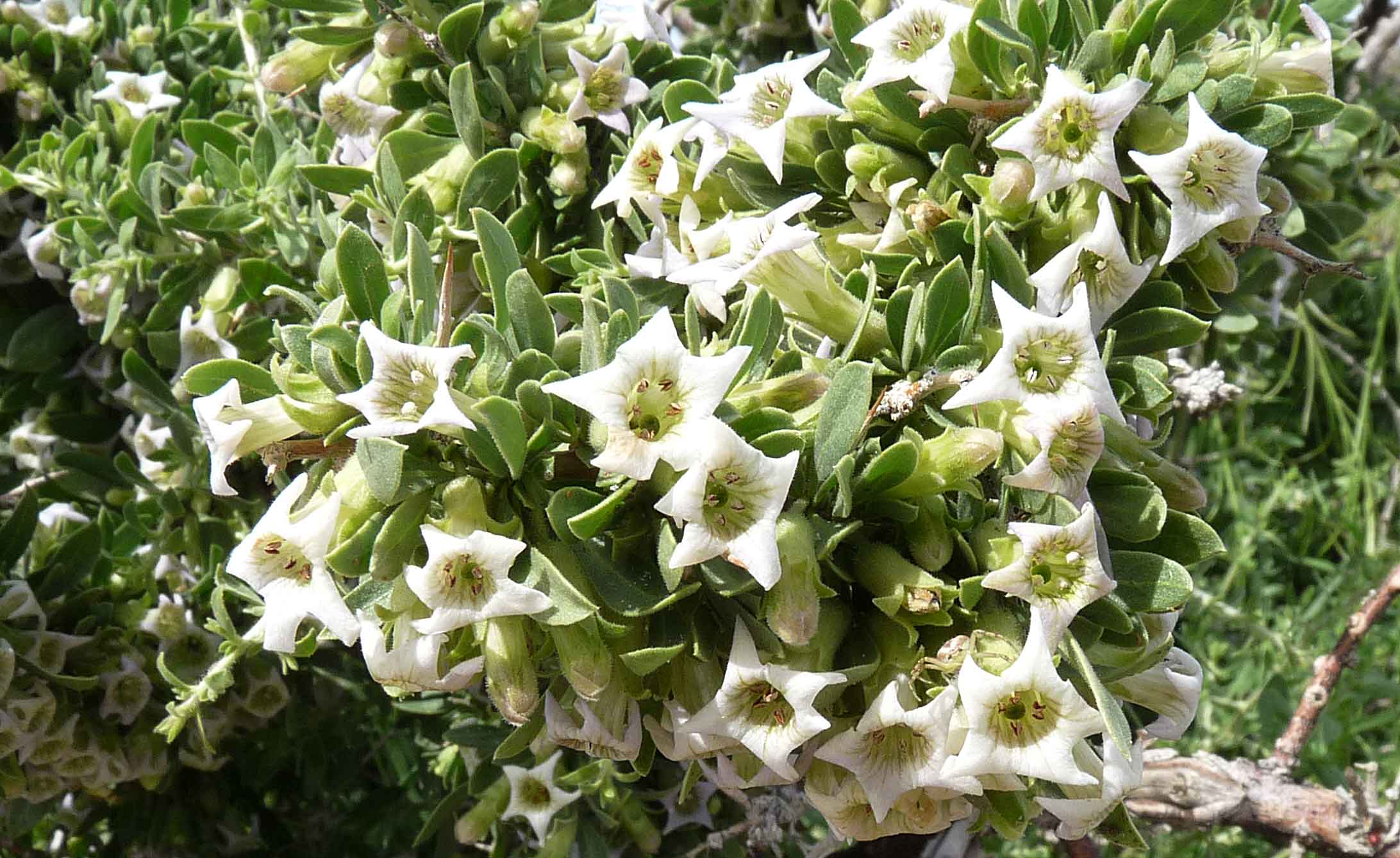
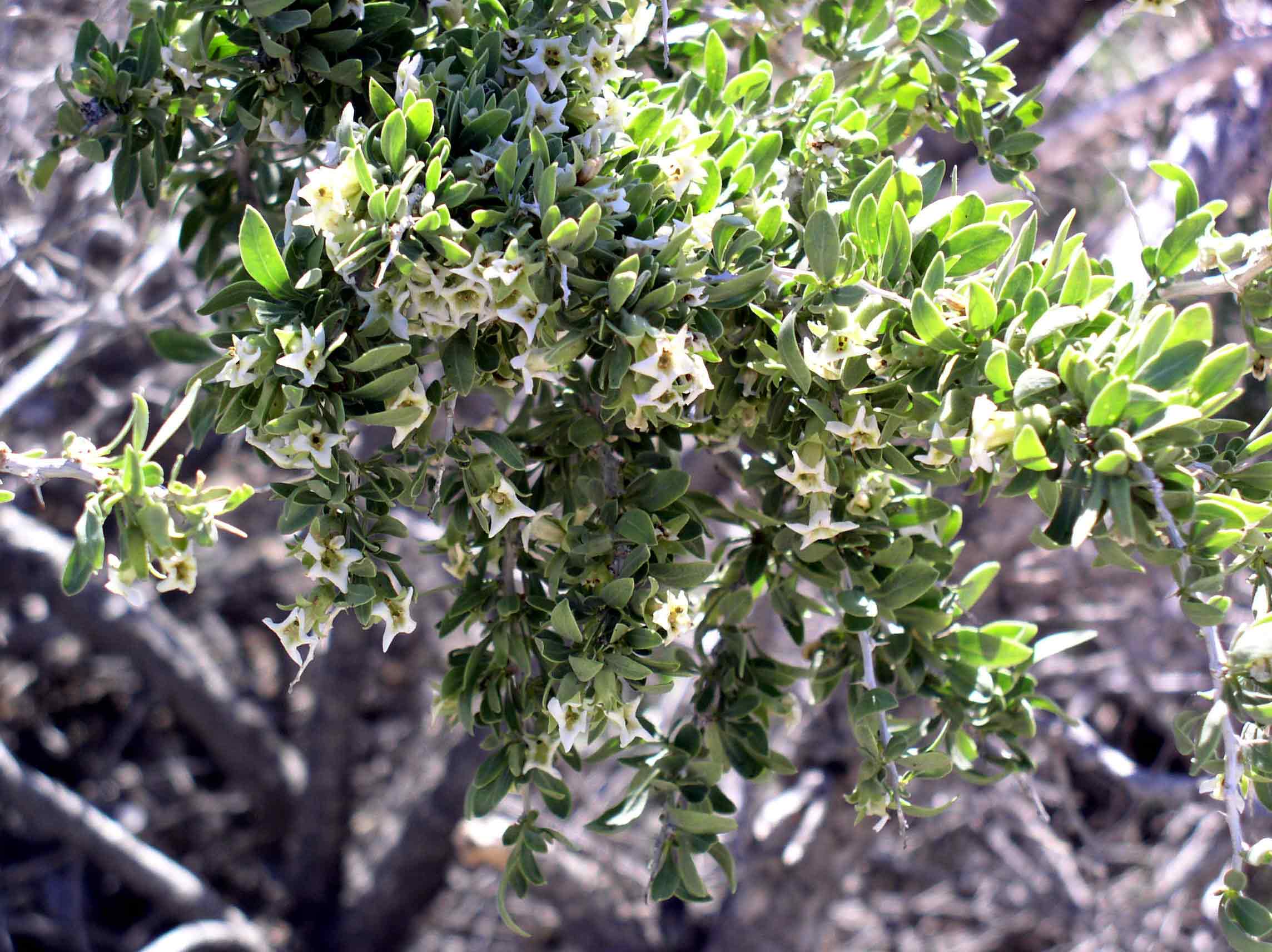
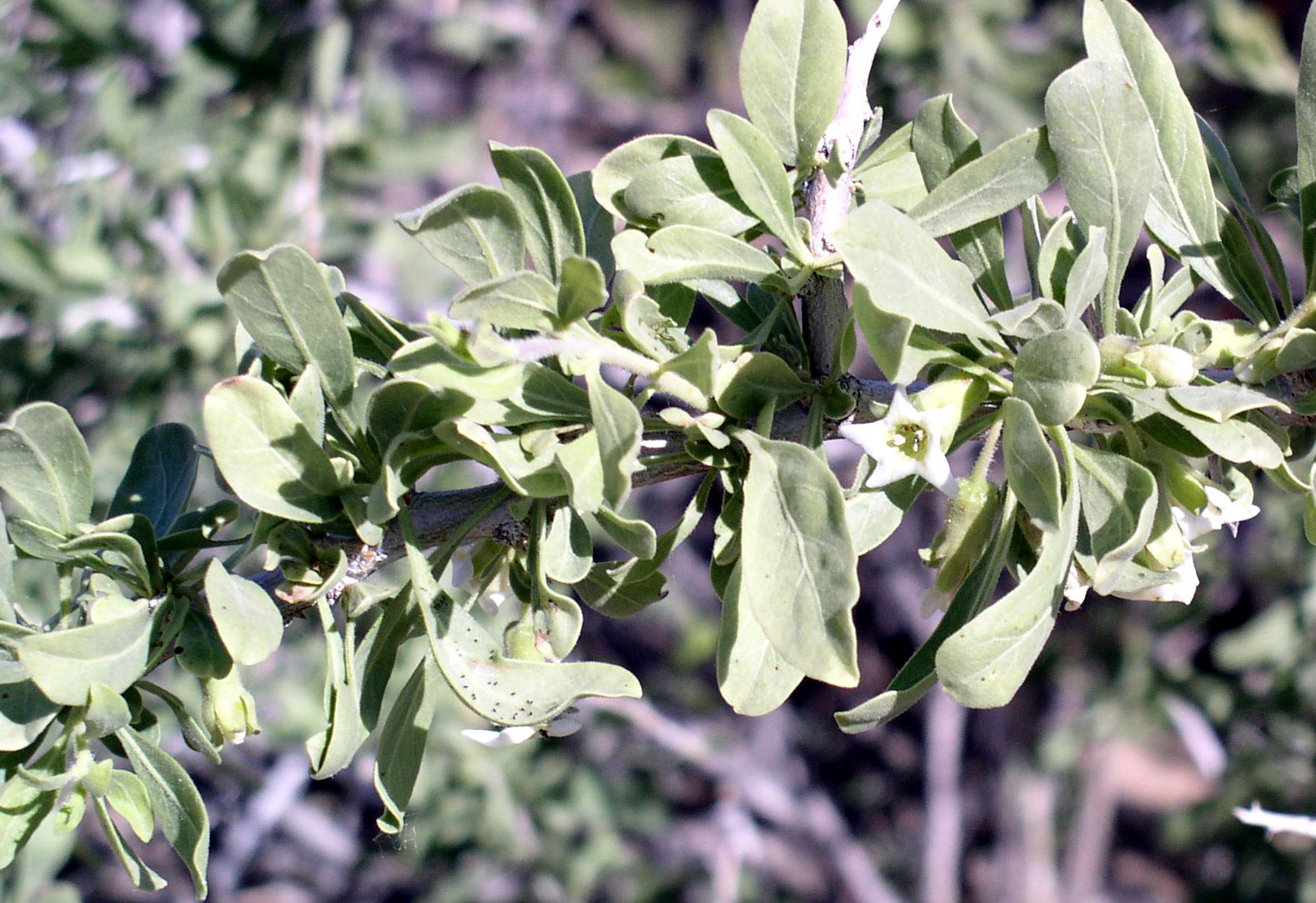

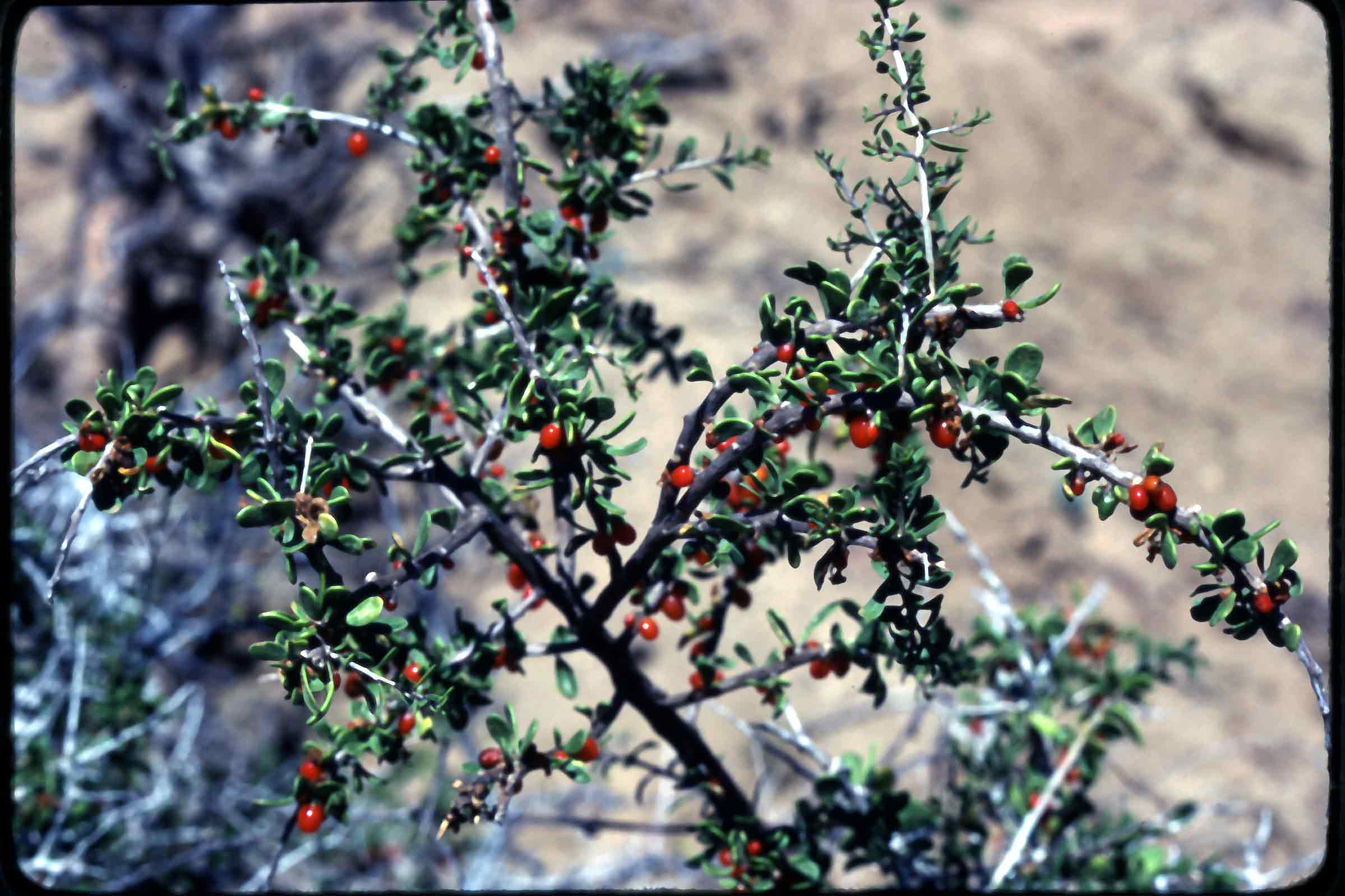
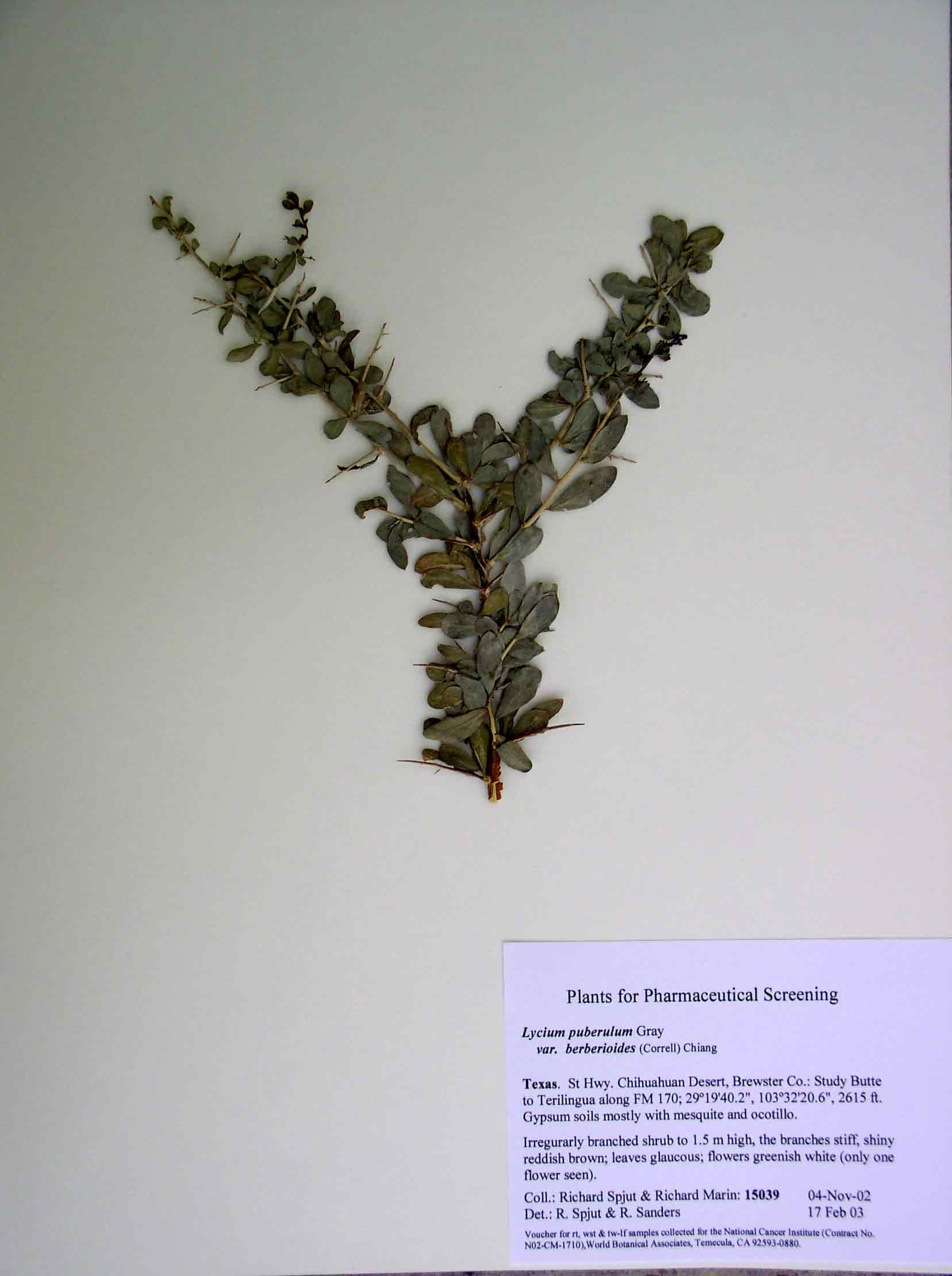
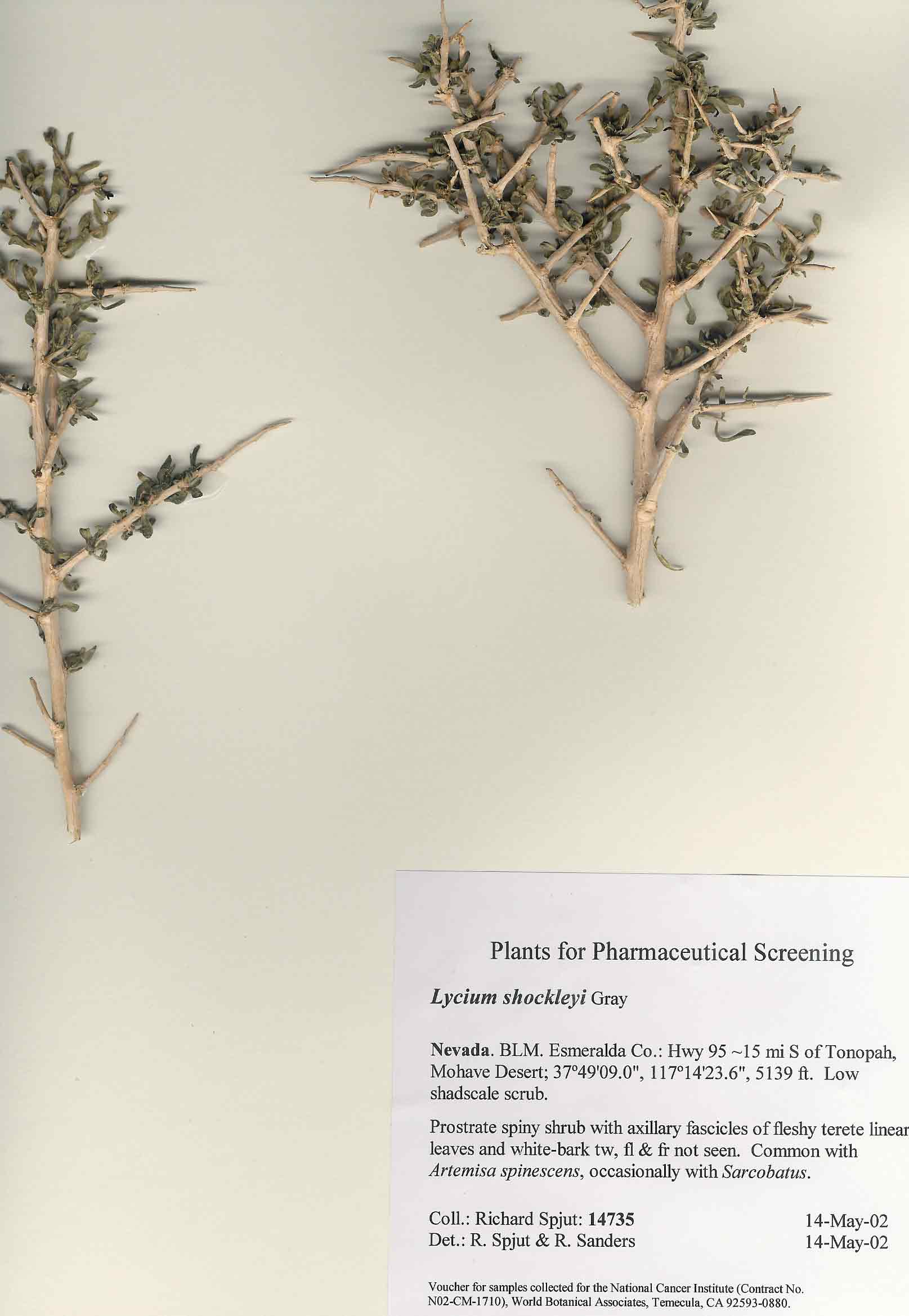
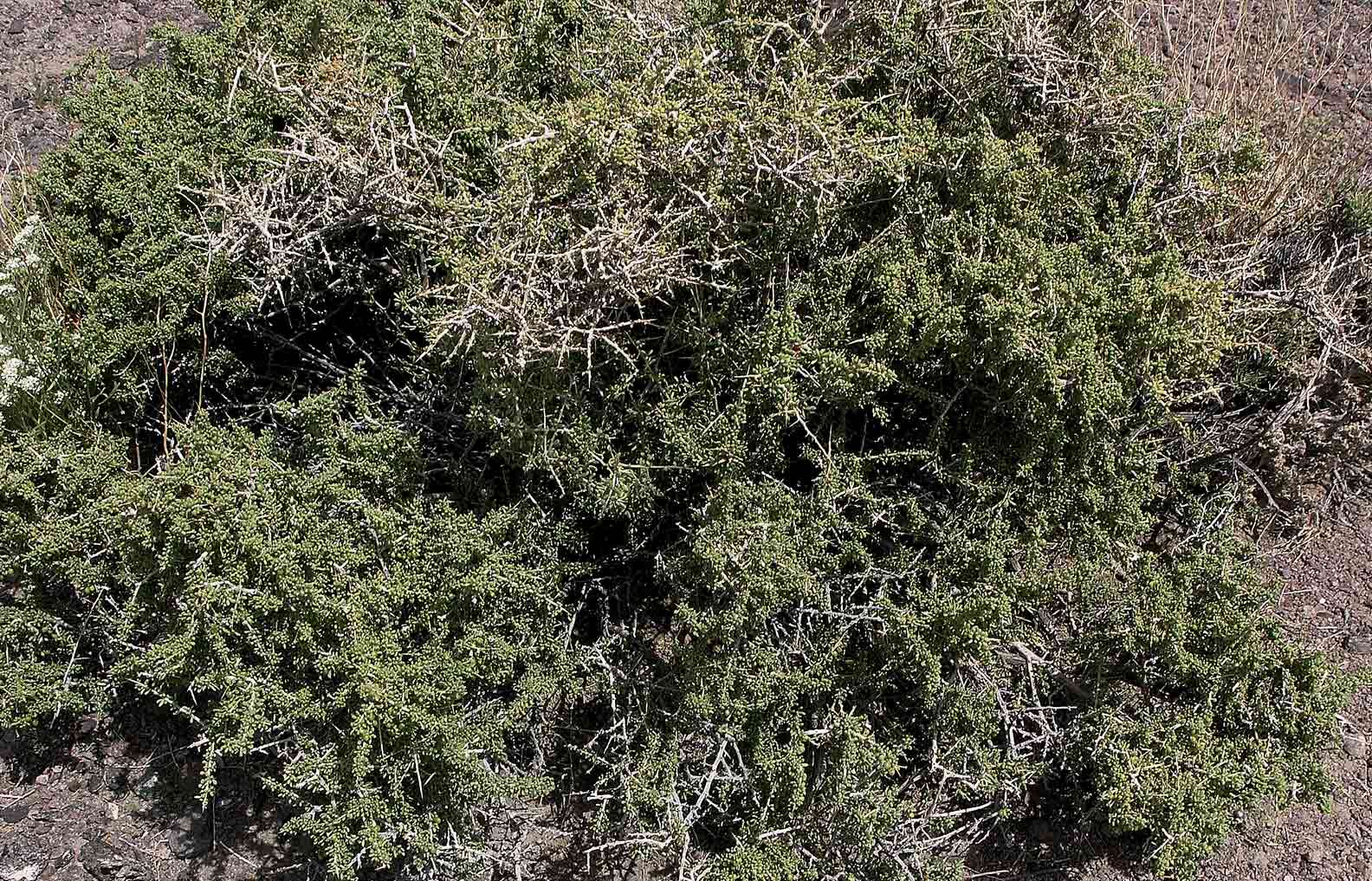
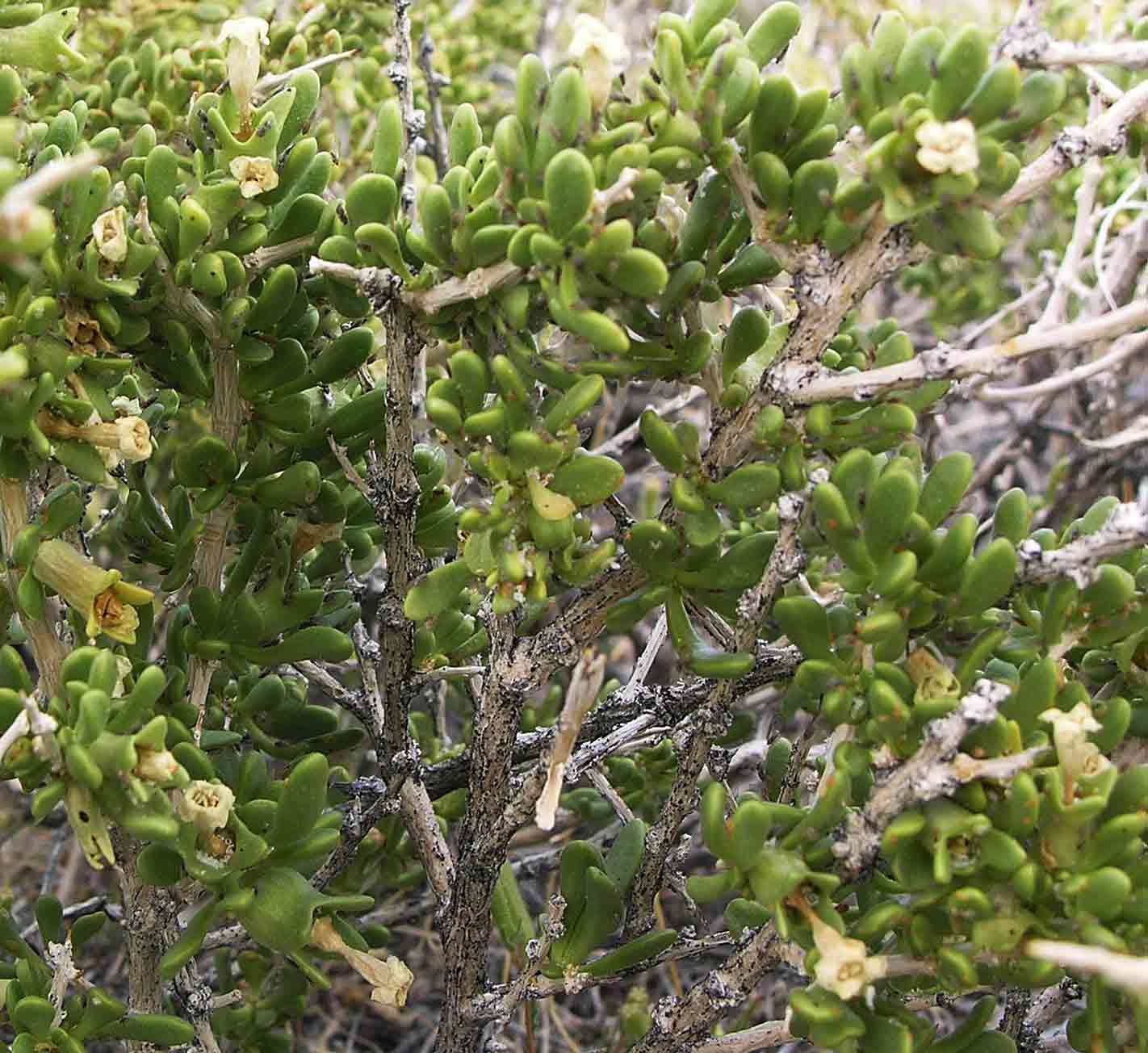
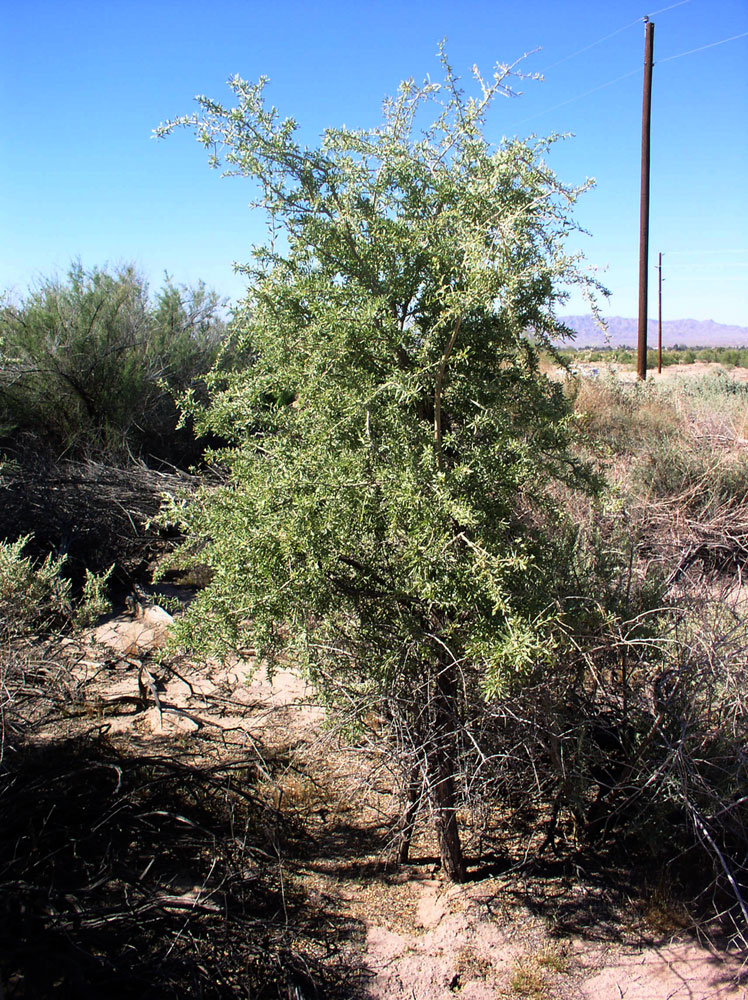
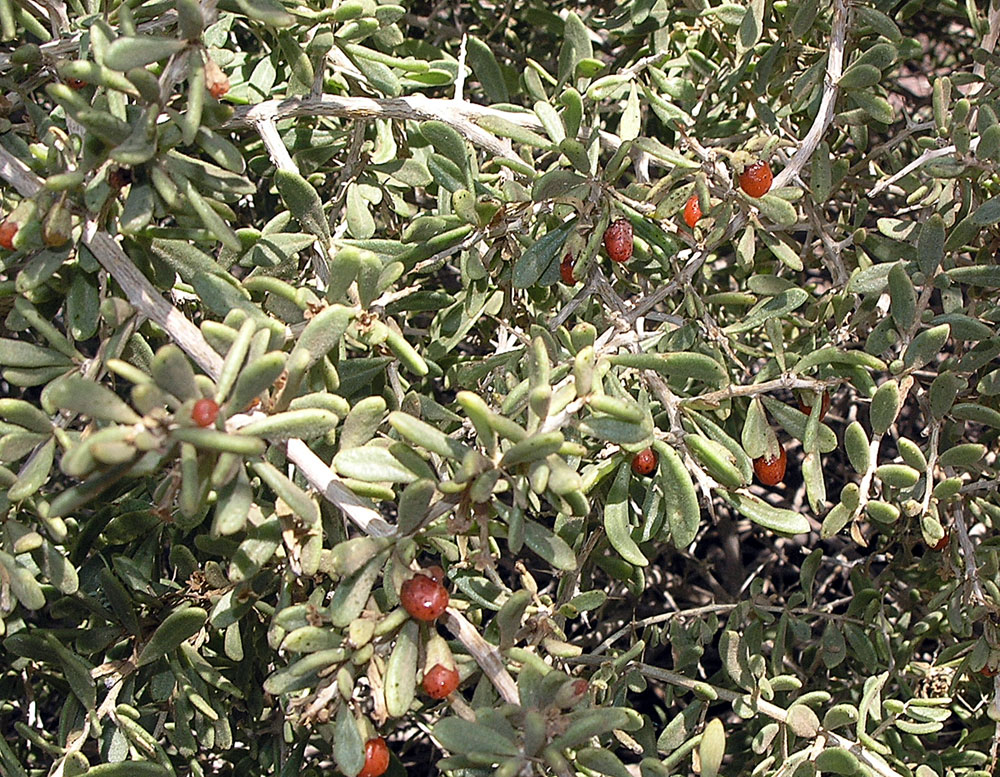
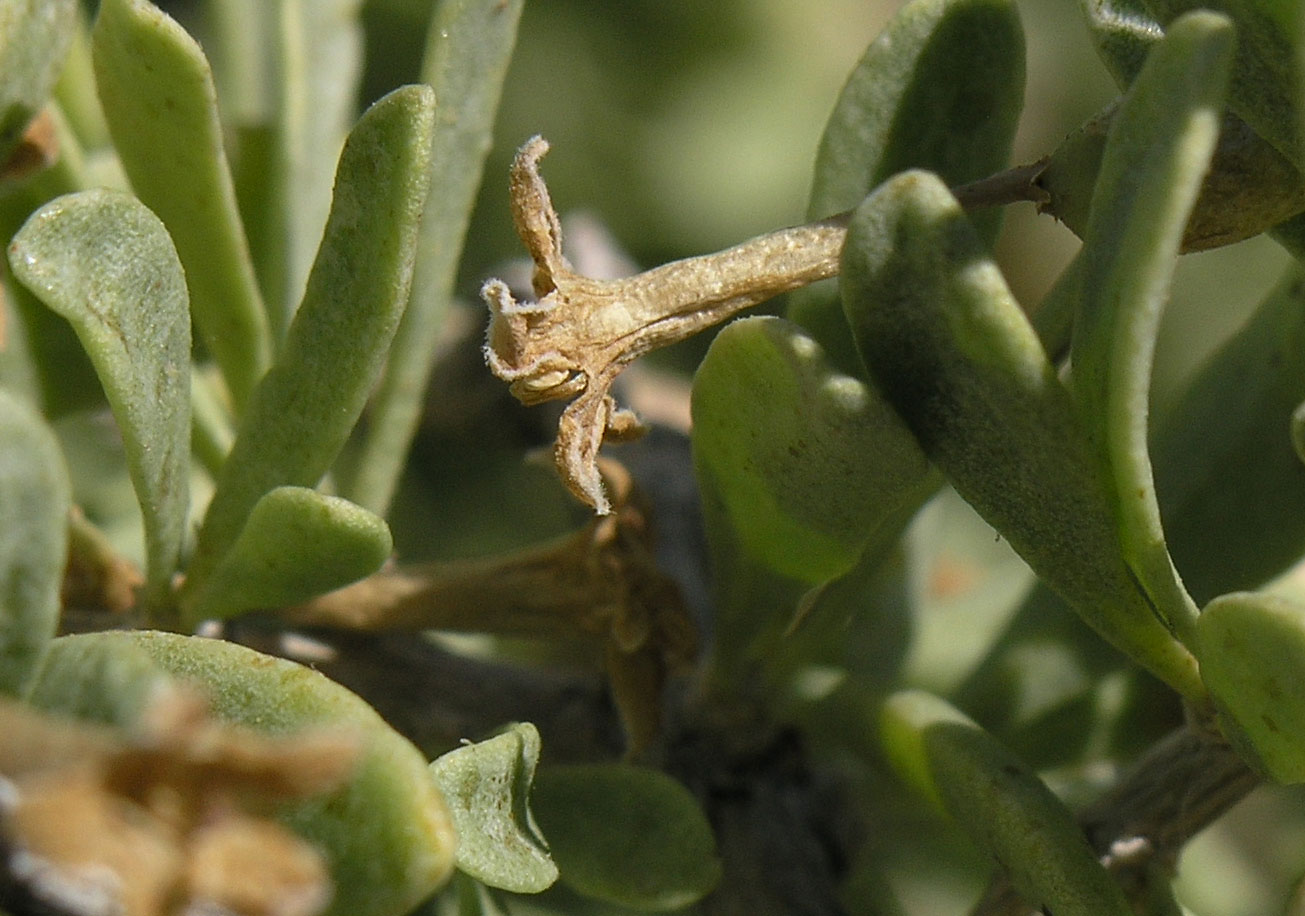
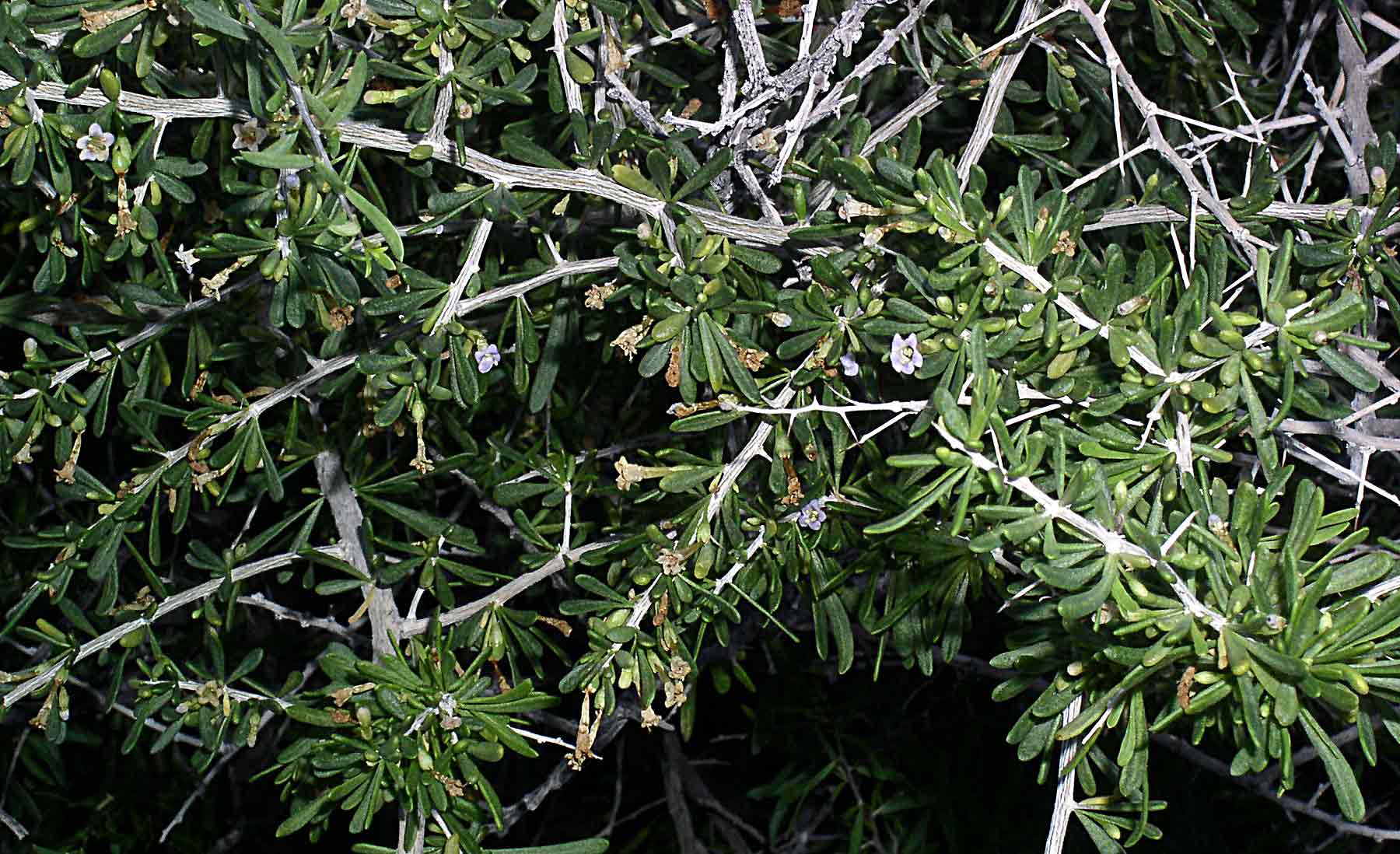
 gradually widened to apex, 3–15 mm, partially flattened to nearly round
in x-section; flowers Mar–May, with a long greenish yellow tube, the
corolla white to lavender, well exserted from leaves and from calyx,
2–4×, with 4–6 short spreading lobes ~as wide as long,1.5–2.5 mm;
fruit a red ovoid miniature tomato–like berry, 3–8 mm, many seeded.
Desert washes below 6,000 ft, also reported in southern San Joaquin
Valley, southern Coast Ranges, to Utah, New Mexico and northwestern
Mexico. Type from southeastern Nevada. Anderson’s box thorn scrub
recognized in MCV2 when >50% relative cover in the shrub canopy. Kern
Co.: Mostly around the fringe of the Mojave Desert between 2,500 and
3,600 ft, from north of Hwy 178 to Antelope Valley, and Red Rock Canyon.
gradually widened to apex, 3–15 mm, partially flattened to nearly round
in x-section; flowers Mar–May, with a long greenish yellow tube, the
corolla white to lavender, well exserted from leaves and from calyx,
2–4×, with 4–6 short spreading lobes ~as wide as long,1.5–2.5 mm;
fruit a red ovoid miniature tomato–like berry, 3–8 mm, many seeded.
Desert washes below 6,000 ft, also reported in southern San Joaquin
Valley, southern Coast Ranges, to Utah, New Mexico and northwestern
Mexico. Type from southeastern Nevada. Anderson’s box thorn scrub
recognized in MCV2 when >50% relative cover in the shrub canopy. Kern
Co.: Mostly around the fringe of the Mojave Desert between 2,500 and
3,600 ft, from north of Hwy 178 to Antelope Valley, and Red Rock Canyon.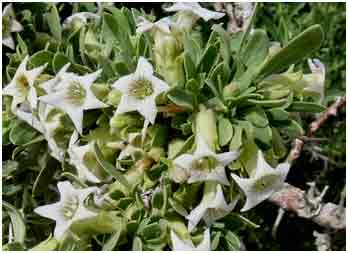 mostly below the constriction; seeds compartmentalized in four separate
pyrenoid sections. Sandy to rocky flats, washes in deserts with creosote
scrub to pinyon-juniper woodland, and in upper San Joaquin Valley to
Kern Co., below 6,000 ft., to Utah and Arizona. Type from eastern slopes
of Providence Mts., San Bernardino Co., CA. Kern Co.: “Common
in the dunes around the Muroc dry lakes, occasional on the desert and
the desert-facing slopes of the mountains west of to Kelso Canyon,
Cameron, and the arid slopes north of South Fork Valley; scarce in the
Elk and McKittrick hills; rare (one plant) on the Belridge Plain in the
valley” (Twisselmann), 106–1,524 m (CCH). Plants in the El Paso Mts. in
having plain petal lobes less reflexed.
mostly below the constriction; seeds compartmentalized in four separate
pyrenoid sections. Sandy to rocky flats, washes in deserts with creosote
scrub to pinyon-juniper woodland, and in upper San Joaquin Valley to
Kern Co., below 6,000 ft., to Utah and Arizona. Type from eastern slopes
of Providence Mts., San Bernardino Co., CA. Kern Co.: “Common
in the dunes around the Muroc dry lakes, occasional on the desert and
the desert-facing slopes of the mountains west of to Kelso Canyon,
Cameron, and the arid slopes north of South Fork Valley; scarce in the
Elk and McKittrick hills; rare (one plant) on the Belridge Plain in the
valley” (Twisselmann), 106–1,524 m (CCH). Plants in the El Paso Mts. in
having plain petal lobes less reflexed.