North American Species of Taxus
Wallichiana Group (Subgroup Wallichiana)

Last Update: Oct 2007.  Photos taken by Rick Spjut for
 T. brevifolia var. polychaeta added 11 Oct 2006; photos for T. floridana added 6 Jan 2007;
data for types revised 14 Dec 2007; Record for var. polychaeta occurring in Idaho noted 30 May 2007.


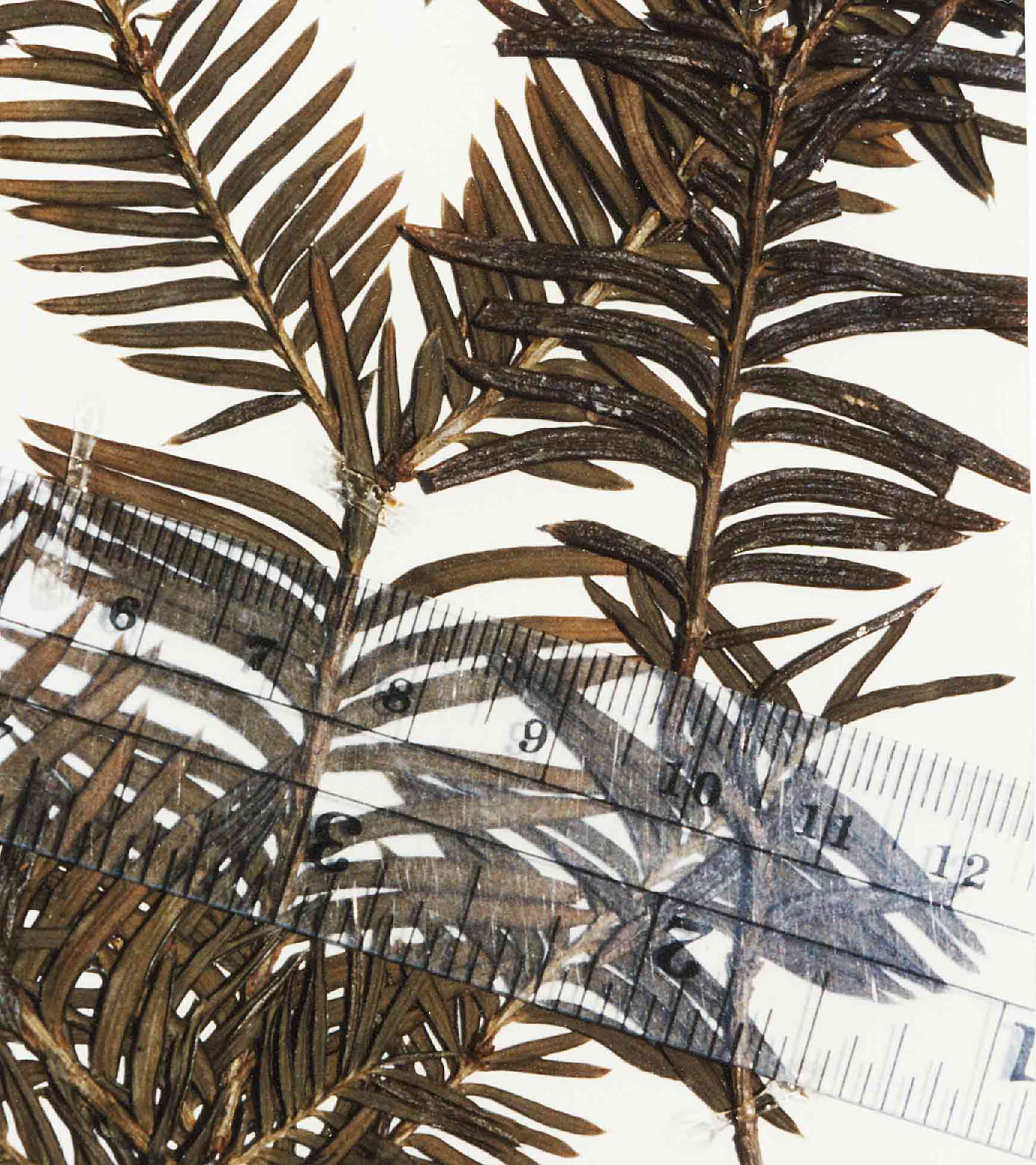
3. Taxus brevifolia Nuttall, N. Amer. Sylv. 3: 86 (1849). Tab. 108 captioned “Taxuswpe44669.gif (52711 bytes) occidentalis”, without reference to specimens. T. baccata var. brevifolia (Nutt.) Koehne, Deutsche Dendrol. 6 (1893). T. baccata ssp. brevifolia (Nutt.) Pilger, Planzenreich 4(5): 113 (1903). Type—U.S.A. Oregon: “Columbia woods,” Nuttall s.n.; lectotype BM! (Nuttall Herbarium, annotated “T. occidentalis” —top specimen with mature male cones, shown here in part; designated by Spjut 2007b); isolectotypes K! PH!. This was originally discovered by David Douglas in 1825 (Sargent 1896). Douglas began his journey up the Columbia River at the mouth in April 1824.  However, the lectotype was probably collected by Nuttall along the Columbia River during the spring of 1835.

Taxus boursieri Carrière, Rev. Hort. 1854: 228 (1854), no specimens cited. Type: U.S.A., California, “forests near stream with Thuja, Abies grandis, Pinus lambertiana,” described as an arborescent shrub with slender branches, leaves 1.5–1.8 cm long, glaucous below, original material unknown. Neotype (designated by Spjut 2007b)—California, Siskiyou Co., Shasta Springs, Jepson s.n., Aug. 1894 (US!).

Taxus lindleyana M. A. Murray, Edinburgh New Philos. J. 1:294. 1855. Also, Rev. Hort. sér 4, 4:379. 1855; Lawson ex Carrière, Traité gén. conif. 523 (1855). Type: U.S.A., California, N and E of San Francisco between 40° and 41° latitude [Klamath Region], “along sides of a glen.under the shade of larger trees”; lectotype (designated by Spjut 2007b) from original material of two specimens at Edinburgh—specimen with accession number E00030316 (E!), shown below, annotation Taxus lindleyana, presumably by Murray, additional notation indicating journal publication (possibly R. Jameson), and another notation indicating “probably only a form of T. baccata, perhaps the T. cuspidatus [spelling?] of Sieb. & Zucc.”  Another specimen annotated T. lindleyana was indicated to have been collected from Vancouver, which may have been before his trip to California.

Taxus lindleyana, lectotype


wpe68193.gif (301540 bytes)

Taxus lindleyana, lectotype


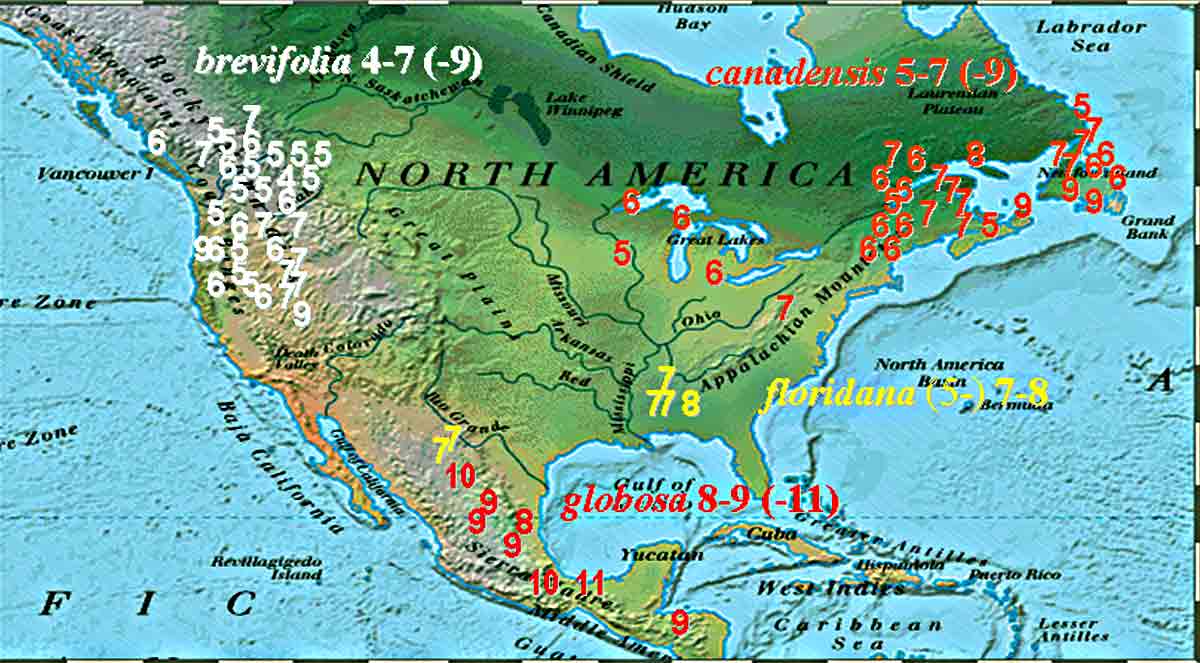
Pacific yew. Distribution: S coastal Alaska to central California—Coast Ranges and W Sierra Nevada (to Sequoia Natl. Park), S Canadian Rockies—British Columbia and W Alberta, S to W Montana. Often in shade of old-growth forests on N slopes, in bottomland forests, occurring also in seral communities along streams and forest margins; generally in mixed evergreen and montane coniferous forests from sea level to 2650 m; most frequent in forest dominants of western hemlock along W Cascades (Franklin & Dyrness 1969), Douglas fir (Eliot 1938] and lowland fir (Bolsinger & Jaramillo 1990), or sitka spruce and western red cedar in the northern range (Taylor 1932; Taylor & Taylor 1980).

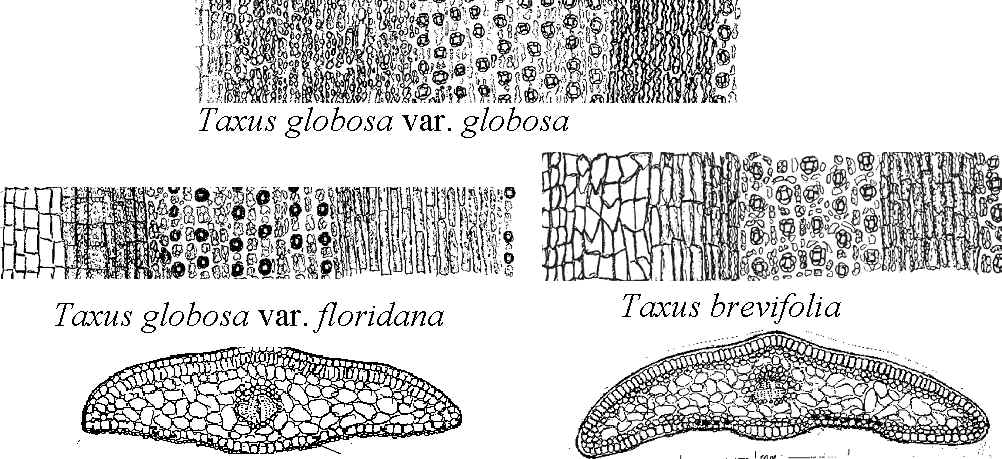
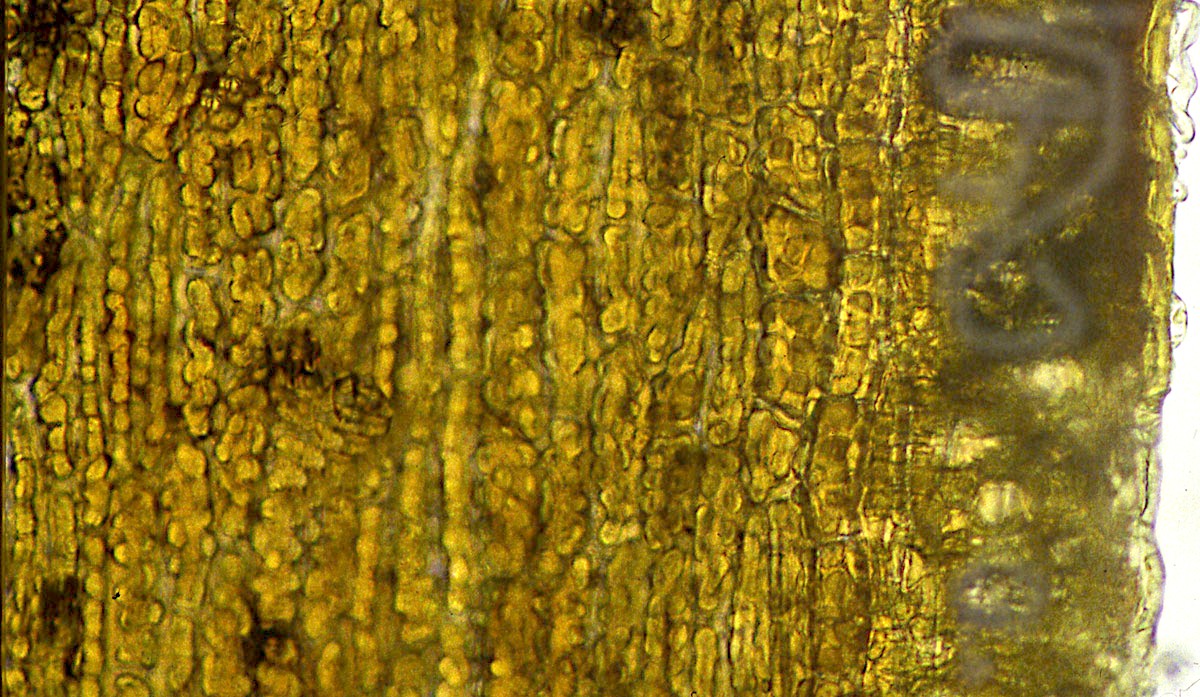
This species is distinguished by its leaves having relatively large angular epidermal cells as seen in T-section (see below),  by relatively narrow stomata bands with usually 4–7 stomata rows, and by the trapezoidal or wedge-shaped cells in the abaxial marginal zone (see illus. in key). The leaf arrangement, shape and texture, and large angular cells in T-section, and the persistent bud-scales are features also seen in a rare Himalayan species, T. suffnessii Spjut (Myanmar), one that I regard as having most of the ancestral features of the Wallichiana group.  Nevertheless, leaf anatomical data suggests T. brevifolia was derived from T. globosa by loss of stomata and increase in cell size, possibly as it adapted to a drier climate that developed during the Tertiary.  Moreover, I believe that Mesoamerican yew  descended directly from the Suffness yew, and that the Florin yew, although nearly indistinguishable,  evolved independently (apomorphy).

Although T. brevifolia is typically a tree, four rather distinct shrub forms can be recognized in the field; however, I have not been able to distinguish them in the herbarium with exception to possibly one that occurs in the Klamath  and Rocky Mountains (Spjut et al. 1993).  Here I recognize several varieties based on whether plants reproduce by layering, and by differences in length and persistence of cone scales.  In further study, additional species and varieties might be segregated.

Additional Comment concerning the southern limits of the geographical distribution (Oct 2007):  Spjut (1977) indicated the southern distributional limits of the species as possibly Marin County along the Coast and Tulare County in the Sierra Nevada; however, he has since cited a specimen from San Mateo County (Spjut 2007a), which belongs to var. brevifolia.   The coastal limits of the species could be further south—in the Santa Cruz Mountains (John G. Lemmon, Handbook of West-American Cone bearers, 1895; Munz 1959)—but this has not been substantiated in modern checklists of the area (R. Morgan et al. 2005.  An annotated checklist of the vascular plants of Santa Cruz County, California.  California Native Plant Society; SEINet 2006, http://seinet.asu.edu/seinet/symbiota/sonora/checklist.php?clname=Santa%20Cruz%20County).  Similarly, Spjut (1977) also noted that the distribution in the Sierra Nevada has been questioned (see P. W. Rundel, The southern limits of Taxus brevifolia in the Sierra Nevada, Madroño 19: 300, 1968). The southern limits in the Sierra Nevada—Tulare County, possibly Sequoia National Park (Spjut 2007b;  Munz 1959)—may be traced to Jepson (Silva of California, 1910; Univ. Press, pp. 164-168), but present day records of the species are not known south of Calaveras County (the North Grove, Calaveras Big Trees State Park. Dean Taylor, pers. comm., Sep 2007).  Moreover, the reported southern occurrences—in Yosemite Natl. Park (based on specimens by Lemmon (UC334344; US) who may have received them from John Muir) and Tulare County (Jepson 1910)—may be erroneous (Rundel 1967), especially in view of the Wieslander vegetation surveys of the 1930's (Dean Taylor, pers. comm., Sep 2007).  It is nevertheless interesting to note that T. brevifolia has once occurred in southern Sierras—on the Kern Plateau—during the Quaternary (Axelrod in Barbour & Major, Terrestrial Vegetation of California, 1977; John Wiley & Sons, NY).

3a. Variety brevifolia. Tree, reproducing vegetatively by adventitious shoots from trunks or roots; cone scales deciduous except near base, seed longer than the pedunculate axis.

Representative SpecimensU.S.A.—Idaho: Idaho Co.: near Allison Creek, bridge 221-65.1, T28N R2E Sec 14, tree 28' high, 15.8" dbh (fresh), Shields s.n. (wba). Washington:  Lewis Co., Gifford Pinchot Natl. For., 7 mi N of Packwood along State Hwy. 5, small tree to 8 m, Barclay et al. 1645, voucher for antitumor active sample in discovery of taxol (NA); same locality, tree to 35 ft, Barclay & Arguelles 1771, voucher for recollection from which taxol was isolated (Wani et al. 1971) (NA). Oregon: Clackamas Co., Mt. Hood Natl. For., above Ripplebrook For. Sta., Perdue 13002 (NA); W Cascades, Clackamas River area, T7S R8E, tree number 007-011, 930 m (fresh), Lankford s.n. (wba); Josephine Co., mi S on road 2500.052, above Taylor Creek on Minnow Creek Road, T35S R8W Sec. 27, 650 m, USFS s.n. (wba); same locality, just above jct. with road 25, tree form, 70 cm to 10 m tall (fresh); T35S R8W Sec. 34, tree, 16.3" dbh (wba); Columbia River, 1860, Lyall s.n. (K). California: Del Norte Co., Oregon Mt. Rd., 1 mi up from S end, along both sides of road, T 18N R4E Sec. 16, 200 m, fresh specimens from various trees and heights, female tree—top middle and bottom branches, lower branch of female tree 12-13 m high and 50 cm diam., middle branch of female tree 6-7 m high and 15 cm diam., middle branch of female tree 5 m high and 7-8 cm diam.; top branch of male tree, lower branch of male tree 13 m high and 30 cm dbh, Yager & Bozovsky s.n. (wba); Siskiyou Co., Marble Mts. Wilderness Area, Lovers Camp, 2000 m, tree to 10 m (fresh), Spjut 10171 (wba); Salmon/Trinity Mts., Klamath Natl. For., 11 mi W of Callahan-Etna Road along French Creek Road, Duck Creek drainage, mixed evergreen forest in narrow ravine. 41º20' N, 122º54.32'W, 3700 ft, tree, 4–6 m high, Spjut 12309 (wba); Trinity Co., Slate Creek near Tannery Gulch, Trinity Lake, 700 m, Spjut 10179 (wba); Humboldt Co., base of heavily wooded slope bordering flood plain of E fork of Willow Creek, ca 6 mi W of Willow Creek town, near Hwy. 299, 1500 ft; same locality, Terrell et al. 4170 (NA).


Taxus brevifoliaOregon—Type (BM).  Lectotype: upper left specimen.

Taxus brevifolia var. brevifoliaWashington.  Thurston Co., Barclay 1645, Aug 1962; voucher for sample that led to the discovery of taxol, photo showing close-up of seed.

California. Humboldt Co.  Inner Coast Ranges.  Terrell et al. 4170, sample from one tree, special study.

Oregon: Near Ashland. Area clear-cut, except for yew trees.


Marble Mountains, Lovers Camp Trailhead to Wilderness area, Spjut 10171, July 1987.  Area evidently selectively logged in the past, yew trees left standing.

California: Shasta-Trinity NF, Trinity Co., Stuart Fork Valley, July 1997. Area clear-logged and yew trees left, the foliage turned orange from exposure to sun.  Tree in forest on steep bank.  Close-up of branchlet with male cones.

California.  Klamath NF.  Callahan-Cecilville Rd, 2900 ft, Douglas fir, ponderosa pine forest, Spjut 16019, Aug. 2006. Photos show trees with both single and multiple trunks from base.


California. Klamath NF: Siskiyou Mts. NW of Yreka; Rich Spjut & Susan Spjut 15802, Oct. 2004.

California—Var. brevifolia, showing mostly plants developing from what appears to be a burl-like base.  Various plants photographed along the North Fork of the Salmon River, Marble Mt Wilderness, between 3000 and 3500 ft., July 2006.  This also appears to be another distinct variety by the multiple stems that arise from the base; however, both single and multiple trunk types may occur together.  Also, the phyllotaxy is very much like that of the lectotype. Stuart and Sawyer in Trees and Shrubs of California (Univ. Calif. Press, 2001) distinguish Juniperus osteosperma by its single stem from the multistemmed J. californica.  Note that yew trees growing on steep banks have erect stems instead of decumbent stems; thus, decumbent vs. erect stem growth appears to be a genetic difference. Center right photo shows branches trailing along ground that do not appear to generate new shoots, only leaves are evident.


Taxus brevifolia var. brevifolia.  Specimens with seed.  Left: from California, Sierra Nevada, Yosemite, Lemmon, yr 1874 (US).  Right: California: Mt. Shasta, Brewer 1361 (US).

Taxus brevifolia var. brevifolia.  Specimens with male cones.  Left: California. Sacramento Valley, USDA without number, yr 1888 (US). Right: California. Sierra Nevada, Placer Co. Bolander 4554 (US).

Taxus brevifolia var. brevifolia.  California.  San Mateo Co. Stokes s.n. (US).

Taxus brevifolia var. brevifolia.  California.  Mendocino Co., Clark s.n., yr 1877 (US).

3b. Taxus brevifolia var. polychaeta Spjut—J. Bot. Res. Inst. Texas 1 (1): 217. 2007. Type: U.S.A., Washington: Thurston Co., Mud Bay, near Tacoma, F. G. Meyer 1589 (holotype: K!), photo shown in key.  . 

Worm-cone yew: California (Mendocino Co.?, Sonoma Co.), Washington (Mud Bay near Tacoma).  Additional Specimens: California: Sonoma Co.: 7 km E of Stewarts Point, redwood-grand fir forest, 200 m, Rich Spjut & Rick Spjut 16021 (wba). Bigelow (Marin, Sonoma or Mendocino Co.), yr 1854 (US); Salmon Creek (Sonoma or Mendocino Co.?), McMurphy 315 (US).  Idaho, near Coeur d'Alene, shipped by Marion Blatch as fresh material via overnight mail from Coeur d'Alene Nursery, 26 June 1992, possibly collected in nearby Washington; collector, locality, and habit of plant unknown, supplied by the USDA Forest Service.  A report by Spjut (1977) noted a collection from “Coeur d'Alene National Forest: T51N R8W Sec. 25; 3,800 ft, on north slope near stream.”

This new variety is recognized by elongate cones (well-developed secondary fertile shoots) that resemble annelid or polychaete worms, hence, the epithet, polychaeta.  It apparently occurs with the typical variety as other specimens collected by Fred Meyer at the type locality under the same number (US) have typical cones.  It remains to be determined whether var. polychaeta  has biological 'species' significance.  Unique genotypes in T. brevifolia have been recognized, but only in relationship to other geographically differentiated genotypic populations (El- Kassaby & Yanchuk 1994), which have been studied without correlation to morphological and reproductive differences. The California specimens have shorter cones (fertile shoots) compared to the northern collections from Washington and Idaho; nevertheless, the stipe-like base in the female cones in California specimens appears to be a consistent developmental feature.  Female cones in some specimens of var. reptaneta also appear elongate, especially on older branchlets, while its male cones are typical of the species.  This is in contrast to the specimen collected by John Milton Bigelow from California.

The collection—McMurphy 315—from Salmon Creek CA may have been from near the town of Salmon Creek just north of Bodega Bay in Sonoma Co., or possibly along Big Salmon Creek just south of Albion along the Mendocino coast, or more inland in Mendocino County where there is a Salmon Creek ~ 12 km E of Willits in the Mendocino National Forest, which is where yew might be expected to occur as the vegetation is a mixed evergreen forest. James Ira McMurphy (1871–1943) lived in Mendocino County.  A plant inventory for Big Salmon Creek does not include yew (Plants of the Salmon Creek Watershed, April 2006, http://www.sonomawetlands.org/Planrts-May%20Occur-Fix.htm), although this area was logged.  The most likely location appears to be Salmon Creek itself (Sonoma Co.) that drains to the coast from the east where old growth redwood forest occurs predominantly along the creek, an area largely under private ownership. Additionally, John Milton Bigelow was also known to have collected in Marin, Sonoma and Mendocino Counties (CNPS, Marin Chapter, website); thus, the possibility that his collection was obtained from coastal Marin or Sonoma County seems likely. 

The occurrence of yew along the California coast is rare, however.  One record for Sonoma County is from near Annapolis by Milo Baker and is related to more recent reports of yew populations from nearby Fuller Creek and its north-facing drainages, but in a brief survey of this area in August 2006, we could only find one tree (Rich Spjut & Rick Spjut 16021); the immature female cones with a short-stipe-like base indicate that it is indeed similar to the McMurphy specimen of T. brevifolia var. polychaeta.  Another coastal occurrence that is also regarded rare is from a ravine on Sea Ranch in southern Mendocino County; this area was reportedly logged in early 1900’s and again in the early 1990’s.

The occurrence of T. brevifolia var. polychaeta just north of Bodega Bay is also noteworthy in view of 18 endemic taxa to Sonoma County (Best et al. 1996).   The one tree of T. brevifolia var. polychaeta that we found in northern Sonoma County was noted to be in close association with Torreya californica in a redwood forest with grand fir.  Of additional interest here is that a similar association has been reported for related species of Taxus and Torreya in Florida.   


Taxus brevifolia var. polychaetaCalifornia.  Sonoma Co.: near Mendocino Co. line, 7 km E of Stewarts Point; Rich Spjut & Rick Spjut 16021, Aug. 2006.  Redwood forest with grand fir, Douglas fir, and Torreya.  Here both Taxus and Torreya occur next to each other, their branches tangled (second photo from left).   Taxus rare, only one tree seen.  Seeds appearing immature, without aril (except for one shown in lower right photo), the ovules probably not pollinated due to lack of male plant in the vicinity.  Photo on top row far left shows single trunk of Taxus and also that of Torreya.  Lower row of photos by Rick Spjut (PhD student—Mathematics, Univ. Santa Barbara) shows close-up of bark, leaves with broad leaf margins, stipitate-like seed and enlarged scales around one developing ovule.

Taxus brevifolia var. polychaetaCalifornia.  Bigelow without number, year 1854.

Taxus brevifolia var. polychaeta.  

Washington, Mud Bay.  near Tacoma. F. G. Meyer 1589 (Holotype K).

Taxus brevifolia var. polychaeta

California. Salmon Creek, McMurphy 315

Idaho (or possibly Washington near Spokane along the Spokane River). Shipped overnight mail fresh from Coeur d'Alene by Marion Blatch, shipping clerk at Coeur d'Alene Nursery, to Richard Spjut at the USDA Agricultural Research Service in Beltsville, MD, without information on the collector and collector's number, locality of collection, and habit of the plant.  Sample collected by the USDA Forest Service as part of series of samples collected in the Pacific Northwest during May-June 1992 in regard to an investigation of leaf anatomical characters being used for a taxonomic study of tree vs. shrub yews.


 3c. Taxus brevifolia var. reptaneta Spjut, J. Bot. Res. Inst. Texas 1 (1): 219. 2007— Type: U.S.A., California, near corner of Humboldt, Siskiyou and Trinity Counties, 17 mi S of the town of the Forks of the Salmon on McNeal Creek Road, Knownothing Creek, ca. 1300 m, shrub with long scandent stems ascending to 5 m or more, stems layering, R. Spjut & T. Spjut 11835, with seed—holotype US (isotypes: BM BRIT E GH HSC K).

Thicket yew. NW U.S.A. Scattered or forming dense thickets on steep sunny slopes of avalanche shoots, along streams, or in dense shade of bottomland ravines, 1000–2000 m; Rocky Mountains—Idaho, Montana, British Columbia; E Cascades—Oregon and Washington, Klamath Mountains—Oregon and California; Coast Ranges—Oregon.

The layering habit of var. reptaneta varies. The variety at the type locality and in NW Montana, which occurs in open riparian habitats, has thick trunks—more than 50 cm in diam.—that ascend to 5 m or more in length. These bear numerous divaricate branches often longer than that of the main trunk.  New trunks develop from layering branches within less than 5 m. Collectively, they form impenetrable yew thickets—as I have observed on sun-exposed avalanche shoots in the Kootenai National Forest of NW Montana, and on steep slopes bordering streams in the Klamath Mountains of California (type locality); hence, the epithet, reptaneta. Another form, which occurs in understory of old-growth bottomland forests along the E slopes of the Cascades, has clonal plants more scattered, and their trunks sometimes twist and wrap around the base of Douglas fir and other trees as if ecologically dependent upon them. Another form of a much lower stature hardly differs from that of T. canadensis, except for its leaf anatomy; it is common in the Rocky Mountains.


California: Klamath National Forest,
Marble Mountain Wilderness,
Lake of the Island, 5,650–6,000 ft.  Arrows in upper left photo point to yew thickets on north to northeast exposures, occurring on almost vertical rock faces and steep talus slopes, generally of diorite; Spjut 16013, July 2006.  Upper right photo shows closer view of yew thicket.  Lower left photo shows tangled growth of branches, which appear difficult to walk through.  Lower photos show male cones found on all plants examined in one thicket, as would be expected from plants that layer.  Note the trailing stems along ground in lower left photo.  Occurring with red fir, mountain hemlock, white fir, silver fir, western white pine, incense cedar, and subalpine fir (very rare).  Douglas fir occurring just below the lake along the trail at 5,400 ft. An orange color appearing on older leaves of many plants is an apparent disease that I have not generally seen on yew.

California: Marble Mountain Wilderness, Lake of the Island, small thicket along north shore, 5650 ft.  Here the ground is level, but the plants still show the ascending stems as if growing on steep slopes.  Plants in this thicket were entirely female in contrast to male thickets seen elsewhere around the lake. Spjut 16015, July 2006.


California: Marble Mountain Wilderness,
Lake of the Island, small thicket along east shore, 5800 ft. Spjut 16014, July 2006.


California: Marble Mountain Wilderness,
North Fork of the Salmon River just below junction with Lake of the Island Trail, 4000 ft. Plants forming thickets but appearing intermediate in characters of phyllotaxy and habit to var. brevifolia.  These plants have less crowded leaves in a more definite 2-ranked arrangement, and the basal branches were not as trailing.  This form is similar to plants seen in understory forests in the eastern Cascades of Oregon and Washington; Spjut 16016, July 2006


Type locality, Knownothing Creek, 17 mi S of the Forks-of-the-Salmon town.  Left photo shows yew thicket.  Aug. 1991.


Washington—Cascades: Washington National Forest, 18 mi S of Leavenworth, Black Pine Horse Camp, forming thickets locally on flats or gentle slopes in understory of old growth coniferous forest with Engelmann spruce,  mature Douglas fir forest, incense cedar, grand fir, sugar pine and ponderosa pine, 47º36 N, 120º56.70W, 3050 ft, Spjut 12302, 12101.  In this area, thicket yew seemed to show a definite close association with other conifers by growing around their base as evident in the above photos. Lower right photo shows yellowish seed attached to branch.  Lichen growth on yew branches indicate that yew plants are not young.


Canada—British Columbia:  Between Rocky Mountain National Park and Glacier National Park, 2.5 mi W of Golden, S off Hwy 1, S of Big Lake Resort, elev. ca 1000 m.  On steep rocky slopes of narrow ravine, occurring with Douglas fir, western red cedar, maple and hazelnut, Spjut 12090.  Thought to be distinct for the basal burl, but this character is not easily evaluated without causing damage to plants.


NW Montana.  Lincoln Co., near northern panhandle of Idaho, Kootenai National Forest, Libby Mt., Snowshoe Mine Road, T28N R31W Sec. 495, Top photos— provided by David Deevy—shows thicket of yew before collectors debarked stems.  Right photo shows a good view of the habit of the plant after collectors removed branches and bark from plants.

Oregon: E Cascades, E of Portland, Spjut 12301, Aug. 1992.


Montana: Flat Head NF, Swan Lake Dist. Big Head, Bay Creek road (FS Road 129), T25N R 18W Sec 6; Spjut & Broster 12308. Aug 1992.  Showing low creeping habit much like T. canadensis, also in the vicinity one large tree of typical T. brevifolia.


I had considered thicket yew as a distinct species by the darker green foliage with leaves overlapping more closely and irregularly compared to the typical tree form.  This was based on plants in the Klamath Region of California.  It was even possible to recognize herbarium specimens that had these features, but primarily in California.  A good example was a specimen I recognized in the HSC herbarium, Oettinger 504 (MA thesis, 1975); it was reportedly collected in the vicinity of English Peak, northeast side of Hancock Lake, in montane chaparral, an open dry site of decomposed granitic rock, 2000 m, further indicated as one shrub, 4 ft high and 8 ft in diam. (HSC).  This is not far from the Lake-of-the-Island site shown above. A well-known packer in Salyer CA, Dean McCroom, reported (pers. comm. July 2006) that thicket yew is quite common on north to northeast exposures of English Peak near  6,000 ft. in elevation. The English Peak area is know for other relict conifers.

In studies with assistance from the USDA Forest Service in the Pacific Northwest Region, the author was directed to many other sites during the early 1990's where "shrub yew" was known.  At least four distinct growth forms were recognized in the Klamath Region, Eastern Cascades, and Rocky Mountains.  But these forms could only be distinguished in the field, not from herbarium material alone.  Nevertheless, each seemed worthy of taxonomic status.  Samples from each of these and also of the typical tree variety (var. brevifolia) were obtained for taxoid analysis by Professor C.-j Chang.  The NW Montana collection with David Deevy and samples from the type locality near the Forks-of-the-Salmon in California showed remarkably similar taxoid content, and were clearly distinct from samples of var. brevifolia (Spjut et al. 1993).  Dr. Chang felt that this was sufficient evidence for recognizing it as a distinct species; however,  one cannot simply ignore the other shrub samples; they too had to be dealt with before any new species could be described.  Fifteen years later , var. reptaneta in the Klamath Region still appears to be a distinct species.  The problem remains, however, even with support from molecular data, that one should be able distinguish a species in herbarium specimens using morphological characters, and there is also the question of whether all shrub forms belong to a distinct species with many varieties or should be simply treated as a single variety as I have done here.

7. Taxus globosa Schlectendahl, Linnaea 12: 496 (1838), no specimens cited. Lectotype (designated by Spjut 2007b): Mexico, Hidalgo: Real del Monte, Cerro de las Nabajas, [Sep] 1837 Ehrenberg s.n. Kwpe31516.gif (118603 bytes)! (photo at right); isolectotypes L, S, US!. 

Mesoamerican yew. Distribution: El Salvador and Honduras to Florida.

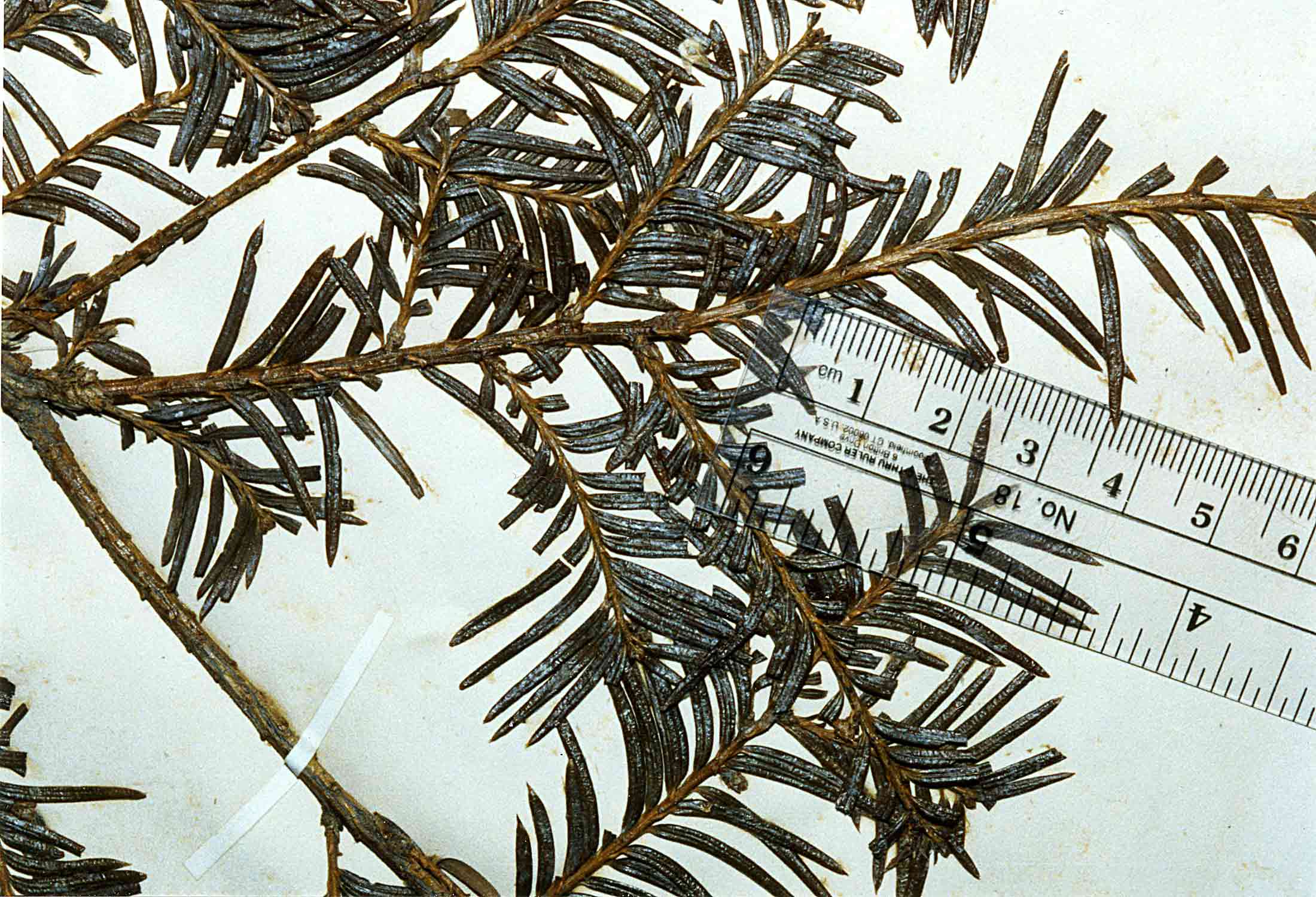
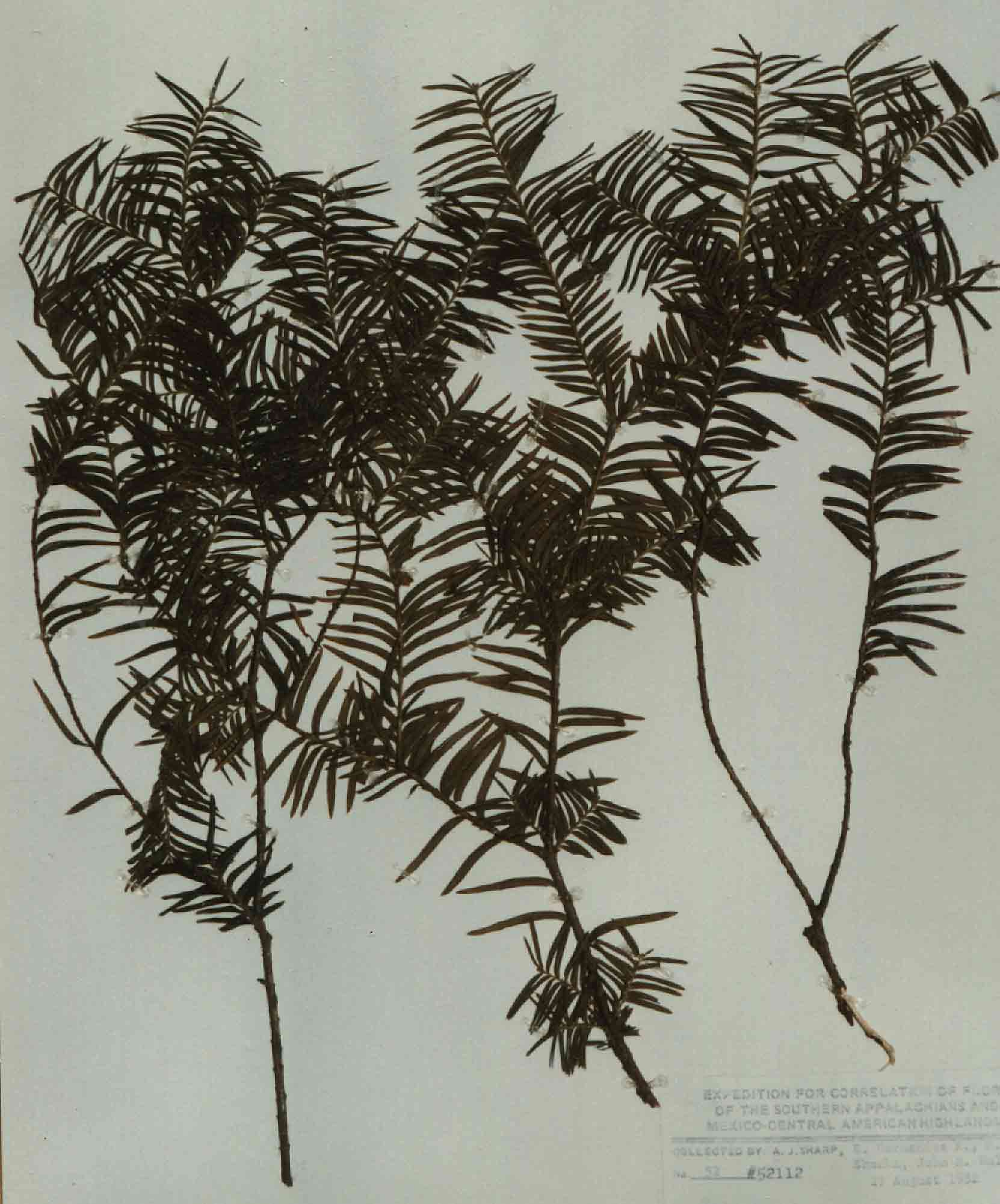
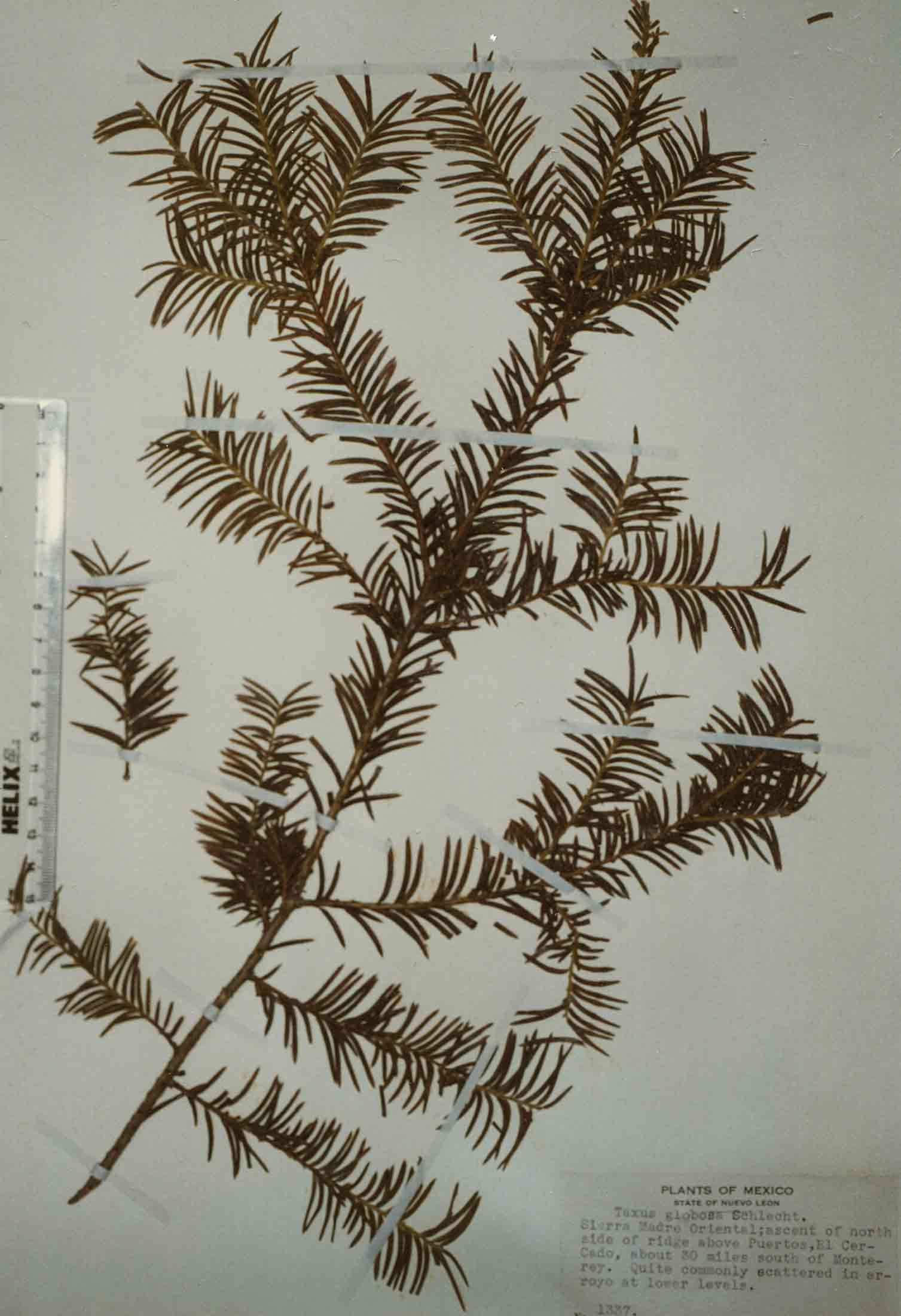
7a. Var. globosa.  Low spreading shrub or tree, to 40 m tall, bole to 40 cm diam.; bud-scales loosely persistent, 2–3 seriate, brownish, 1.5 (-2) mm long, chartaceous, dull, lower scales ovate, upper narrower, plane to slightly concave, carinate towards apex, or cuspidate. Leaves spreading as in T. brevifolia, overlapping in two-ranks, linear-falcate, 1.5–2.2 (-3.5) cm long, 1.5–2.2 (-2.5) mm wide, 200–350 µm thick, pale to dark green and slightly convex above to a rounded midrib that is slightly channeled at base, yellowish or pale green and slightly concave below to a slightly rounded midrib, plane to revolute near margins, acute to apex. Upper (abaxial) epidermal cells isodiametric to slightly elliptical in transverse section, or slightly taller than wide, 20–25 (-40) µm tall, 20–30 (-45) µm wide; lower epidermal cells similar to upper in transverse section, fusiform to rectangular near margins, slightly inflated, narrower and more incrassate towards stomata bands, mostly 3–10×+ l/w, longer on midrib, papillose to 3–4 rows from margins; papillae conspicuous in 2–3 alternate rows on each cell, positioned submarginally and marginally (along cell walls); stomata (7-) 8–9 (-11) rows/band. Male cones not studied; aril red, maturing in the fall.

Mesoamerican yew. Distribution: montane cloud forests above 2,000 m, S Mexico (Veracruz, Hidalgo, Mexico, Oaxaca), Guatemala (Baja Verapaz, El Progreso [Sierra de las Minas, Volcán de Santa Luisa], Zacapa, Volcán Gemelos, Monte Virgen] Huehuetenango [Sierra de los Cuchumatanes, Cerro Cananá]) to British Honduras (Merrendón, San Idalfonso, Omoa, Montecillos, Opalaca, Congolón) and El Salvador.

Representative Specimens—Mexico: Trinidad Iron Works, 24 May 1904, Pringle s.n. (US). Tamaulipas: from El Cielo to Ojo de los Indios and the Parque above Gómez Farías, A. J. Sharp 52112 (GH). Veracruz to Orizaba, 1851, Meisner s.n., Herb. Gordon (K). Hidalgo: barranca below Honey Station, Pringle s.n. (BH); Real del Monte, Hartweg 438 (BM). Guatemala: Dept. El Progreso: hills N of Finca Piamonte, 2400–3333 m, Steyermark 43487 (F); W end of Sierra Las Minas, Baja Verapaz, 6500 ft., Sharp 45247 (F). Honduras: Cerro Sta. Barbara, steep rocky slopes, 2750 m, tree 30–50 ft, usually of low spreading, or even semi-procumbent habit, 10–12" diam. at base, Armour & Chable 6083 (US). El Salvador: Dept. Chalatenango, Summit to Los Esesmiles, 14º20'N, 89º09'W, dense cloud forest, 2670 m, Tucker 1073 (BH, PH, US).

This species is recognized by the abaxial leaf epidermis having relatively narrow wavy-walled cells.  Specimens from northern Mexico are not easily distinguished from those in Florida, thus, I conclude that the Florida yew also occurs in Mexico, and that differences between the two varieties are relatively minor compared greater variation in their Asian relatives.  The Florida yew is also difficult to distinguish from related species in SE Asia,  particularly T florinii in Sichuan and Yunnan, and T. phytonii in the Philippines, Taiwan, and Yunnan their epidermal cells differ in being slightly inflated near margins, and by the slightly elliptical shape in T-section. 

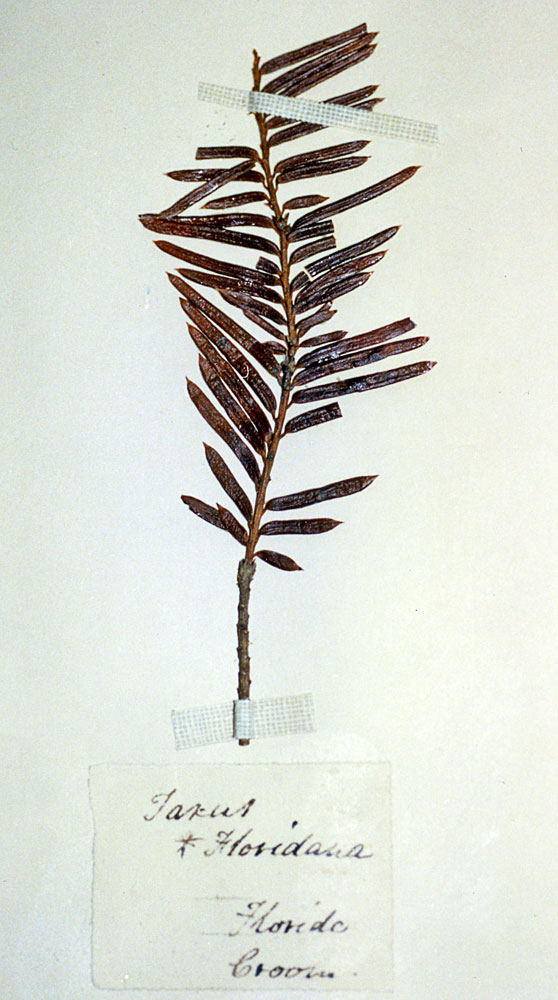
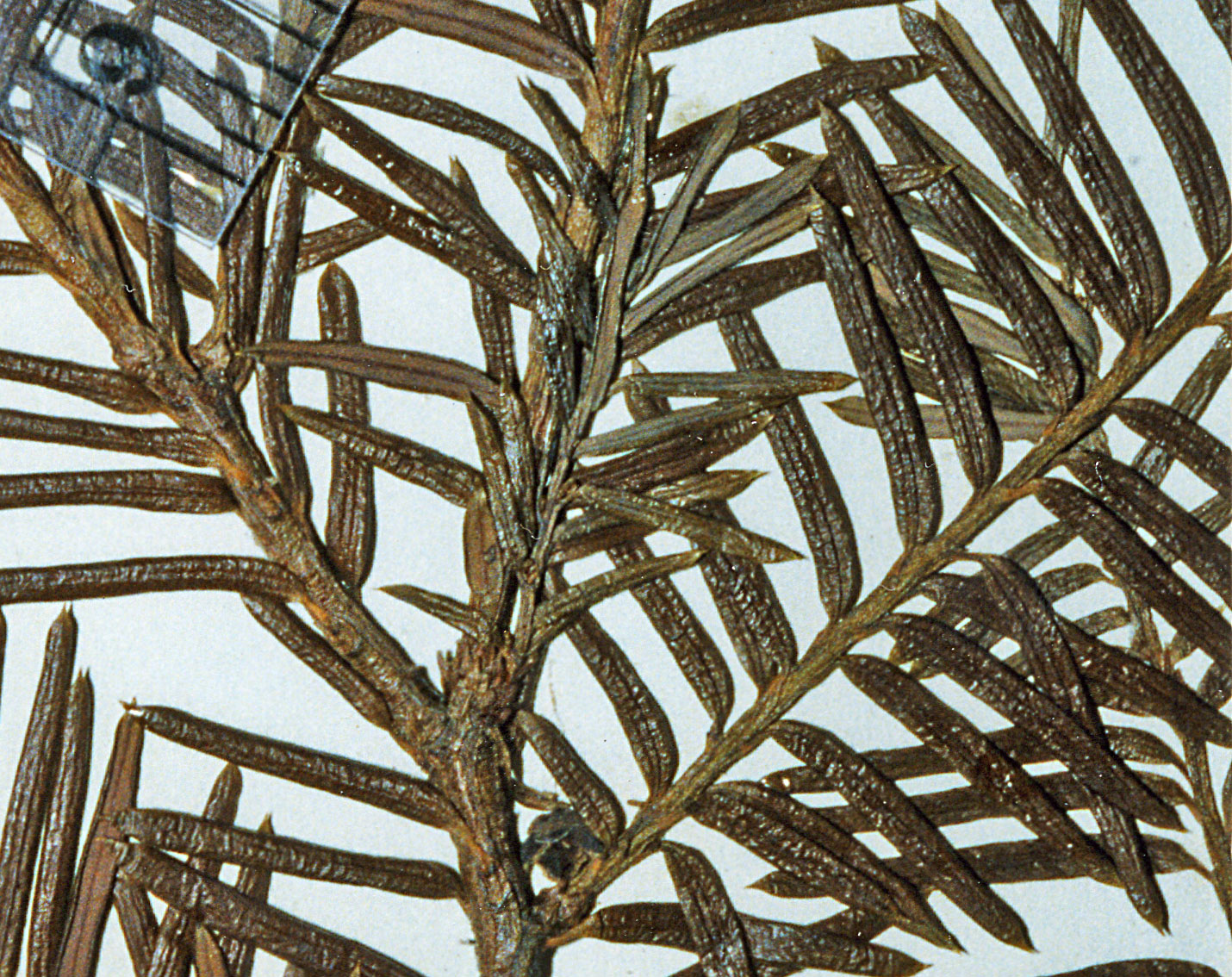
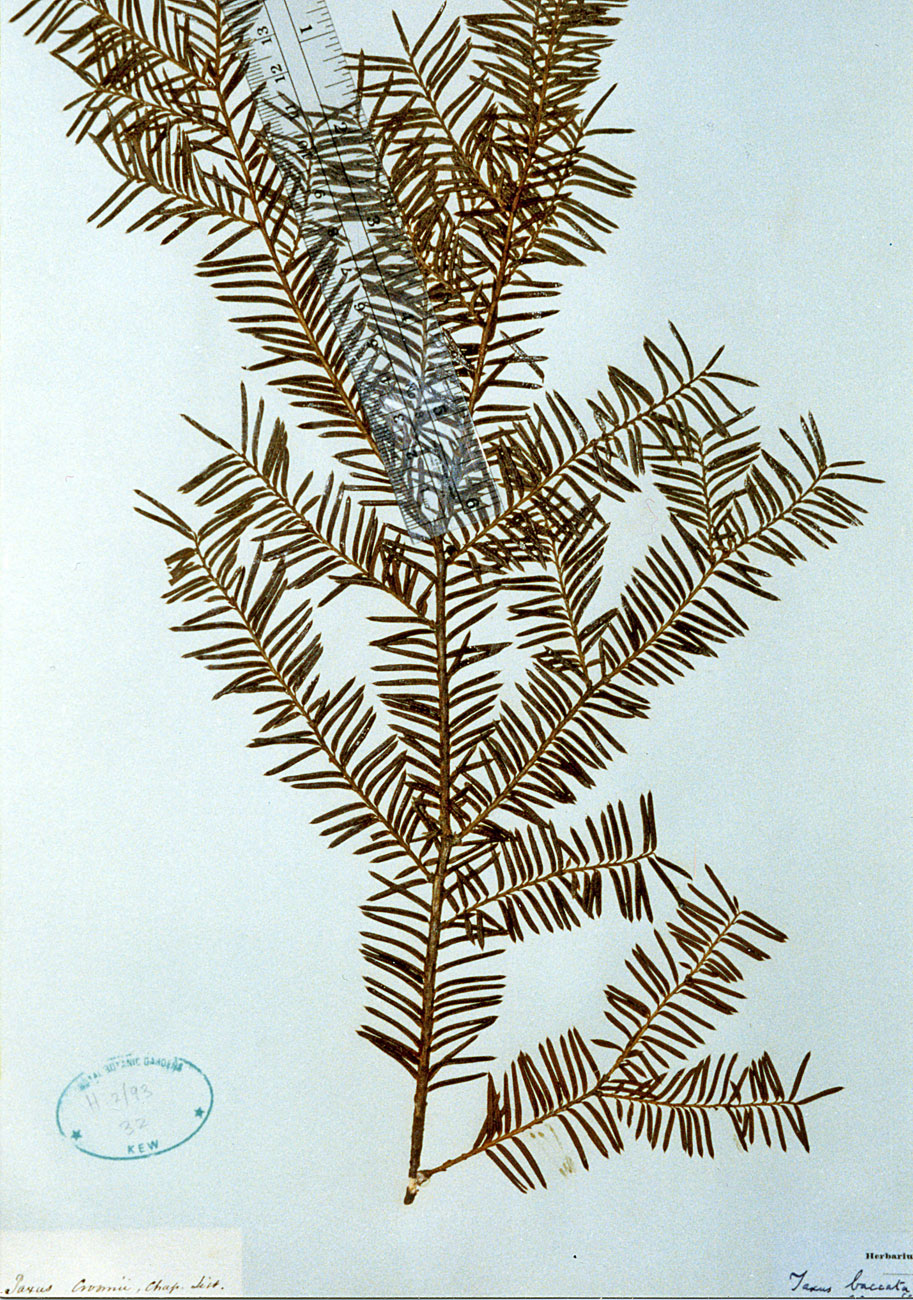
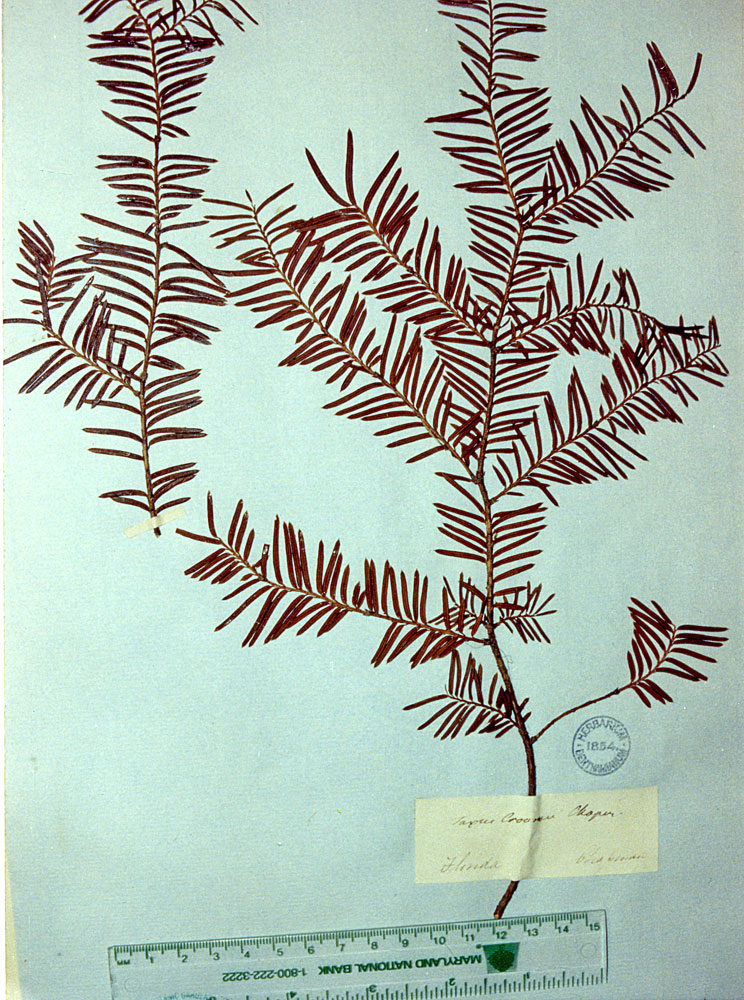
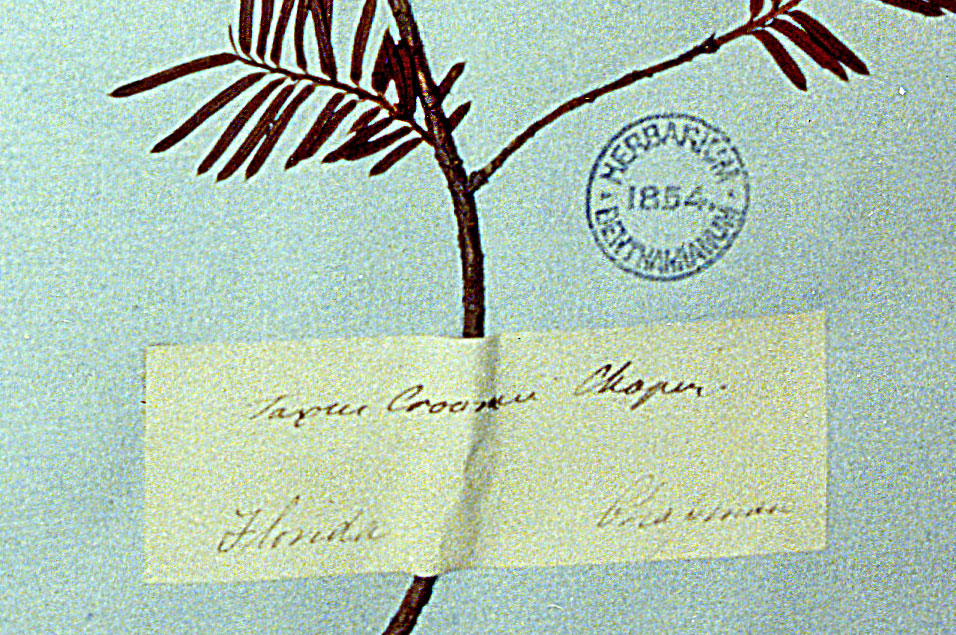
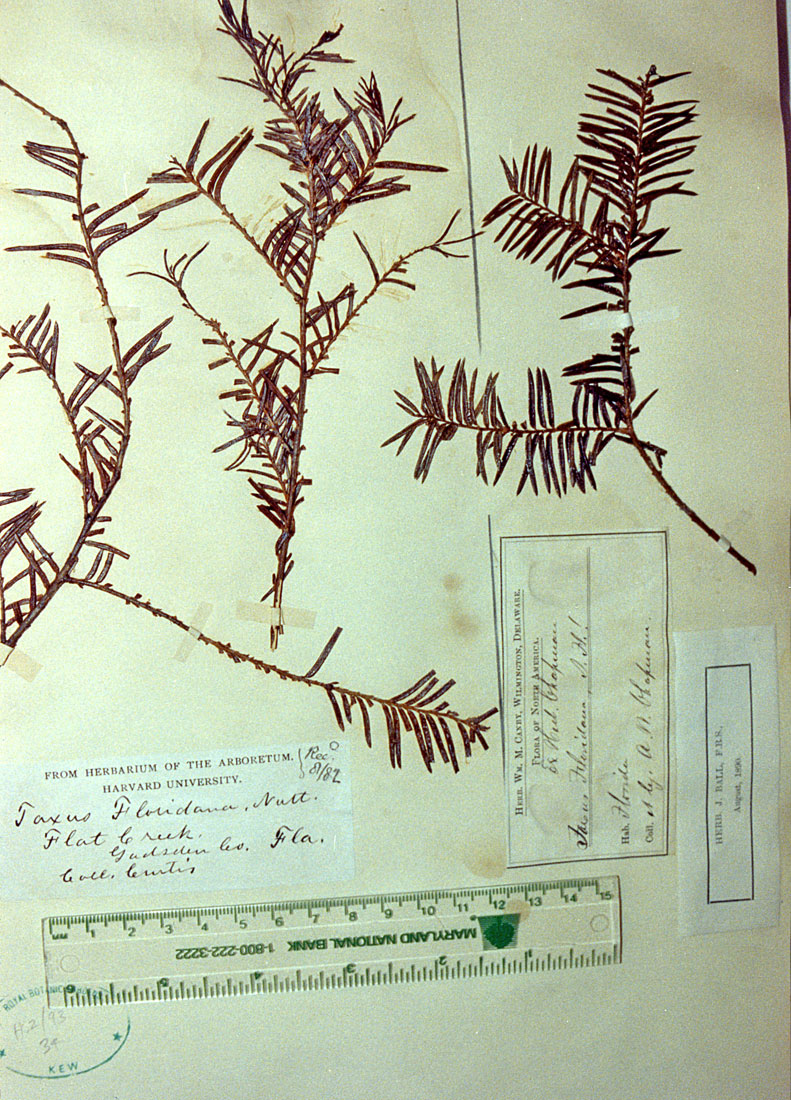
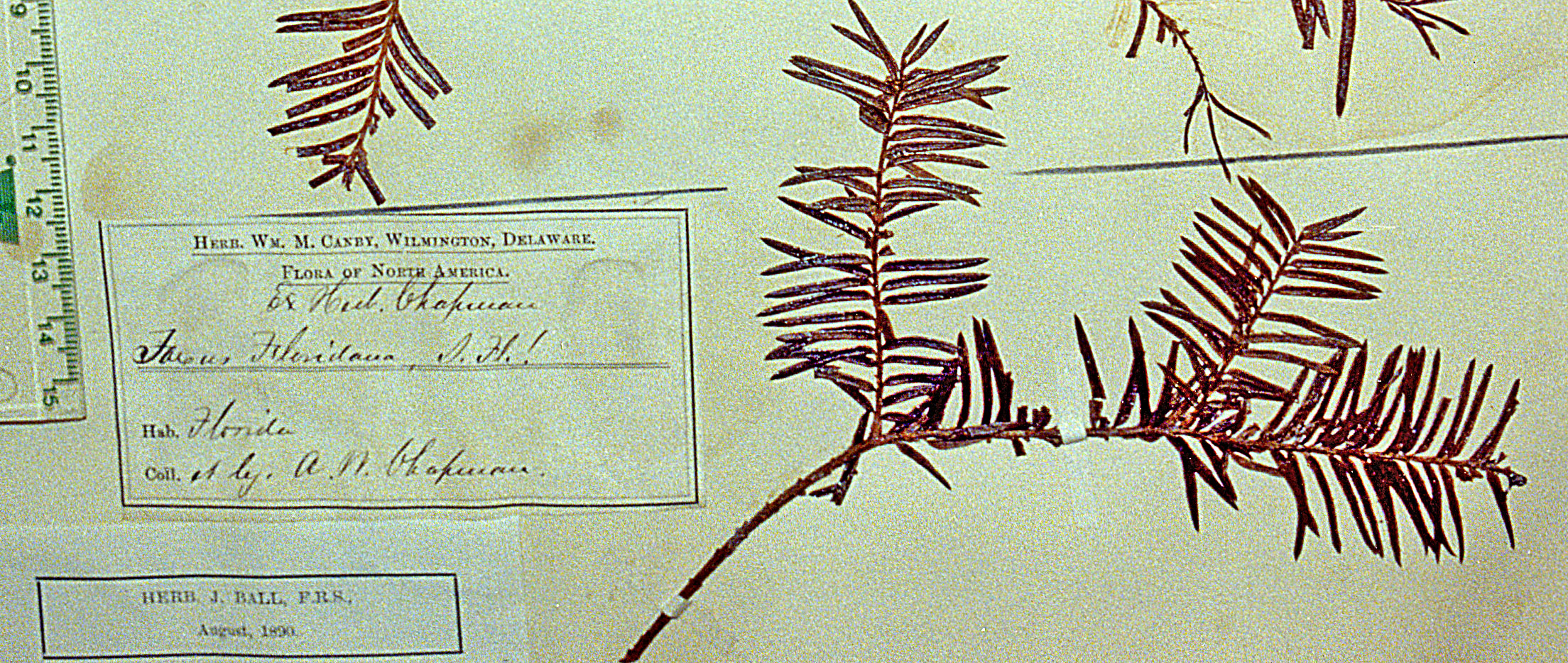
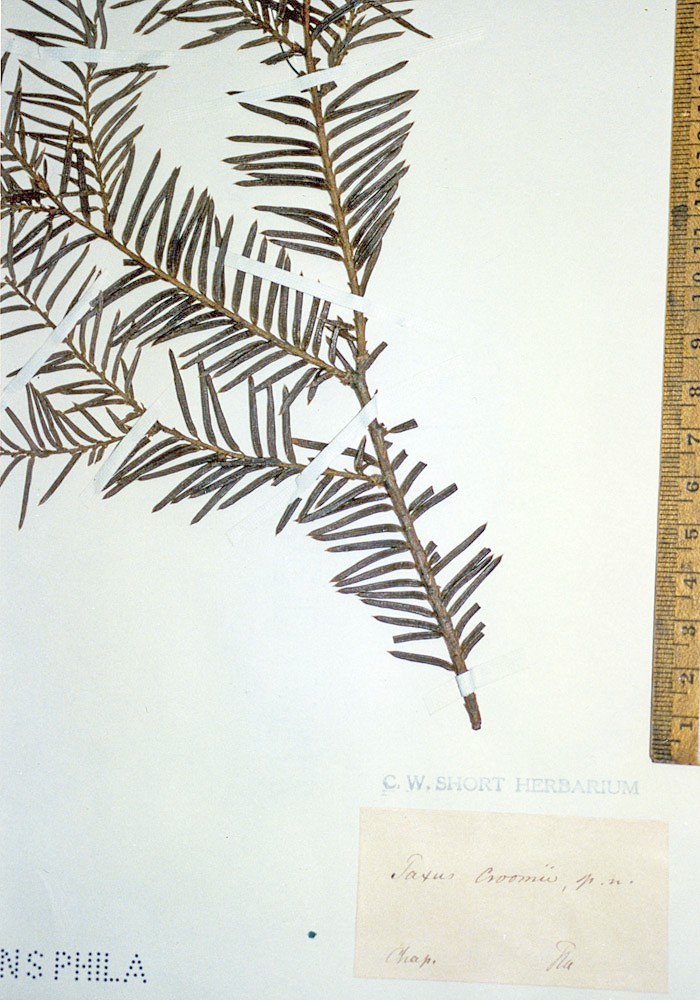
7b. Taxus globosa var. floridana (Nutt. ex Chapman), Spjut, J. Bot. Res. Inst. Texas 1(1): 224. Taxus floridana Nuttall, Chapman, Fl. South. U.S. 436 (1860), no specimens cited; T. baccata ssp. floridana (Nutt.) Pilger, Planzenreich 4(5): 113 (1903); T. canadensis Marshall var. floridana (Nutt. ex Chapman) Silba, Phytologia Mem. 7: 72 (1984). Type. U.S.A. Florida: near Aspalaga, 1833, Croom s.n.; lectotype (designated by Spjut 2007b): PH! (with label in Nuttall handwriting).  Specimens referred to as T. croomii, which were obtained by Chapman, are also original material, but are not isolectotypes as earlier noted on this site.

Tree or shrub, 6–10 m tall, bole to 40 cm diam. Leaves mostly (1.0-) 2.0–3.0 cm long, 0.3–1.5 (-2.2) mm wide, 200–350 µm thick, often glossy dark green and convex above to a rounded midrib, yellowish or pale green and concave below to a rounded midrib, recurved near margins. Epidermal cells nearly isodiametric to nearly quadrangular in transverse section, similar in height on both surfaces, 25–40 µm diam., those on abaxial surface uniformly rectangular, thick-walled, larger or slightly inflated or irregular in shape in up to 6 rows nearest stomata bands, mostly 1–5× l/w near margins, more than 10× l/w on midrib; papillae lacking on 5 or more cells across margins, mostly concrescent, globose to cylindrical, in 2–3 linear rows on each cell, positioned marginally, along cell walls, prominent in stomata bands, less developed on midrib; stomata (5-) 6–8 rows. Male cones numerous on young branchlets, scales 3-seriate, microsporophylls ca. 8, each with ca. 6 cucullate microsporangia. Female cones on 1st yr branchlets, the scales decussate in 3–4 ranks; aril red, Sep.-Oct.; seed conical, 4-angled.

Florida yew. Rare, W Florida: Apalachicola River; Chamaecyparis swamp ca. 8 mi SE of Bristol) (http://www.floridata.com/ref/T/taxu_flo.cfm);  N Mexico (Nuevo Leon, Tamaulipas).

Representative Specimens—MexicoVeracruz: 2200 m, Hernandez 01459 (BM). Tamaulipas: Sierra Madre Oriental, ca. 30 mi S of Monterrey, C. H. & M.T. Mueller 1337 (BM, PH); Tamaulipas/Nuevo Leon, 24º99'N; 100º5'W, 1690 m, Meyer & Rogers 2746 (BM). U.S.A.Florida: near Bristol, Mohr s.n. (PH), ex Canby Herb. (PH); Rock Bluff, limestone, Blanton 7050 (PH), Wherry s.n. (PH). Cultivation. University of Florida, Gainesville, hedge like shrub outside campus building, Gilliland & Spjut 12172 (wba); fresh specimen without collector or locality, Snader s.n. (National Cancer Institute). Other material submitted by Phyton (Ithaca, NY).

This differs from the typical variety by the broader marginal area of rectangular epidermal cells on the ventral (abaxial) surface of the leaf, and by the slightly lower stature in development of papillae.  The Florida yew is exceptional in occurring at relatively low elevations in seasonally hot humid forests and also having leaves with a papillose midrib and angular (isodiametric) cells.  These features are usually found in yew species that grow above 2000 m.  At lower elevations, as seen for yews in  China, yew leaves generally lack papillae on the abaxial midrib, and their epidermal cells in T-section appear more rounded elliptical than angular.  

The Florida yew is clearly related to the Mesoamerican yew.  It may have found refuge at lower elevations along the Gulf as glaciers advanced during the Pleistocene. Compared to a wide range in differences seen in Asian yew, the Florida yew evidently has not had much time to differentiate itself from the Mesoamerican yew.


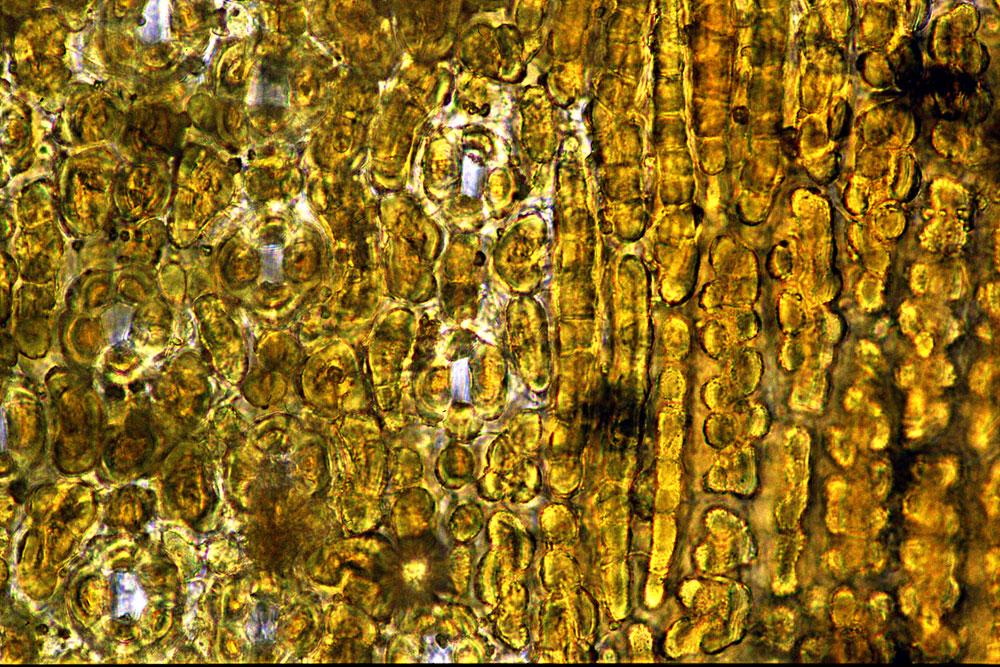
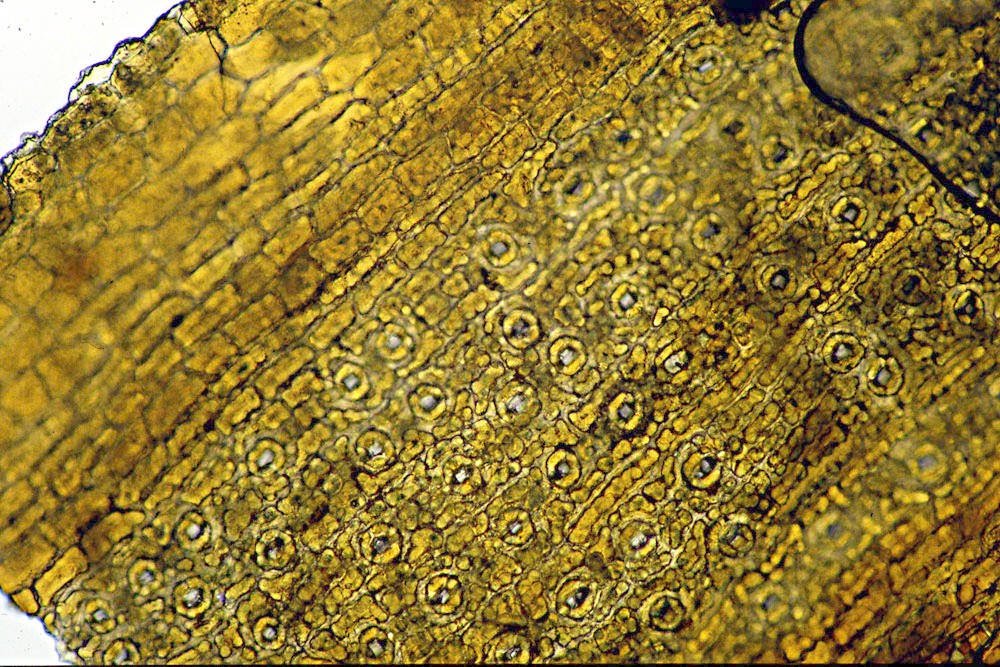
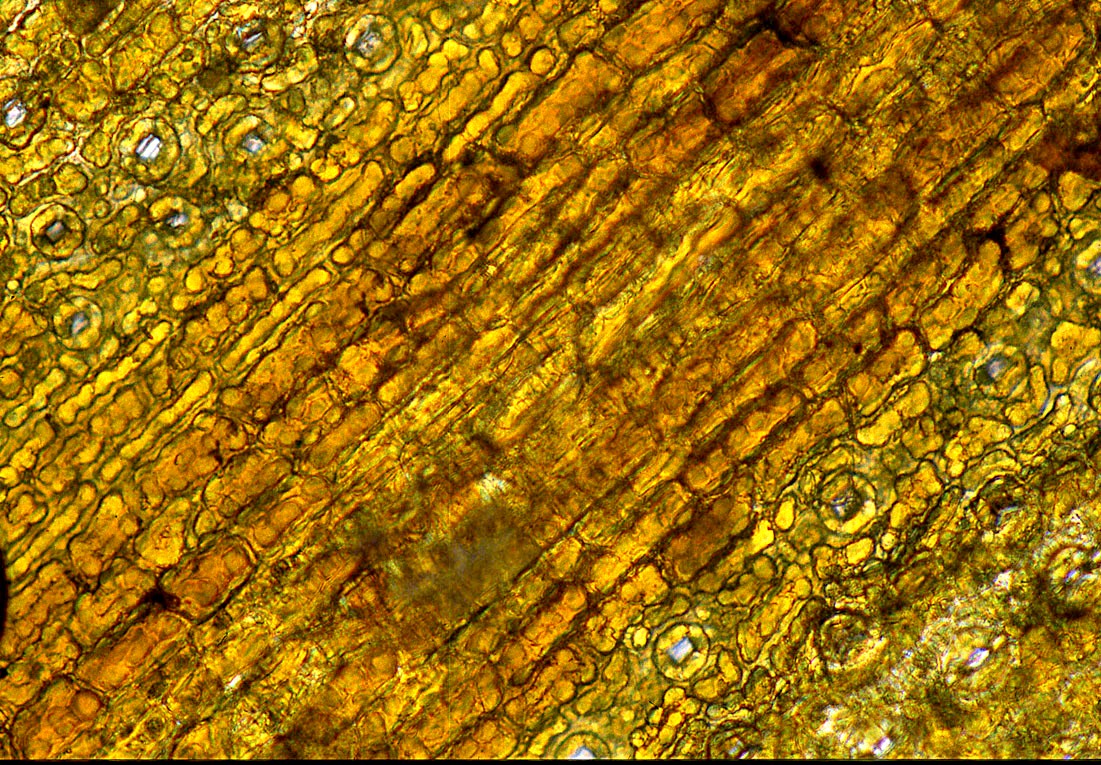
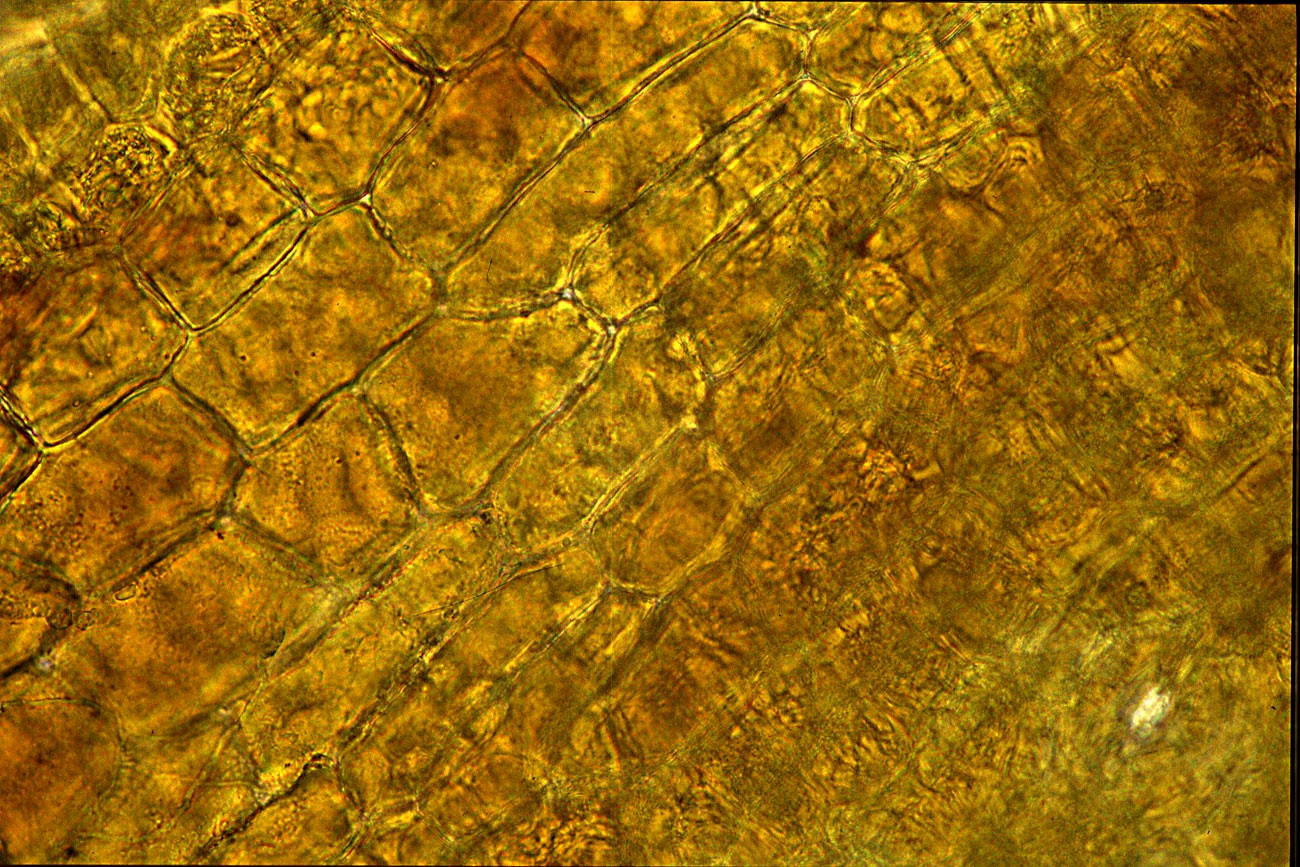
Taxus globosa var. globosa, showing marginal cells on abaxial leaf surface and marginal papillae, magnified 250x

Taxus globosa var. floridana, showing stomata band with 7 rows of stomata, and midrib and marginal cells in mid region of leaf on abaxial surface, magnified 250–400x

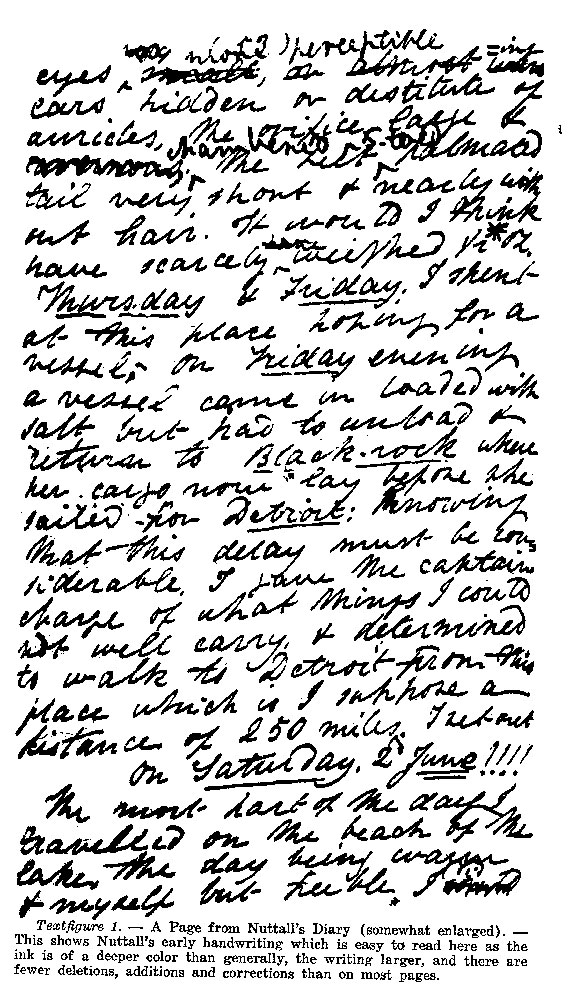
Taxus globosa var. floridana, lectotype (PH) and handwriting of Thomas Nuttall from diary  (J. E. Graustein.  1951.  Nuttall's travels into the old Northwest, an unpublished 1810 diary.  Chronica Botanica Co., Waltham, MA).


Taxus globosa var. floridana, specimen at K labeled T. croomii

Taxus globosa var. floridana, specimen at K labeled T. croomii from Bentham Herbarium

Taxus globosa var. floridana, specimen at K labeled T. floridana collected by Chapman


Taxus globosa var. floridana, specimen at PH labeled T. croomii Chapman